 Call Us:
  B3/51 Vibhuti Khand, Gomti Nagar, Lucknow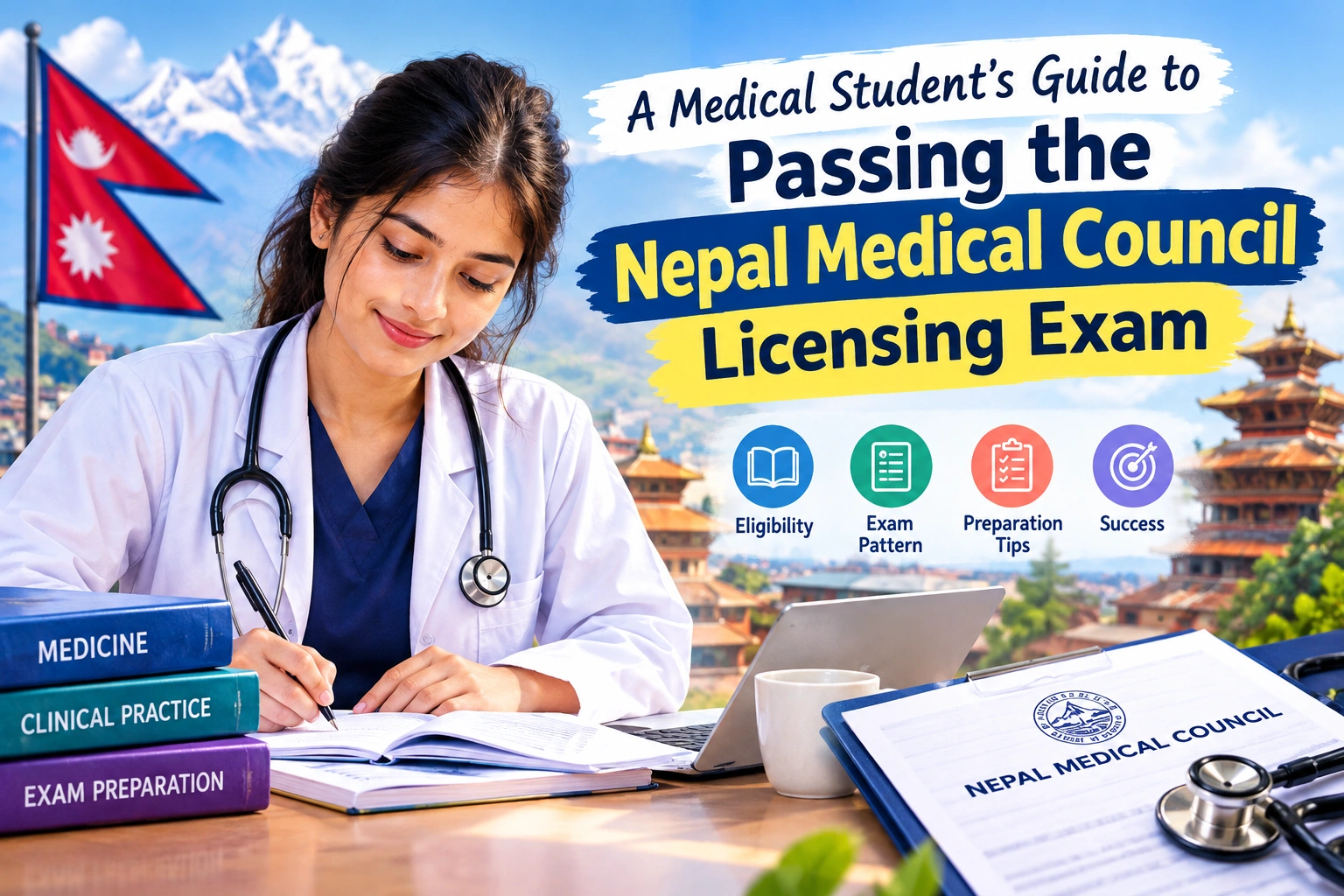
Finishing your MBBS is a huge milestone. But if you plan to practise medicine in Nepal, there’s one more serious hurdle: the Nepal Medical Council Licensing Examination, commonly called NMCLE. A medical degree alone doesn’t automatically give you the right to practise. The Nepal Medical Council conducts a registration examination, and successful candidates can then proceed with professional registration subject to the applicable internship and regulatory requirements.
For students considering MBBS in Nepal, this exam shouldn’t be treated as something to worry about only after graduation. Your preparation actually starts much earlier — with how well you understand basic sciences, clinical subjects, patient cases and community medicine. The good news? With a sensible study plan, regular question practice and enough clinical revision, the exam is manageable.
What Is the Nepal Medical Council Licensing Exam?
The NMCLE is the professional licensing examination conducted by the Nepal Medical Council for medical graduates seeking registration to practise medicine in Nepal. The Council's rules allow registration examinations to include written, practical or interview components, depending on the provisions set by the Council. The commonly published MBBS examination pattern consists of 180 marks, with 130 one-mark MCQs and 10 comprehensive/clinical scenario questions carrying 5 marks each. The standard qualifying score is 90 out of 180, or 50%, although students should always check the latest NMC notice because the Council can revise the examination modality. The examination is currently conducted as a computer-based test. Recent 2026 information also lists a three-hour duration and 90 marks as the passing requirement.
Who Can Appear for the NMCLE?
This is where students sometimes get confused. According to Nepal's MBBS accreditation standards, medical graduates can appear for the licensing examination after completing the MBBS course and at least six months of compulsory rotatory internship. The full one-year compulsory internship must be completed for the NMC registration certificate.
So, don't wait until the final week to check your eligibility documents. Your university records, internship details, identity documents and other required paperwork should be ready well before the application deadline. For students doing MBBS in Nepal, the medical college itself can also be a useful source of guidance about application procedures, but the final requirements should always be checked against the latest Nepal Medical Council notice.
Understand the NMCLE Syllabus Before You Start Studying
A common mistake is opening a huge textbook and simply starting from page one. That feels productive. It usually isn't. The published MBBS licensing pattern covers both basic and clinical subjects. The indicative distribution includes areas such as Anatomy, Physiology, Pharmacology, Biochemistry, Pathology, Microbiology, Forensic Medicine, Community Medicine, Medicine, Surgery, Obstetrics and Gynecology, Pediatrics, Anesthesia, Orthopedics, Ophthalmology, ENT, Dermatology and Psychiatry.
Medicine and Surgery deserve serious attention because they carry substantial weight, while Obstetrics and Gynecology, Pediatrics and Community Medicine also account for meaningful portions of the paper. The CSQ section is particularly useful for testing whether you can apply knowledge to a clinical situation rather than simply remember a definition. Honestly, that's the part many students underestimate.
Give More Time to High-Yield Clinical Subjects
Don't divide your study hours equally among every subject. A better approach is to first build strong coverage in:
- Medicine
- Surgery
- Obstetrics and Gynecology
- Pediatrics
- Community Medicine
- Pharmacology
- Pathology
- Microbiology
Then revise the smaller subjects systematically. Anatomy and Physiology shouldn't be ignored just because they're basic sciences. Their concepts keep appearing in clinical questions.
How to Prepare for the MCQs
MCQs can look deceptively easy. Four options. One answer. Done. Not always. Start with your core textbooks and class notes, then move quickly toward question practice. Solving 50–100 questions a day during the serious revision phase can be useful, provided you're actually reviewing the mistakes rather than just counting how many questions you completed. Keep a small error notebook — digital or physical, doesn't matter. Write down things you repeatedly forget: drug choices, contraindications, diagnostic criteria, emergency management, microbiology facts and confusing clinical differences.
After a few weeks, you'll notice patterns. For MBBS in Nepal, also pay attention to clinical situations and public-health topics relevant to the local healthcare setting. Recent research describes the NMCLE as a computer-based, 180-mark examination with questions focused heavily on common diseases, clinical care, surgery and public health.
Don't Ignore Clinical Scenario Questions
A student may score well in straightforward MCQs and still struggle with CSQs. Why? Because CSQs ask you to think. You may be given a patient's age, symptoms, examination findings and investigation results, followed by several related questions. Instead of memorising one isolated fact, you need to identify the diagnosis and then choose the most appropriate next step.
Try this method:
- Read the patient presentation completely.
- Identify the major clinical clue.
- Decide what diagnosis or problem is most likely.
- Eliminate clearly incorrect options.
- Then choose the best management or investigation.
- Don't change an answer simply because you become nervous.
Practice clinical cases under time pressure. That last part matters.
A Simple 12-Week Study Plan
Three months can be enough for focused revision if your MBBS foundation is already reasonable.
Weeks 1–4: Revise major subjects. Focus on concepts, common diseases, important drugs and clinical management.
Weeks 5–8: Increase MCQ practice. Aim for mixed-subject tests rather than studying one subject forever. Review every wrong answer.
Weeks 9–10: Start intensive clinical scenario practice. Medicine, Surgery, Pediatrics and Obstetrics should receive particular attention.
Weeks 11–12: Full mock exams, rapid revision and error-book revision. Avoid trying to learn five new books in the final week.
And please sleep. Seriously. A tired brain doesn't suddenly become smarter because you studied until 4 a.m.
What About Indian Students Studying MBBS in Nepal?
This needs a separate mention because passing the Nepal licensing examination and becoming eligible to practise in India are not the same thing. If you're an Indian student planning MBBS in Nepal, you need to understand the Indian regulatory requirements before admission, not after graduation. The National Medical Commission has specific regulations for foreign medical graduates covering issues such as course duration, medium of instruction, curriculum, clinical training and internship. Its current guidance states, among other requirements, a minimum 54 months of education in a single institution and a 12-month internship at the same foreign university for the relevant foreign medical graduate pathway. You should therefore check the latest NMC regulations and notices before selecting a college.
NEET eligibility is another point Indian applicants shouldn't overlook. The NMC maintains information regarding NEET-UG and foreign medical education requirements, while the official NEET website should be checked for the current examination and admission rules. And there's the FMGE/NExT question. Don't assume that a Nepal Medical Council licence automatically gives you permission to practise in India. Indian foreign-medical-graduate registration rules are separate, and the applicable licensing route can change as Indian regulations develop. Check the latest NMC notification applicable to your admission year and graduation pathway.
Check Your Medical College Before Admission
Exam preparation is only one side of the story. Before choosing a college for MBBS in Nepal, check its current status, university affiliation, clinical training arrangements and regulatory position. The World Directory of Medical Schools lists multiple operational Nepalese medical schools, including Institute of Medicine, Kathmandu University School of Medical Sciences, Nepal Medical College, College of Medical Sciences Bharatpur and Manipal College of Medical Sciences.
But here's a detail students often miss: being listed in WDOMS doesn't itself mean that the school is recognised, accredited or endorsed by WDOMS or its publishers. So use the World Directory of Medical Schools as one verification source, not as your only approval check. Also check the relevant Nepal regulator and Indian NMC requirements if your goal is eventually to return to India.
Common Mistakes Students Make
The same problems appear again and again.
- Studying only from MCQs without understanding concepts
- Ignoring Community Medicine
- Spending too much time on one favourite subject
- Avoiding clinical scenario questions
- Starting revision very late
- Not analysing mock-test mistakes
- Memorising answers without understanding why they're correct
- Assuming the latest exam pattern will remain unchanged
- Forgetting to check internship and registration requirements
That last one is boring. Still important.
The NMC itself says the published question distribution is provided as a reference and can change over time. So don't build your entire preparation around one old question bank.
FAQs About the Nepal Medical Council Licensing Exam
Is the NMCLE difficult?
It can be challenging, particularly if your clinical concepts aren't strong. But it isn't an exam that requires some mysterious trick. Consistent revision, MCQ practice and clinical case preparation make a big difference.
What is the passing score?
The standard pattern is 90 out of 180 marks, equal to 50%. Current exam information should be verified through the latest Nepal Medical Council notice before your attempt.
How long is the examination?
The current reported format is three hours for the 180-mark computer-based examination.
Can Indian students take the Nepal Medical Council licensing exam?
Eligibility depends on the applicable Nepal Medical Council requirements, including the recognised MBBS qualification and internship requirements. Indian students should also separately check the rules governing medical practice in India.
Does passing NMCLE allow me to practise in India?
No. A Nepalese medical licence and Indian medical registration are separate regulatory matters. Indian graduates of foreign medical institutions need to satisfy the applicable NMC requirements for registration in India.
Where should I check the latest NMCLE information?
The safest source is the official Nepal Medical Council website, particularly its current licensing examination notices.
Conclusion
Passing the Nepal Medical Council Licensing Examination isn't about studying every medical book ever written. It's about knowing what the exam expects, building strong clinical fundamentals and practising enough questions that you stop panicking when the options look confusing. If you're planning MBBS in Nepal, think about the licensing exam from your first years of medical school itself. Attend clinical postings seriously. Understand diseases instead of memorising lists. Keep your notes usable. And during the final months, make mock tests and mistake analysis part of your routine.
For students researching colleges, admission requirements and the overall process, you can also explore the medical education information available at MBBS in Nepal. Just remember one thing: college selection and licensing preparation go together. Choose the course carefully, keep track of regulatory requirements, and give yourself enough time to prepare. That approach will serve you far better than trying to rescue everything in the final few weeks.