 Call Us:
  B3/51 Vibhuti Khand, Gomti Nagar, Lucknow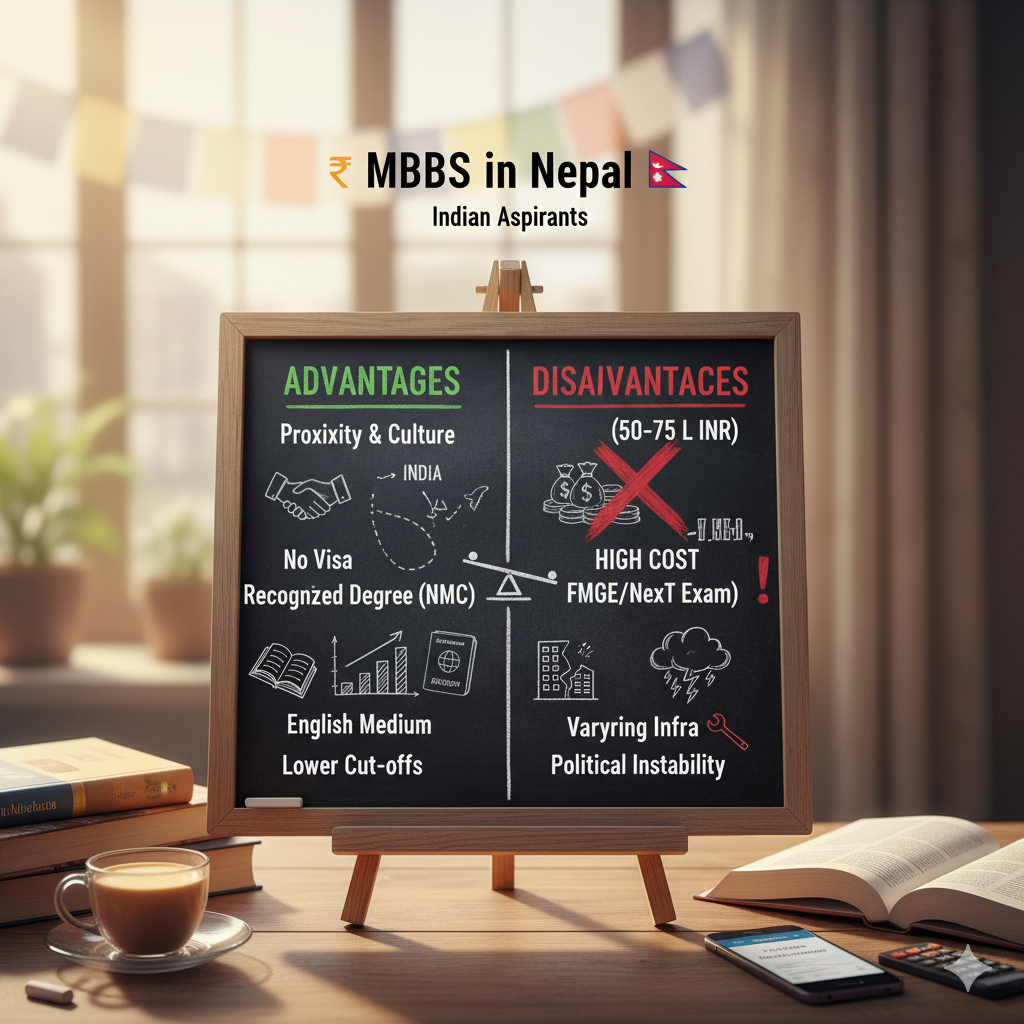
Deciding to pursue a medical degree is one of the most important choices for any aspiring doctor. Among the several international destinations that attract Indian students, Nepal has emerged as a compelling option due to its proximity, cultural familiarity, and academic compatibility. While the overall experience is often positive, it is essential to understand both the pros and cons before making a final decision.
✅ Why Choose Nepal for Medical Studies: Key Benefits
1. Cost-Effective Education
Nepal offers a budget-friendly alternative to many Western and Asian countries when it comes to studying medicine.
- The total tuition fee typically ranges from ₹45 to ₹65 lakhs for the entire course.
- Most reputed colleges do not charge any donation or capitation fees.
- Living expenses are also relatively low compared to India’s metropolitan cities or other countries.
👉 Check college-wise tuition structures and updates at MBBS in Nepal.
2. Close Proximity and Cultural Affinity
India and Nepal share open borders and deep-rooted cultural, linguistic, and religious connections.
- Indian food, traditions, and lifestyle are common in many areas of Nepal.
- Students feel culturally comfortable and settle quickly into their new environment.
- Parents can also visit easily without visa restrictions.
3. Recognized and Accredited Colleges
Nepalese medical institutions are recognized by major global and regional bodies such as:
- National Medical Commission (NMC), India
- World Health Organization (WHO)
- FAIMER and ECFMG databases
This global recognition enables graduates to appear for licensing exams like FMGE in India and USMLE/PLAB for countries like the USA and UK.
4. English as the Medium of Instruction
Medical courses are taught in English, eliminating language barriers for Indian students.
- Most professors are trained in India or are Indian nationals.
- No requirement to learn a new language, as seen in countries like Russia, China, or Ukraine.
- Smooth academic communication and better understanding of concepts.
5. Simplified Admission Process
Getting admission to Nepalese colleges is significantly less complicated than in many other countries.
- Indian students only need to qualify NEET, which is already mandatory for Indian MBBS aspirants.
- Most colleges do not conduct separate entrance exams.
- Visa-free travel simplifies documentation and the admission process.
6. Strong Clinical Exposure
Reputed medical colleges in Nepal provide students with excellent hospital training.
- Clinical rotations are carried out in well-established teaching hospitals.
- Patients present similar health conditions as those seen in India, which enhances diagnostic familiarity.
- Exposure to diverse medical cases strengthens practical skills.
7. Better Success Rate in Screening Exams
Thanks to similar teaching methods and syllabus structures, Indian graduates from Nepal have historically performed better in the FMGE (Foreign Medical Graduate Examination) compared to those from other countries.
❌ Challenges You Should Be Aware Of
1. Fewer Seats in Reputed Institutions
The most prestigious medical colleges in Nepal offer limited seats for foreign (especially Indian) students.
- Intense competition for a handful of quality seats.
- Applying early and having proper counseling is crucial.
2. No Direct Entry into Postgraduate Programs in India
While undergraduate studies are relatively smooth, pursuing specialization requires clearing competitive exams like NEXT or NEET PG.
- There is no automatic transition to postgraduate medical programs in India.
- Students must prepare thoroughly for licensing and entrance tests.
3. Infrastructure Disparities Among Colleges
Though top-tier colleges are well-equipped, some lower-ranked institutions may not offer:
- Modern labs or advanced technology
- Updated infrastructure
- Qualified and experienced faculty
Hence, it’s essential to select an institution after careful research and consultation.
4. Fee Hike in Private Colleges
Some private colleges in Nepal have started charging premium fees, nearing the costs of Indian private institutions.
- These colleges may charge ₹65 lakhs or more over five years.
- Always validate tuition costs from official or trusted admission channels.
5. Variable Living Conditions
While Nepal is generally safe, the standard of living varies depending on the location.
- Students in rural campuses may face occasional power cuts or internet issues.
- Emergency medical services may be limited in remote regions.
- Urban locations like Kathmandu or Biratnagar offer better facilities and infrastructure.
6. Mandatory Screening Exam for Practice in India
Graduates must still clear the FMGE or NEXT to gain a medical license in India.
- Although the pass rate is better than many foreign alternatives, students must invest in additional preparation.
- NEXT is expected to be more comprehensive and may impact graduate readiness.
🎓 Top-Ranked Medical Colleges Preferred by Indian Students
Below is a list of Top-Ranked Medical Colleges:
|
College Name |
City |
Approx. Fee (INR) |
|
Kathmandu |
₹45–50 lakhs |
|
|
Dharan |
₹50–55 lakhs |
|
|
Palpa |
₹55–60 lakhs |
|
|
Kathmandu |
₹50–55 lakhs |
|
|
Biratnagar |
₹55–60 lakhs |
👉 For admission assistance and real-time fee guidance, visit MBBS in Nepal.
📌Conclusion
Choosing to study medicine in Nepal can be a smart decision for Indian students who:
- Are looking for affordable education without compromising on quality
- Prefer to stay close to home in a culturally similar environment
- Want to avoid learning new languages for academic success
- Seek colleges recognized by global medical authorities
However, challenges such as limited top-college seats and mandatory screening tests must be considered. With proper planning, timely application, and reliable career guidance, studying in Nepal can be a great stepping stone to a successful career in medicine.