 Call Us:
  B3/51 Vibhuti Khand, Gomti Nagar, Lucknow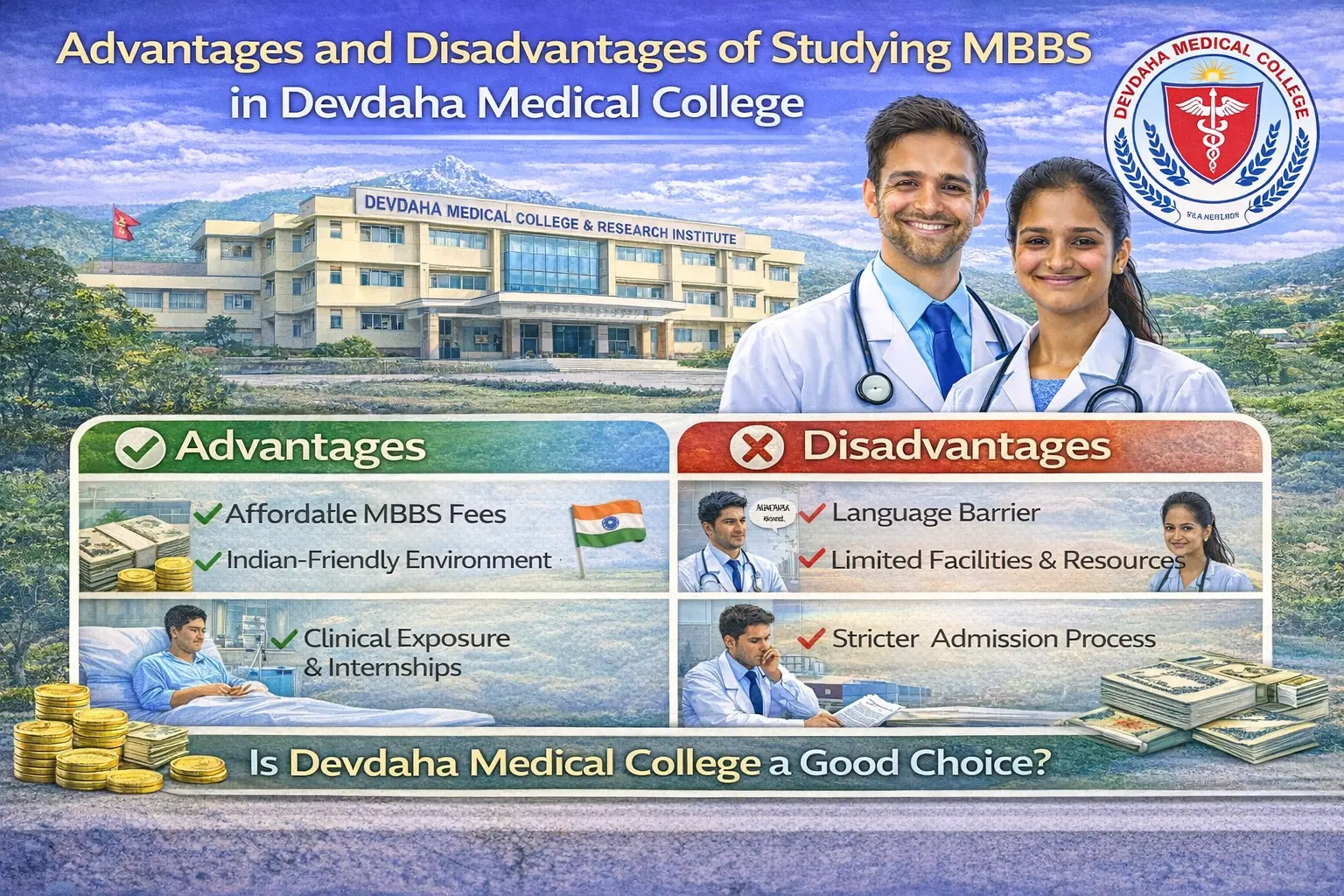
Devdaha Medical College in Devdaha, Lumbini Province of Nepal, is an emerging option for Indian students to study MBBS in Nepal. As with any international medical program, it has its pros and cons that one must weigh before applying.
Here is a balanced opinion of the pros and cons of doing an MBBS, from academics to clinical exposure to recognition, per annum fees and lifestyle at Devdaha Medical College.
Advantages of Pursuing MBBS at Devdaha Medical College
Affordable Medical Education Near India
Devdaha Medical College Fee structure One of the highlights of the Devdaha Medical College is its affordable fee structure. Compensation Cost of a Medical School in Pakistan If we compare it with the private medical colleges of India, then their tuition fee and living cost is quite less than those in India.
Being in Nepal also means:
- Lower travel cost
- Cultural similarity
- Reduction in food and lifestyle miles
This convenience helps Indian students to get adjusted while studying MBBS in Nepal.
English-Medium Instruction
All medical programs in Devdaha Medical College are taught in English medium; there is no issue of language for Indian students now. This helps in:
- Understanding lectures clearly
- Communicating with professors and peers
- Performing better in clinical training
English training also helps prepare for the licensing exams in the future.
Eligibility Through NEET UG
Indian Nationals are required to qualify for NEET UG if they want to take a medical course abroad (Ukraine). Since NEET clearance is a prerequisite for seeking admission to foreign MBBS as per the NMC guidelines, your medical course in India will stay recognised after coming back home if you clear NEET.
So, the pathway is straightforward:
NEET eligibility → Admission abroad → FMGE/NExT eligibility after that.
That gives Indian students a real academic path.
Recognition and Global Validity
The qualification is also inscribed in the World Directory of Medical Schools (WDOMS), thus ensuring its recognition worldwide. Several international medical boards use listings from the World Directory as part of their licensing considerations.
Moreover, medical education in Nepal is directed following theWorld Health Organisation (WHO) standards provided to offer a systemised and homogenised art of training effective healthcare workers.
This means graduates have:
It may include, but not be limited to the following: 5) Eligibility or application for appearance in FMGE/NExT examination in India.
Potential courses of study as a postgraduate after graduating abroad
Recognised qualification in many jurisdictions
Clinical Exposure and Hospital Training
It may vary from one type of case to another, including the number of cases & types and the degree of in-hospital exposure. 6-year medical education at Devdaha also includes bedside practice (such as an internship) at hospitals affiliated with DAH. Your clinical rotations commonly start later in your academic career and serve to:
- Transfer theoretical knowledge into the practice of medicine
- Improve diagnostic and communication skills
- Gain confidence in patient interactions
This early exposure is the backbone of their future practice.
Student Community and Cultural Comfort
Devdaha hosts an expanding Indian student community, which eases the process of adjustment. Common culture, food choices and recognisable social settings can allay homesickness. This often develops into study groups and support systems amongst students that enhance both the academic experience as well as the social one.
Disadvantages of Pursuing MBBS at Devdaha Medical College
Moderate Brand Recognition
Although Devdaha Medical College is a valid, licensed course to train and graduate MD clinicians, it does not yet have the same long history or international name brand recognition as some other old Nepal schools. This may be a consideration for students who seek prestige or want to make a name search instead.
Older colleges, on the other hand, can draw from wider alumni networks and deep-rooted academic partnerships.
Infrastructure Development Phase
Facilities like advanced research laboratories or super-speciality wards may still be under construction. Though there is hospital training, students interested in very high-end clinical tech may need to realise that the infrastructure isn’t quite as state-of-the-art as some other, bigger institutions.
Competitive Clinical Exposure
Even though clinical rotations are excellent, sometimes the number and exposure to different patient cases might be less than what you can see at bigger and older tertiary hospitals. Larger urban teaching hospitals are often (but not always!) able to offer students more exposure to rare or unusual cases, which some students want to learn deeply.
Adjustment to Foreign System
While the cultural proximity with India exists in Nepal, students are still required to adapt to:
- Different academic schedules
- Local healthcare practices
- Administrative procedures
That can be an adjustment, particularly for students who have never lived outside their home country.
Licensing Exams After Graduation
Getting a degree from Devdaha means that you will be able to take the license exam; however, Indian students still have to mandatorily pass FMGE/NExT according to rules by NMC for practising in India.
This means:
- Additional exam preparation after MBBS
- Time & money for coaching or self-study
That may be the case for any MBBS degree abroad, though it still is a part of post-grad decision-making.
Who Should Study MBBS in Devdaha Medical College?
Ideal candidates are students who:
- Have cleared NEET UG
- Seek an affordable MBBS option
- Prefer English-medium medical education
- Urge to work well in a clinical setup, and don't want huge private college fees
- Are fine to be living so close to India
If you are looking for an affordable MBBS course, clinicals based and with exemption to come back & practice in India, the Devdaha Medical College is a good option.
Quick Comparison: Devdaha vs Other Nepalese Colleges
|
Factor |
Devdaha Medical College |
Older Nepalese Colleges |
|
Tuition Cost |
Moderate |
Moderate–High |
|
Clinical Exposure |
Good |
Very Good (larger hospitals) |
|
Recognition |
Listed in WDOMS |
Listed in WDOMS |
|
International Reputation |
Growing |
Established |
|
Indian Student Community |
Developing |
Larger |
Final Thoughts
Deciding where to study MBBS in Nepal is a complex choice. A mix of affordability, clinical training and international recognition has made Devdaha Medical a favourite among Indian students.
Summary of Pros:
- Affordable cost of living
- English-medium instruction
- Indian students to be NEET-qualified
- Global acceptance based on the World Directory of Medical Schools (WDOMS), and the World Health Organisation (WHO),
- Strong basic clinical exposure
- Culture, comfort and a supportive circle of students
Summary of Cons:
- Infrastructure under development as compared to older colleges
- Moderate brand recognition
- Potentially less diversified clinical case exposure
- Preparing for the Licensing exam (FMGE/NExT) is required after graduation