 Call Us:
  B3/51 Vibhuti Khand, Gomti Nagar, Lucknow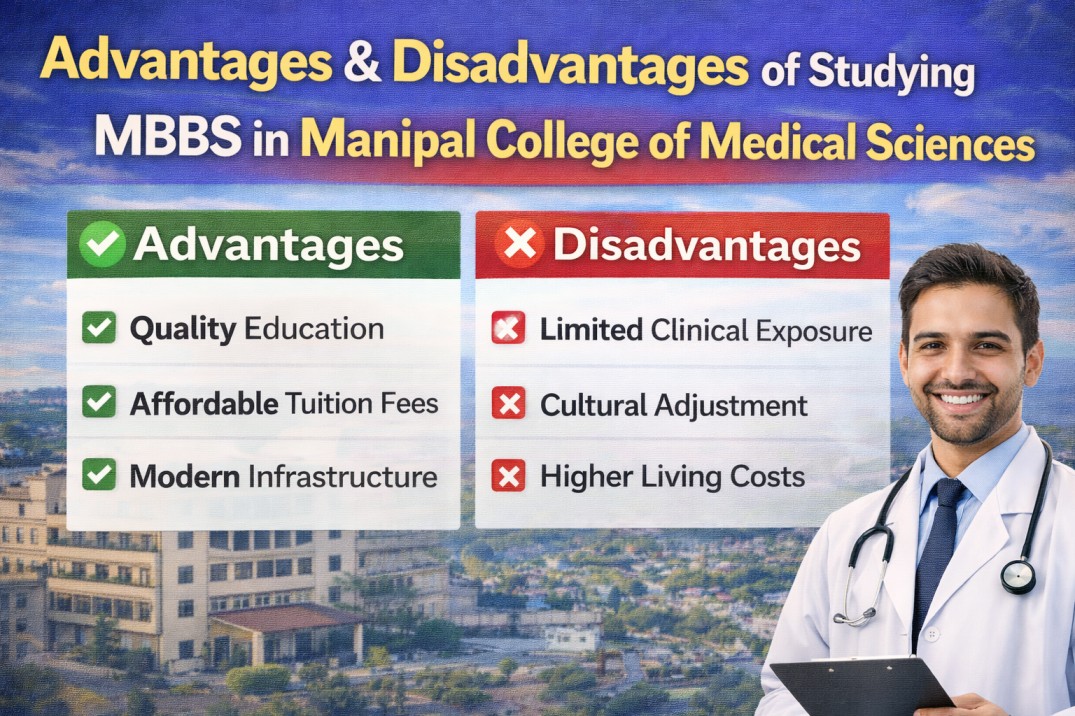
The selection of an appropriate medical college is one of the most vital decisions potential physicians must make. Manipal College of Medical Sciences (MCOMS) has emerged as the topmost choice for Indian students who opt for quality MBBS education abroad, which is situated in the beautiful city of Pokhara in Nepal. Affiliated with Kathmandu University and internationally recognized, MCOMS reflects a strong academic foundation and practical exposure. But like any other school, it has its pros and cons that prospective students should think over before applying.
If you're looking for full details of MBBS in Nepal, including eligibility, fees, and admission process, then visit MBBS in Nepal.
Advantages of Studying MBBS at Manipal College of Medical Sciences
1. Internationally Recognized Degree
MCOMS has the advantage of being widely recognized. It is included in the World Directory of Medical Schools (WDOMS) and recognized by the Nepal Medical Council (NMC Nepal). You can pursue your FMGE/NEXT, USMLE, and PLAB training while going for the degree, so that you can easily work abroad.
You can get more details regarding eligibility and recognition at MBBS in Nepal.
2. English-Medium Curriculum
The MCOMS’s MBBS program is entirely taught in English, which means it becomes easier for Indian students to comprehend lectures, textbooks, and clinical direction. Also, many Nepali citizens are of Vedic origin, and they speak Hindi, so students can easily talk with local language speakers in clinical rotations. This also removes any language restrictions and smooths the academic process.
3. Excellent Clinical Exposure
Hands-on learning opportunities at the MCOMS take place in Manipal Teaching Hospital, with more than 750 beds for a variety of patients. It consists of a minimum of six months in internal medicine and/or surgery, with other rotations including pediatrics, obstetrics & gynecology, orthopedics, and emergency medicine. Such hands-on experience is critical for gaining medical skills and confidence in the run-up to graduation.
4. Inexpensive lifestyle and proximity to India
Nepal is more affordable for education and living than Western countries. No need to get a student visa for Indian students, so travel and stay become very convenient. Regular air- and road connections between the two countries allow students a physical proximity to family that provides emotional succor while they are pursuing their degree programme.
5. Supportive Campus Environment
MCOMS provides a hostel with an Indian Mess, safe lodging, recreational facilities, and an active student life. Pokhara itself is a calm and aesthetically beautiful city with a safe, friendly environment to study medicine.
Disadvantages of Studying MBBS in Manipal College of Medical Sciences
1. Higher Tuition Fees
As Nepal is cheaper than a few other countries, so are the MCOMS tuition fee is also higher in comparison to other medical colleges of Nepal or another country nearby. With hostel, food, and monthly running expenditure, students must also factor this in as a cost towards their education.
2. FMGE / NEXT Exam Preparation
Foreign Medical Graduates should clear FMGE/NEXT to practice medicine in India. Despite a good MBBS curriculum, targeted exam preparation is required. Students frequently require some extra coaching to succeed, and pressure often increases as students approach exams.
3. Limited Advanced Research Opportunities
Although clinical training is strong, state-of-the-art research facilities and cutting-edge labs may not be the same as those in Western medical schools. Students who are interested in a career with an emphasis on research may want to consider other internships or fellowships.
4. Cultural and Environmental Adjustment
The next big thing is that, being an Indian, you might have a cultural shock in Nepal, but at the same time, you will enjoy their traditions and beliefs. It's tough at first for anyone, especially if you've just left home and moved to a new area.
Conclusion
Manipal College of Medical Sciences features a perfect blend of globally-recognized medical education, direct hands-on clinical experience, and a suitable environment for Indian students. Although you need to prepare for FMGE and manage the tuition fees properly, advantages such as proximity to India, English medium curriculum with about 95% syllabus matching with that of India, and good exposure during clinical training keep Nepal a preferable option for many MBBS aspirants.
For detailed information on admissions, fees, eligibility, and student life, visit MBBS in Nepal ↗️.
For official recognition and updates from Nepal’s regulatory authorities, check Nepal Medical Council (NMC) ↗️.