 Call Us:
  B3/51 Vibhuti Khand, Gomti Nagar, Lucknow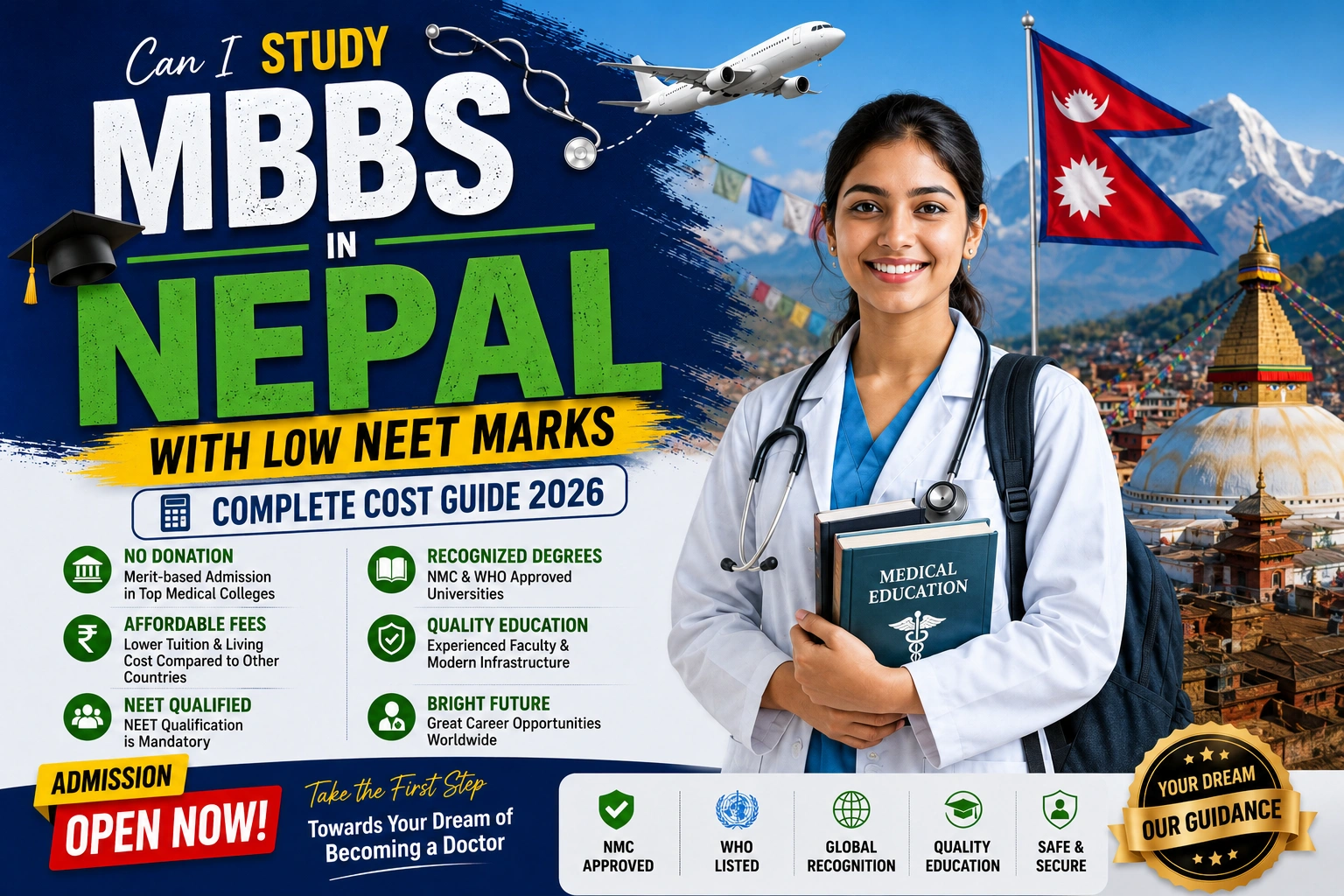
Every year, tens of thousands of aspiring doctors in India face obstacles in the realization of their ambition due to increasing competition and a limited number of places in Indian medical colleges. Students who perform poorly on the NEET exam are on the lookout for viable alternatives, and the excellent medical programs, lower costs, and easy access to Nepal make it an attractive option.
A frequently asked question is, “Is it possible to pursue MBBS in Nepal with a low NEET score?” The short answer is that as long as the student has passed the NEET and meets the eligibility criteria to pursue medical education abroad, the answer is yes. A candidate's NEET score may limit options within India, but may not limit their opportunities for MBBS in Nepal as long as the candidate meets the criteria.
Medical education in Nepal is offered by a number of recognized medical colleges and universities that have MBBS programs in English. It is advisable that Indian students check the recognition of the universities and the frameworks of the courses and the regulations prior to making their admission decision. For guidance on the medical education system and practices in other countries, students are advised to visit the National Medical Commission (NMC) and the World Directory of Medical Schools (WDOMS) among other official sources.
Is NEET Necessary for MBBS in Nepal?
It is true that Indian students must clear NEET if they wish to study MBBS in Nepal and want to practice medicine in India. Many students think that if they go abroad for studies, they don’t need to clear NEET. This thought process is incorrect for Indians who wish to have a medical career in India.
As per the guidelines of the National Medical Commission (NMC), Indian students who wish to study medicine outside India, need to clear the National Eligibility cum Entrance Test (NEET). NEET is considered a prerequisite if students wish to study MBBS and other equivalent courses outside India.
The good thing is students do not need very high NEET scores to get admission to medical colleges in other countries. Unlike the government medical colleges of India that have very high cutoff scores, the medical colleges in Nepal have a lower cutoff and offer a chance to students who have cleared NEET and met the other requirements.
The official NEET website has information and updates regarding NEET scores. Students are encouraged to visit the official NEET website for accurate information.
What are the Minimum NEET Marks Required to Get Admission to MBBS in Nepal?
The minimum NEET marks required to study MBBS in Nepal vary and depend on the particular criterion and rules for that admission season. Indian students need to clear NEET as per the prescribed category-wise percentile.
The following factors are primarily considered for admission into MBBS in Nepal:
- NEET qualification
- Class 12 marks in PCB
- Eligibility of the medical college
- Seat availability
- College admission procedure
Since there is much less competition for MBBS in Nepal as compared to Indian government medical colleges, students with lower NEET scores may also be able to secure admission in Nepal.
However, students need to be aware that there is a difference between qualifying for the NEET and scoring in the top ranks. Students who have scored poorly in NEET, but have qualified the exam, can consider MBBS in Nepal.
Eligibility Criteria for Indian Students to Pursue MBBS in Nepal
There are certain eligibility criteria that students need to fulfill before they can pursue MBBS in Nepal.
The general criteria include:
Academic Qualification
Completion of 10+2 with compulsory subjects Physics, Chemistry, and Biology.
Generally, students need:
- Needed marks for PCB subjects
- Qualified NEET
- Have attained age of 17 years at the time of admission
Several of the Nepalese medical colleges also have a requirement of having secured a minimum of 50% marks in PCB subjects. Foreign students may also have to fulfill entrance-related requirements as per the medical education regulations of Nepal.
NEET Qualification
For Indian students, qualifying NEET is a necessary requirement. Students who have not qualified NEET may also face several difficulties in getting eligibility for practicing medicine in India after completing their MBBS.
Therefore, students have to keep in mind that even if they have scored poorly in NEET, qualifying the exam is most important.
Benefits of Choosing MBBS in Nepal for Students with Low NEET Scores
Medical aspirants with low NEET scores are more inclined towards MBBS in Nepal for the following reasons:
Similar Medical Education System
Although there are differences in Pedagogy, the Medical Educational System in India and Nepal is fairly similar. Indian Medical Students are also familiar with the Nepalese system when it comes to the syllabus, clinical training, and patient exposure.
Less Cultural Adjustment
There is a little cultural gap between India and Nepal so the students interested in pursuing MBBS in Nepal are less likely to have any difficulties adjusting.
Education in English
There is a better chance of students from India being offered lectures and instruction of clinical and medical subjects in English. This is because most medical colleges in Nepal offer MBBS in English.
Fairly Priced Medical Education
MBBS in Nepal is an appealing option for students interested in pursuing lower-cost medical education as compared to several private educational institutions in India that charge donation fees.
The total amount of fees varies depending on the chosen University and the available accommodations. Students are encouraged to gather the latest information regarding the amounts of fees from the concerned colleges prior to their enrollment.
Fewer Difficulties in Adjustment
There are a number of similarities in the cultural and social practices between India and Nepal. Students from India also have an easier time finding accommodation and practicing eating habits there compared to many other foreign countries.
Admission Process for MBBS in Nepal for Indian Students
The admission process for Indians wishing to pursue MBBS in Nepal involves the following steps:
Step 1: Eligibility
The following should be confirmed:
- NEET clearance
- PCB scores
- Age limit
- Availability of passport
Step 2: Recognized Medical College
Selecting a medical college is an important step. Verify that the college is listed in WDOMS and recognized by appropriate authorities. Before confirming admission, check the reliability of the source.
Step 3: Application
The following will typically be required:
- Documents that verify NEET qualification
- 10th and 12th scorecards
- Passport
- Medical fitness certificate
- Photograph
- Identity proof
Step 4: Admission
This is the final step which consists of following the instructions of the concerned university.
Duration of MBBS in Nepal
The MBBS course in Nepal is 5.5 years long with an integrated internship. The course consists of pre-clinical, para-clinical, and clinical subjects with an included internship.
Clinical education is necessary for the medical professional as it develops their ability to have practical knowledge as well as handle patients.
Can Students with a Low NEET Score from Nepal MBBS Practice in India?
Yes, but students from MBBS Nepal are foreign medical graduates and therefore must adhere to the regulations set by the Indian Medical Council.
Students should consider multiple factors while choosing a medical college in Nepal. These factors should include the recognition, the quality of education, the facilities available for clinical training, the structure of internships, and the support offered for licensing exams.
Students with a lower NEET score should not feel discouraged from pursuing their medical degree if they have the opportunity to attend a quality institution.
The Required Documentation for MBBS Admission in Nepal
The following documentation is generally required for admission of Indian students to a medical college in Nepal:
- NEET scorecard
- 10th-grade mark sheet
- 12th-grade mark sheet
- Birth certificate
- Passport
- Passport-size photos
- Medical fitness certificate
- Migration certificate
- Other academic documents
Students should keep both the originals and photocopies of all the documentation throughout the admission process.
The Most Important Factors to Consider Prior to Admission
Students interested in pursuing their medical degree in Nepal should consider the following questions before embarking on the process:
- Is the medical college recognized?
- Is the university included in WDOMS?
- Will the college facilitate adequate exposure to hospitals?
- Is the internship structure appropriate?
- Are boarding and other living accommodations available?
- Is the tuition fee structure clear?
Selecting a reputed college is more important than choosing the one with the lowest tuition fees.
Conclusion
MBBS in Nepal can be a viable option for students who are unsuccessful in gaining admission to an Indian medical college due to the NEET score and educational seat competition. With the appropriate research, eligibility checks, and the choice of a recognized medical college, low NEET scores do not need to be an obstacle for students wishing to obtain a quality medical education from Nepal.
Affordable education, cultural similarities, classes in English, and good clinical exposure are all advantages of studying in Nepal. Students should verify colleges through official sources like NMC, WHO, and WDOMS.
For complete guidance related to colleges, admission process, fees, and eligibility, students can explore MBBS in Nepal.