 Call Us:
  B3/51 Vibhuti Khand, Gomti Nagar, Lucknow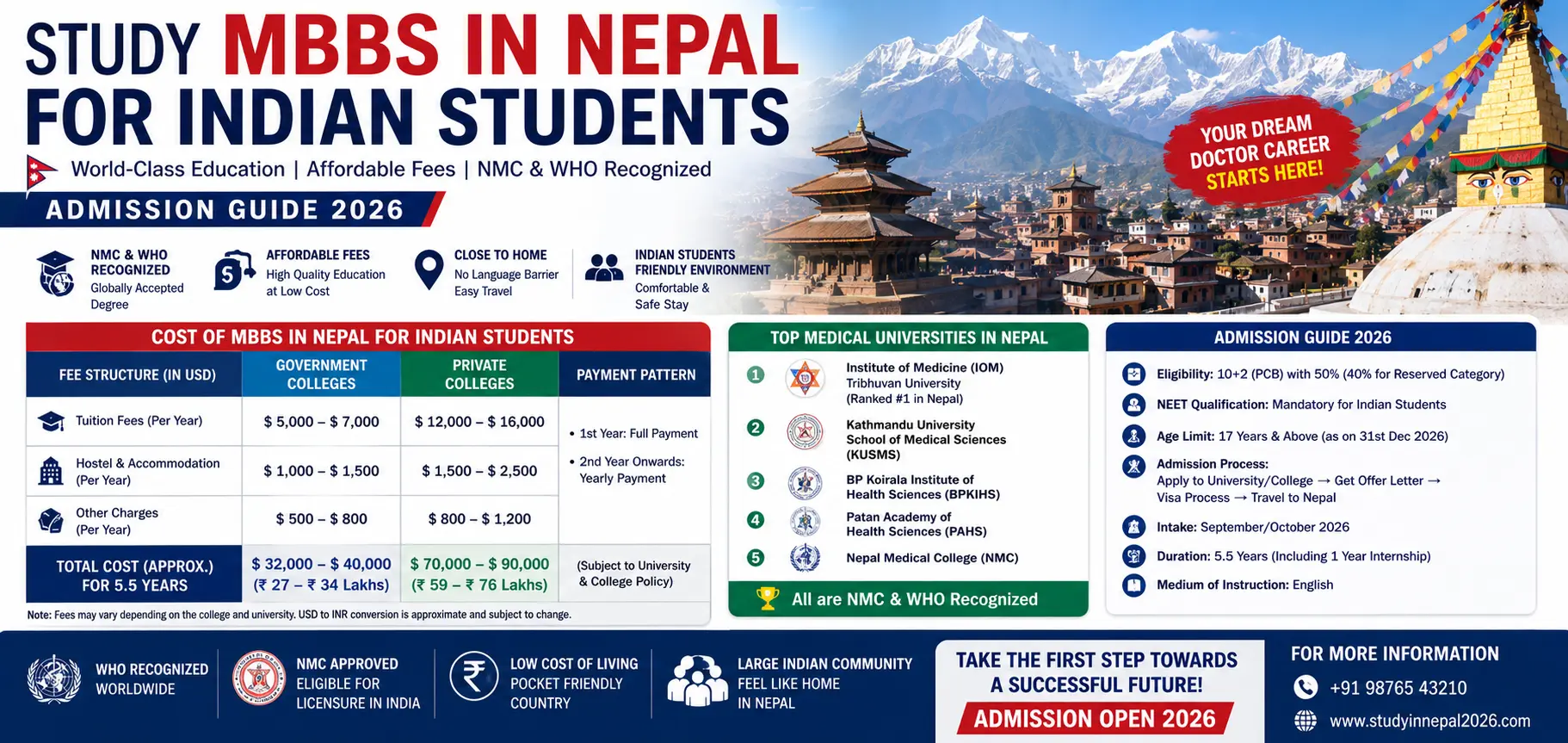
As the top current overseas destination for Indian medical applicants pursuing a bachelor’s degree in medicine, Nepal has become the first choice for a growing number of Indian families applying for medical programs, thanks to its exceptional cost-effectiveness and cross-regional adaptability.
We organize all core decision-making information in clear modules.
📊 Full MBBS Cost in Nepal
First, we calculate the full cost of the entire program:
The total expenditure to complete an MBBS in Nepal ranges from 4.5 million to 7 million Indian rupees.
Compared with the total cost of over 10 million Indian rupees that private medical colleges of the same level in India often charge, its cost advantage is extremely prominent.
💡 Core Advantages of MBBS in Nepal
We have sorted out 6 core advantages that draw Indian students to Nepalese medical schools, covering all key decision pain points including:
- Application thresholds
- Teaching pace
- Language environment
- Further study pathways
All information is verified through official channels and is authentic and publicly traceable.
✅ Recognition & Accreditation
In terms of institutional qualifications, all formal medical schools in Nepal have received official recognition from India’s National Medical Commission (NMC), and are listed in the World Directory of Medical Schools associated with the World Health Organization (WHO).
Graduates are eligible to take global national licensing exams for physicians, including India’s FMGE and NExT, the US’ USMLE, and the UK’s PLAB.
🏥 Most Popular Medical Colleges in Nepal
Currently, the three top medical schools most popular among Indian students are:
- Nobel Medical College
- Nepal Medical College
- National Academy of Medical Sciences
Their annual application volumes consistently rank at the forefront of all overseas medical schools.
💸 Tuition Fees & Living Expenses
In addition to the total program cost, we have also broken down the specific amounts of various expenditures including tuition and accommodation fees.
Furthermore, the average monthly living cost in Nepal only amounts to 10,000 to 20,000 Indian rupees.
On top of that, the two countries share similar cultures and customs, so Indian students do not need to adapt to a completely unfamiliar living environment.
📚 MBBS Eligibility Criteria for Indian Students
For Indian students intending to pursue a Bachelor of Medicine and Bachelor of Surgery (MBBS) in Nepal, they must first meet clear application eligibility requirements:
- A minimum total score of 50% in 12th-grade Physics, Chemistry, and Biology (PCB) subjects
- A passing result on India’s National Eligibility cum Entrance Test (NEET)
- A valid passport
- A full set of academic documents
These requirements comply with regulations set by India’s National Medical Commission (NMC), and NEET qualification is a mandatory, non-negotiable threshold.
⏳ Duration of MBBS in Nepal
Nepal’s MBBS program spans 5.5 years in total, comprising:
- 5 years of on-campus academic study
- 1-year internship
Its framework is highly consistent with that of MBBS programs offered within India, making it convenient for students to return to their home country to prepare for medical licensing examinations.
🌍 Why Nepal is a Preferred MBBS Destination
This study pathway has five core advantages:
- Tuition fees are far lower than those of private medical colleges in India
- There are no significant cultural or lifestyle gaps between the two countries
- Leading Nepali medical institutions offer full English-medium instruction
- Affiliated teaching hospitals provide sufficient opportunities for hands-on clinical practice
- The degree is recognized by the World Health Organization (WHO) and listed in the World Directory of Medical Schools, which supports graduates’ international career development
Nepal is one of the optimal choices for Indian students seeking affordable, high-quality overseas medical education, attracting thousands of applicants each year.
It is critical to remind all students that before submitting any applications, they must verify the accreditation status of their target institution through the NMC, WHO, and the aforementioned directory, to ensure their degree holds global validity.