 Call Us:
  B3/51 Vibhuti Khand, Gomti Nagar, Lucknow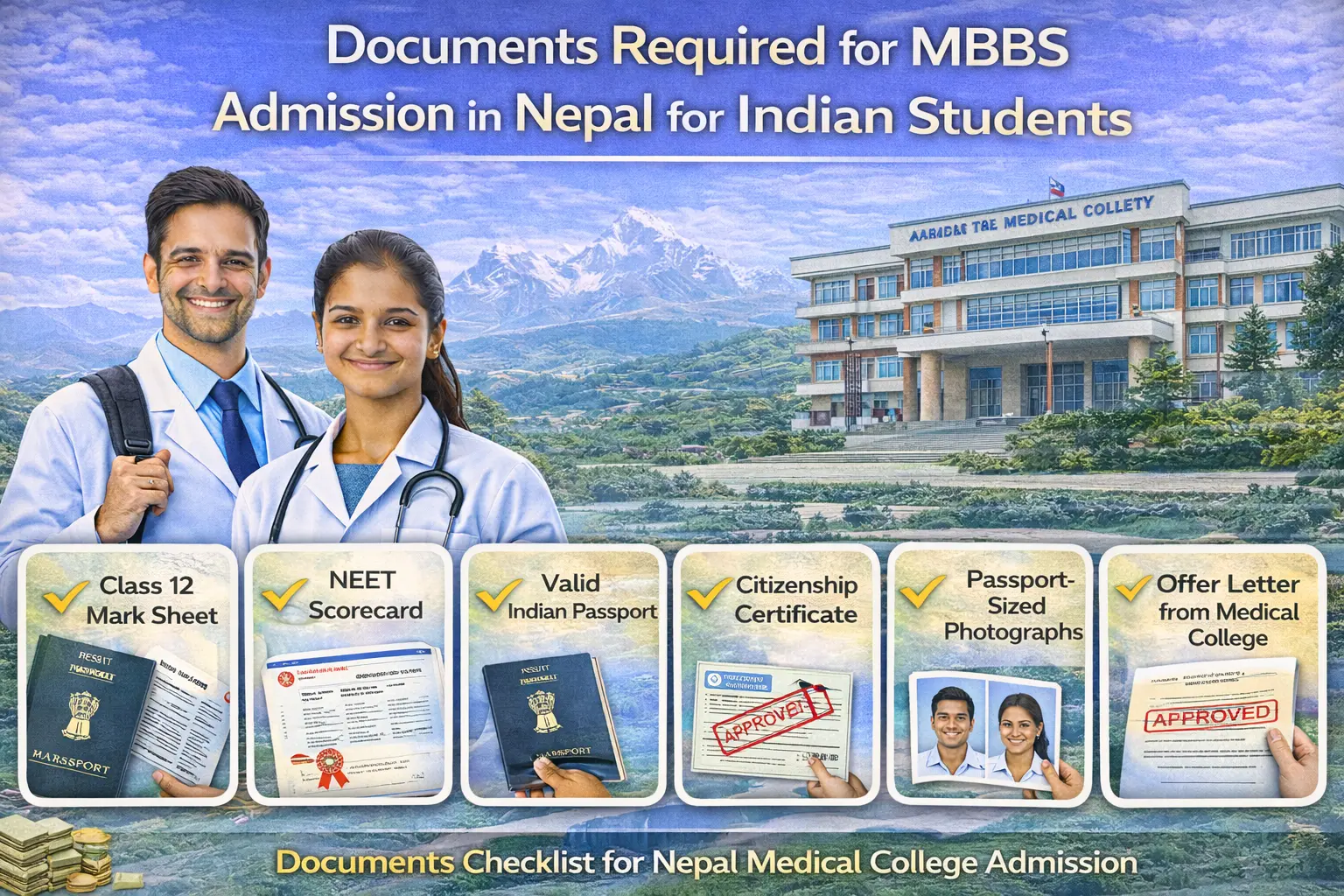
For Indians looking to study MBBS in Nepal, the documents need to be arranged accurately. Lack of proper documentation can delay or even prevent entry. It will help you stay organized and have a hassle-free admissions process if you know exactly what is needed from you in terms of paperwork.
Academic Documents
MBBS study in Nepal requires academic transcripts as the basis for verification. Indian students must submit the following:
- 10th Marksheet & Certificate: As Date of Birth proof and for basic education.
- 12th Marksheet & Certificate: Required for proof of Physics, Chemistry, and Biology.
- Evidence of Minimum Marks: 50% in aggregate in PCB for the General category and 40% for SC/ST candidates.
All academic certificates are to be provided by the respective education board.
NEET-Related Documents
According to Indian law, NEET is mandated for pursuing an MBBS degree outside India.
- NEET Scorecard: As per NMC directives, it is compulsory.
- NEET Admit Card: Also, some colleges may need it for verification purposes.
Without the NEET result, Indian students cannot gain admission in MBBS or practice medicine anywhere in India.
Identity & Personal Documents
In order to be admitted, identification is required to validate nationality and personal information. Students will need to send:
- Valid Passport: At least 18 months' validity is desirable.
- Aadhar Card or Government ID: Required at times for additional verification.
- Passport-Size Photographs: Recent photographs as per the specifications of the college.
An exact match should be there between the passport details and those of the academic and NEET records.
Medical & Fitness Documents
In Nepal, medical schools need to establish a fitness report so that the student can enter clinical training.
- Medical Certificate: By a registered medical practitioner.
- HIV Test Report: Compulsory in several medical colleges of Nepal.
- Vaccination Records: As and if demanded by the institute or hostel authorities.
These documents comply with health and safety regulations upon admission.
Migration & Transfer Certificates
Some colleges might require more academic clearance documents:
- Migration Certificate: Duly certified by the former educational board.
- Transfer Certificate: Last attended school (if available).
Not all of them are required, but it's best to keep these documents in order so you don't encounter any last-minute surprises.
College Recognition & Verification Documents
For Indian students who are pursuing their MBBS in Nepal, they will have to make sure that the medical college they are going to has international and Indian recognition. Eligibility of the candidate can be cross-checked by the admission authorities on:
Going to a reputed college ensures that candidates are eligible to appear in FMGE/NExT exams after they complete their studies.
Financial & Fee-Related Documents
In the admission confirmation process, students may face the following:
- Payment Receipts: For the evidence of payment of seat booking or tuition, if applicable.
- Bank Statements or Fee Transfer Proof: Sometimes required.
- Financial Support Affidavit: In the case that you are sponsored by your parents or legal guardians.
Such documents aid colleges in verifying that applicants have paid the fees and are financially prepared.
Document Format & Attestation Guidelines
✔ Retain several photocopies of all documents
✔ Bring originals while verification
✔ Reconcile names and dates in all paperwork
✔ Translate your documents into English if needed
✔ Certification is subject to attestation for a few certificates
Correct formatting and precision can minimize rejection or delay.
Common Document Mistakes to Avoid
- Name spelling discrepancy among documents
- Expired passport
- Invalid or missing NEET scorecard
- Unclear or low-quality scanned copies
- Reading over your paperwork before submission is recommended.
Conclusion
The most important factor in taking admission for MBBS in Nepal for Indian students is the preparation of the required documents. Academic qualifying records, NEET scorecard, identity proof, and medical certificates are central to the admission. Selecting colleges that are NMC-recognized, listed in WDOMS, and following WHO guidance will make their MBBS degree future-proof for further practice. The documentation process, planning, and attention to detail ensure a hassle-free admission process and prepare one well enough for starting medical education in foreign countries with confidence.