 Call Us:
  B3/51 Vibhuti Khand, Gomti Nagar, Lucknow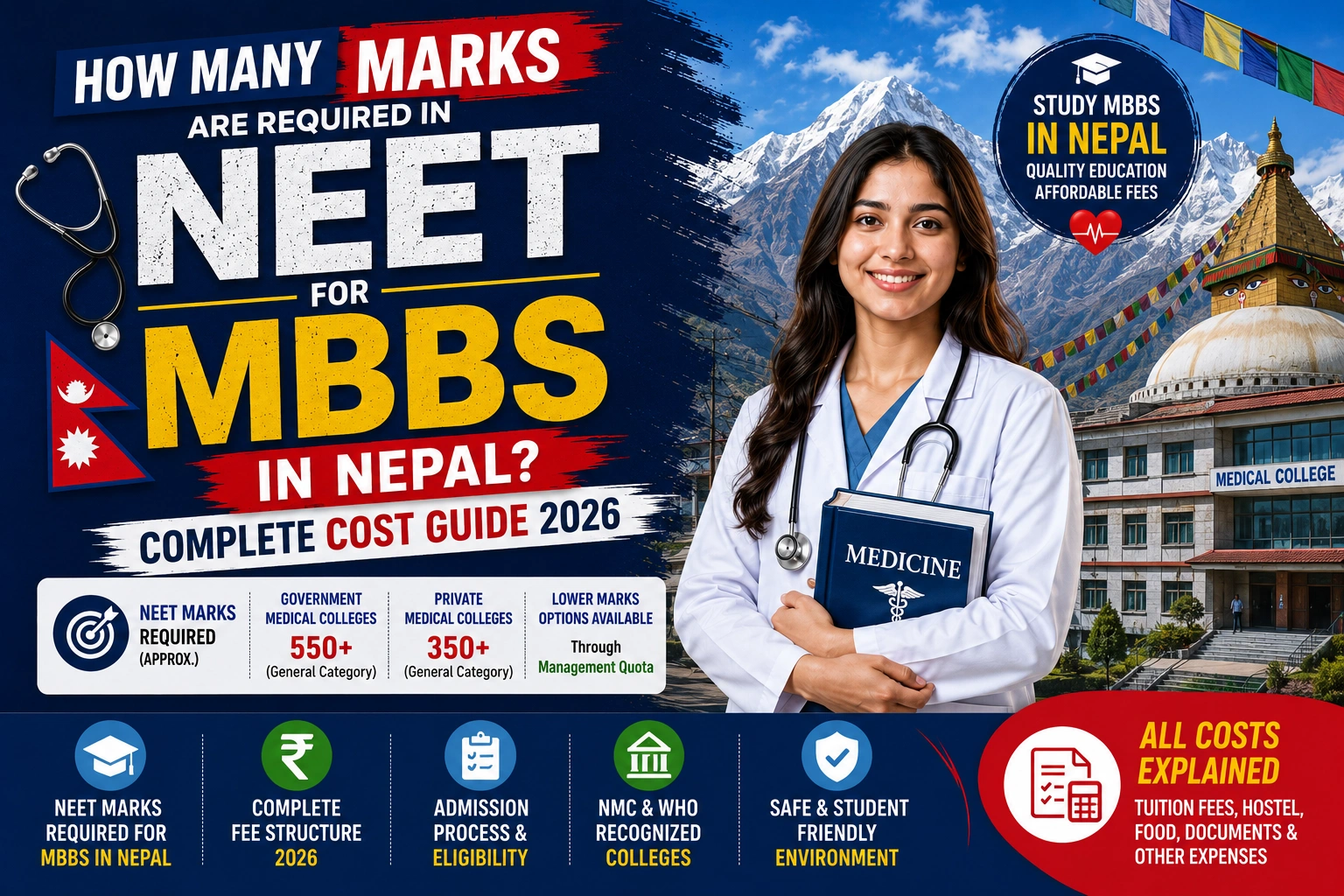
Each year, countless Indian students attempt the NEET UG examination with the aspiration of becoming a doctor. Increased competition and the limited number of MBBS seats in India means that Indian students are looking for alternative options for medical education and many are choosing to study abroad. Nepal is a preferred destination for many Indian students because of its close proximity, a similar education system, a reasonable fee structure, and the safe and hospitable environment for Indian students.
“How many marks are required in NEET for MBBS in Nepal?” has become a frequently asked question among medical aspirants. This answer is dependent on some variables like the NEET qualifying cutoff, category, specific university requirements, and the level of competition. As per the law governing the study of medicine abroad, Indian students must qualify for NEET to be eligible to apply for a medical seat in Nepal.
Students who plan to study medicine abroad must also verify important governing bodies like the National Medical Commission (NMC), World Health Organization (WHO), and the World Directory of Medical Schools (WDOMS) to check recognition and eligibility requirements.
NEET Marks Required for MBBS in Nepal for Indian Students
For Indian students, the minimum requirement to apply for an MBBS seat in Nepal is the qualification of NEET. Nepal is unique in comparison to India as in choosing a NEET score for a government or private medical seat, the majority of students must achieve significantly high scores, whereas in Nepal, the majority of students are required to meet the NEET qualification criteria and fulfill the remaining admission criteria.
Though looking at examinee performance and the test’s difficulty level can help determine NEET cutoff marks, it can change year by year. This means that students should prepare themselves to get a score that is well above the acceptable score, not just the expected score that allows them to qualify.
Not many qualify NEET, and that is the only requirement for application, but there is more potential for successful application for those who score higher. This is the case for many highly regarded medical schools in Nepal, where a limited number of students are admitted every academic year.
What are Acceptable NEET Scores to Get Admission to MBBS Programs in Nepal?
Although it is stated that all applicants need to qualify NEET, students should know what the acceptable score range is to increase their chance of being admitted to medical school in Nepal.
NEET scores can be understood as the following:
- NEET qualifying score: Dependent on the annual cutoff.
- 200–300: Opportunity to be admitted to one of many medical schools, but this is dependent on the conditions set forth.
- 300–400: Better chances to be admitted to medical school.
- 400+: Better chances to be admitted to reputed medical schools.
NEET scores are not the only factor that determine admission. Eligibility, documentation, admission requirements, and counseling also play a significant role.
Why do Students Need to Qualify NEET to be Admitted to MBBS Programs in Nepal?
Many students think that medical schools in foreign countries do not require them to qualify NEET in order to get admission; however, this is not true for Indian students who will be practicing medicine in India after they obtain their medical degree.
The Indian rules on foreign medical education require students to clear the NEET exam prior to enrolling in overseas MBBS programs. This policy is in place to ensure students possess basic medical education eligibility requirements prior to enrolling in programs with foreign medical universities.
Students who pursue MBBS outside of India without clearing NEET will face challenges when registering and applying for medical practice in India. Consequently, it is critical to review the latest updates from the National Medical Commission (NMC) prior to enrollment.
MBBS Admission Requirements in Nepal (Other Than NEET)
Although clearing the NEET exam is essential, there are additional prerequisites for admission to medical schools in Nepal.
The criteria primarily include:
Educational Background
The student must complete the secondary education level of the schooling system (10+2) and must have studied and completed the courses of Physics, Chemistry, and Biology (PCB).
Moreover, several medical colleges mandate the students have and demonstrate a minimum level of achievement in these subjects and many colleges set the threshold for the general category students at 50% in PCB.
Age Criteria
The applicant must be a minimum of 17 years of age at the time of enrolling into the medical school.
NEET Qualification
To be eligible to pursue an MBBS degree in Nepal, Indian students must clear the NEET UG exam with a score that meets the minimum cutoff for the year.
Documents Required
To apply, students need several documents. These include:
- NEET scorecard
- Class 10 and 12 certificates
- Passport
- Birth certificate
- Passport-size photographs
- Medical fitness certificate
- Other admission-related documents
Is a High NEET Score Mandatory for MBBS in Nepal?
A benefit of studying MBBS in Nepal is students are generally not required to possess exceedingly high NEET scores in comparison to admissions for Indian government medical colleges.
In India, the number of students seeking admission far exceeds the number of available seats. Nepal offers an alternative for students who are unable to secure a medical seat in India after qualifying NEET.
Nepal should not be seen as an easy alternative. Medical studies are strenuous and require a student to be dedicated and disciplined. A better NEET score will assist the student in selecting a better university, and it will build confidence to begin the medical journey.
Importance of NMC, WHO and WDOMS MBBS Recognition in Nepal
Recognition of a medical university in Nepal is important for students as it relates to their future employability and the licensing trade if they return to India.
The university must comply with the stipulations set forth by the appropriate medical authorities, and the student may verify such details using the NMC, WHO, and WDOMS.
A medical degree that is acceptable is a gateway for a student to fulfill the requirements for licensing and entry into the medical field.
What is the Admission Process for MBBS in Nepal after NEET?
Generally, the Indian student admission process entails several steps.
First, students must check their NEET qualification status to select applicable medical colleges in Nepal. Then, the students need to complete and submit their application package.
Participating in entrance exams regulated by the Nepal Medical Council may be necessary.
Students need to check their eligibility, academic standing, and available slots.
Visa procedures may be completed after admission is granted, in preparation for travel to Nepal.
Why Indian Students Choose MBBS in Nepal
There are many reasons that have made Nepal one of the more popular MBBS destinations for Indians.
One of the main advantages is the commonality in Indian-Nepalese culture. You will see that the lifestyle, food and even the language have some of the same habits.
You will see that the medical curriculum will be the same and, in fact, there are many medical colleges that have English as the medium of instruction.
Nepal is more affordable because of the travel distance and return for the students is possible during school breaks.
You will see that many hospitals are associated with medical colleges and that will help the students get more clinical training as well as learning the medical profession.
You can see more on the requirements, admission and universities on MBBS in Nepal.
What NEET Score Should You Target for MBBS in Nepal?
More than just the bare minimum qualifying score, having a higher score will always help you get admission to more medical colleges of your choice.
A target score of 300–400+ marks can offer students additional opportunities when applying to medical schools. The impact of even higher scores on college selection can be significant. However, NEET cutoffs and medical school admission policies shift year to year.
There are also other considerations:
- School prestige
- Cost of attendance
- Quality of hospitals
- Amount of clinical exposure and attendance
- Recognition
- Location and the surrounding community
There needs to be a balance of a good NEET score and selecting a medical school.
Conclusion
“How many marks are required in NEET for MBBS in Nepal?” is dependent on the NEET cutoffs for the year and school specific requirements. To gain admission to MBBS programs in Nepal, eligibility requires passing the NEET — however, the likelihood of admission is greater with higher scores.
For students wanting an opportunity to receive a quality medical education and avoid the international exposure of programs in other counties, MBBS programs in Nepal are a good option. It is important for students to evaluate the recognition status of the school, comply with the NMC, and ensure that the medical school meets the bare minimum requirements.
With the right NEET score and selection of the medical school, MBBS programs in Nepal have the potential to be a good opportunity to gain medical practice.