 Call Us:
  B3/51 Vibhuti Khand, Gomti Nagar, Lucknow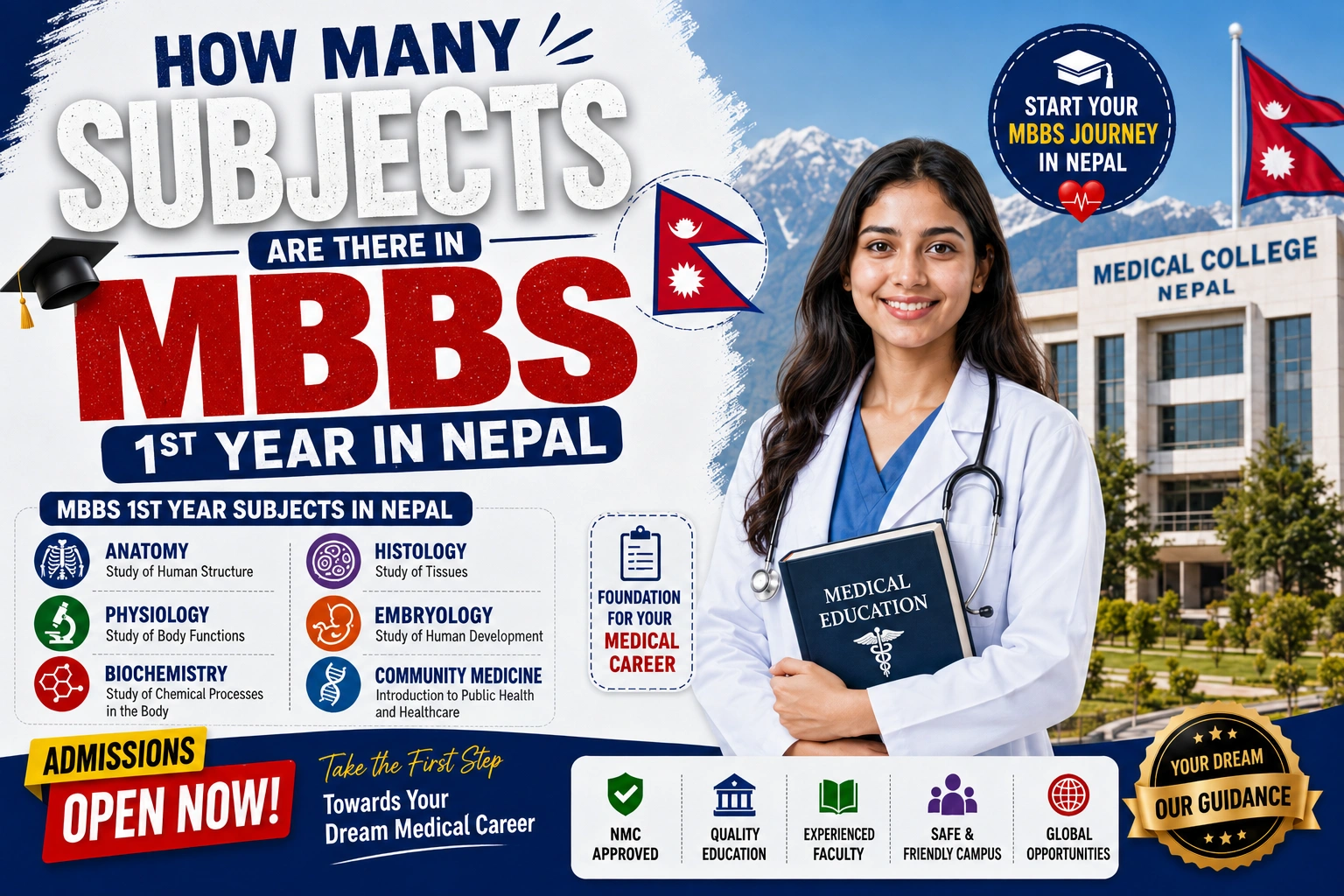
For the students who wish to pursue their MBBS in Nepal, it is essential to know about the first year syllabus and the structure of the programs before taking admission. The first year of medical school is extremely important as it creates the foundation for the entire course. The students are introduced to basic medical sciences, gross anatomy, and other concepts which are essential for clinical practices.
The proximity of Nepal to India along with the quality of medical education, similar culture, the affordability and the recognition of medical degrees makes it the preferred choice for many Indian medical students. It is to be noted that medical students from the recognized universities of Nepal are eligible to practice medicine after fulfilling the additional requirements as per the law. Students are, however, advised to check the recognition of the university from authentic resources of the National Medical Commission (NMC) as well as the global listings of the World Directory of Medical Schools (WDOMS).
The medical education in Nepal is based on an integrated style, with the combination of theory and laboratory skills. The first year is mostly about the basic medical pre-clinical subjects.
MBBS 1st Year in Nepal: Medical Curriculum Overview
Typically, completing the MBBS program in Nepal takes about five and a half years, and is inclusive of the intern year. Basic medical sciences comprise the first segment of the course. At this stage, students start to learn about the structures, functions, and chemical processes of the human body.
For Indian students who qualify through the NEET (National Eligibility cum Entrance Test), the MBBS first year syllabus in Nepal is comparable to the first year of other international medical schools and provides basic medical education.
The first year of medical school is often considered one of the most difficult and the primary reason for this is that there is a huge gap between school level biology and the biology related to the medical profession.
MBBS 1st Year Subjects in Nepal
MBBS 1st Year in Nepal is generally divided into three major subjects:
- Anatomy
- Physiology
- Biochemistry
Most colleges also include other modules, medical ethics, community orientation and basic clinical skills as part of the first year.
Core Subject of MBBS 1st Year in Nepal - Anatomy
Anatomy, which is the study of the structure of the human body, forms one of the core subjects of MBBS 1st year in Nepal. It deals with the study of the various systems of the human body along with their organs, nerves, tissues, blood vessels, muscles, and bones.
In the medical training programs in Nepal, Anatomy is taught via lectures and lab sessions supplemented by demonstrations and dissections. Understanding arrangements of body systems is best achieved through dissections.
Main Disciplines of Anatomy
Gross Anatomy
As the name suggests, Gross Anatomy is the study of structures of body systems that are large enough to be seen by the naked eye. Students study the regions of:
- Upper limb
- Lower limb
- Thorax
- Abdomen
- Head and neck
- Brain and spinal cord
They also study the relationships between organs and body systems and their functions. This knowledge is particularly helpful during the clinical years when a physician will be able to recognize and diagnose a condition based on a physical examination.
Histology
Histology is the study of tissues, and focuses on how different tissues are organized and how their organization relates to their functions. Some of the main topics in histology include the study of:
- Epithelial tissues
- Connective tissues
- Muscle tissues
- Nervous tissues
- Microscopic structures of organs
Embryology
Embryology is the study of development of the human body from conception to birth and of the development of body systems. Some important areas of study include:
- Development of the fetus
- Development of body systems and organs
- Embryonic development
- Congenital abnormalities
Neuroanatomy
Neuroanatomy is the study of the entire nervous system and focuses on the anatomy of the brain and spinal cord and the system of nerves. This corpus of knowledge of Anatomy assists in the understanding of nervous system disorders during the practice of medicine.
2. Physiology: Understanding Human Body Functions
Physiology is the study of functions of the body systems and organs. While Anatomy focuses on the structures of the body and their relationships, Physiology is concerned with the functions of the various organs and systems of the body and their interrelationships.
Students gain an understanding of how the body systems interact to maintain equilibrium and perform the functions necessary to sustain life.
Important Concepts in the Study of Physiology
General Physiology
Fundamental concepts of physiology will be introduced to students including:
- Functions of cells
- Body fluids
- Homeostasis
- Types of membrane transport
Students learn about the mechanisms cells use to communicate and how they help maintain equilibrium in the body.
Blood Physiology
Students learn about the following components of blood and physiology:
- Blood formation
- Hemoglobin
- Blood groups
- Clotting
- Immunity
Students will be able to understand anemia and associated blood and immune disorders.
Cardiovascular System
Students learn about the anatomy and physiology of the heart and blood vessels and the:
- Cardiac cycle
- Heart sounds
- Blood pressure
- Blood circulation
Respiratory System
Students learn the physiology and the mechanics of breathing and how oxygen is delivered to tissues.
Students learn about:
- Lung physiology
- Gas exchange
- Respiratory control
- Pulmonary function tests
Digestive System
The study of the digestive systems encompasses how the body prepares food and its components for cellular use and the processes of absorption.
Students learn about:
- Digestive enzymes
- GI tract motility
- Absorption
Nervous System
The study of physiology is not complete without the study of the nervous system, the most complex bodily system.
Students learn about:
- Neurons
- Reflexes
- The brain
- The sensory and motor systems
Biochemistry: Chemical Processes of the Body
Biochemistry is the study of the molecular and chemical reactions that occur in the body and how they sustain the processes of life. This subject area integrates the basic sciences and their application to clinical medicine.
In Biochemistry the major areas segmented into are:
Biomolecules
These are the life-saving components of the human body like:
- Carbs
- Proteins
- Lipids
- Vitamins
- Minerals
They also learn the structure and the functions and the roles that they play in the body.
Metabolism
Refers to the generation and utilization of body energy.
Some of the major pathways are:
- Carbs metabolism
- Proteins metabolism
- Fats metabolism
Understanding metabolism will help doctors in the management and diagnosis of diabetes and other related disorders.
Molecular Biology
This is the study of cellular processes and genetic information.
Some of the topics in this area are:
- Structure of DNA
- Functions of RNA
- Protein synthesis
- Inheritance
Clinical Biochemistry
This is the application of Biochemistry in the medical field.
Some of the examinations that the students learn are:
- Blood sugar test
- Liver function test
- Kidney function test
- Enzyme function test
Other Subject Areas in MBBS First Year Nepal
In addition to the three major areas of learning, some other areas of learning have been introduced by the medical universities in Nepal that help to broaden the learning of the students.
Medical Ethics and Communication Skills
The doctors should have good communication and professional skills. Learning of medical ethics, communication with patients and understanding the responsibilities of the health care professionals is what is introduced to the students.
Community Medicine Introduction
This is the introduction to basic public health and prevention of disease and the health care delivery system. This emphasizes the importance of preventive medicine.
Basic Clinical Skills
Some of the universities have also included the basic clinical skills like:
- Communication with the patients
- Taking medical history
- Basic examination skills
These help the students prepare for the clinical years.
MBBS 1st Year Nepal: Practical Training and Laboratory Work
There are lectures and practical training. The practical training complements the lectures and helps to learn clinical skills.
In the first year, students learn about:
- Anatomy and histology
- Physiology, biochemistry, and their lab associated experiments
Practical classes build a student’s confidence when they need to attend a hospital.
Medical universities in Nepal aim to harmonize theory and practice, equipping students for their roles in clinics.
First Year Subjects of MBBS in Nepal and Their Difficulty Level
First year MBBS in Nepal is known to be tough as students are adjusting to a completely different style of learning. The syllabus is highly packed, and students need to develop a study routine as their learning style will be scrutinized.
Anatomy is a memory recalling game, Physiology is theory based and Biochemistry is the study of processes and pathways of chemistry.
Regular revisers who practice theory will have no trouble passing the first year, as students are expected to study without memorizing.
Knowledge of First Year MBBS Subjects with Respect to the Career of a Doctor
The first year curriculum lays the groundwork for all the clinical subjects. Anatomy is essential for understanding the body when diagnosing diseases. Physiology helps formulate the impacts of diseases on the body’s functions, while Biochemistry helps in the evaluation of lab findings and in the assessment of dysmetabolic conditions.
Without a clear grasp of these subjects, one cannot fathom the advanced medical subjects of Medicine, Surgery, Pediatrics and Pharmacology.
Medical MBBS first year needs to be cleared to help students develop a medical mindset, which is critical.
Reason for Choosing Nepal for MBBS Education
Nepal is valuable for Indian students for MBBS for being a neighboring country. The geographical closeness, cultural similarities, and English medium availability ease the process for international students.
Many medical colleges in Nepal practice structured medical education and uphold academic standards. Students should check the accreditation of the University, the details of the curriculum, and the recognition by the WHO, NMC, and WDOMS before selecting the University.
For more precise details about admission processes, eligibility criteria, fees, etc. for MBBS in Nepal, please refer to MBBS in Nepal.
Conclusion
In the MBBS 1st year in Nepal the predominant subjects taught are Anatomy, Physiology and Biochemistry. These subjects lay the essential foundation for determining and carving out methods of ameliorating human health and ailments.
The first year may appear challenging with the extensive syllabus, however strategic learning and regular practical sessions pave the way for success. It is imperative that Indian students improve their degree of preparedness for a smooth and seamless transition.
Students may have a fruitful medical practice post their MBBS in Nepal, by enlisting in a recognized medical university and developing solid fundamentals during the 1st year of their study.