 Call Us:
  B3/51 Vibhuti Khand, Gomti Nagar, Lucknow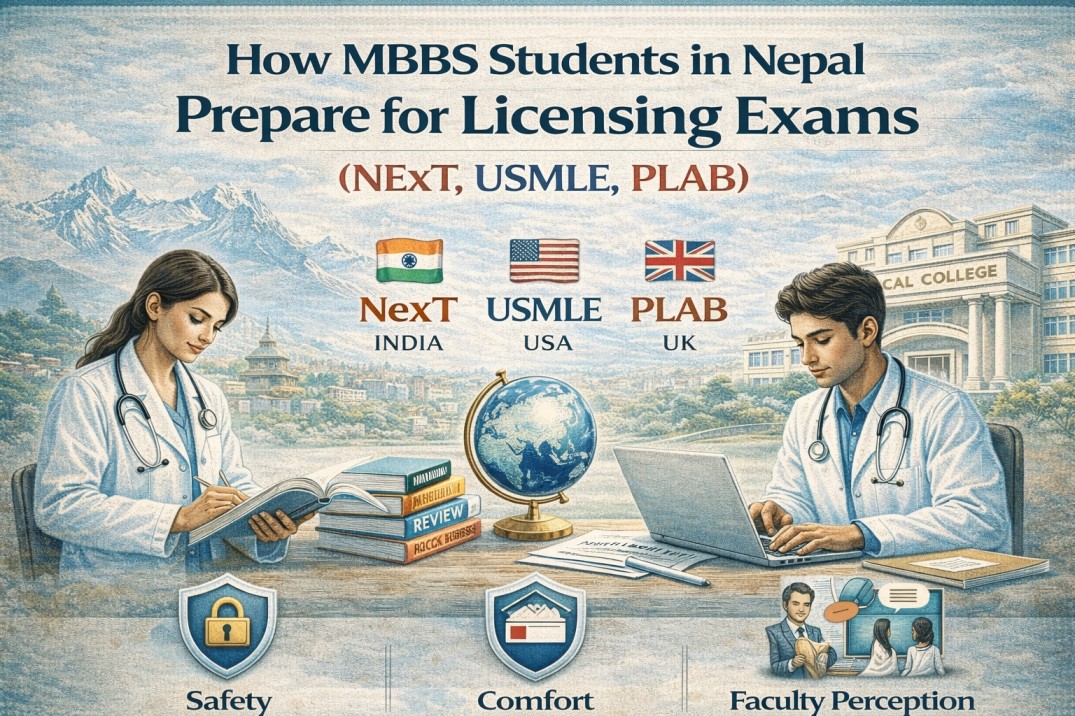
Nepal has become a top choice for Indian and international students pursuing MBBS due to affordable fees, high-quality medical education, and proximity to India. However, for graduates, the journey doesn’t end with earning a degree. To practice medicine in India or abroad, students must pass licensing exams such as NExT in India, USMLE in the USA, or PLAB in the UK. Preparing for these exams while completing MBBS requires strategic planning, disciplined routines, and a strong understanding of both theory and clinical practice.
For comprehensive information on MBBS programs and exam preparation in Nepal, visit MBBS in Nepal.
Understanding the Licensing Exams
1. NExT (National Exit Test, India):
NExT is mandatory for Indian MBBS graduates, including those from Nepal, to obtain a license to practice in India. It covers pre-clinical, para-clinical, and clinical subjects, primarily through MCQs and clinically oriented questions.
2. USMLE (United States Medical Licensing Examination):
USMLE is for students intending to practice in the USA. It consists of Step 1 (basic sciences), Step 2 CK (clinical knowledge), and Step 2 CS (clinical skills), evaluating both theoretical understanding and patient management skills.
3. PLAB (Professional and Linguistic Assessments Board, UK):
PLAB tests graduates who wish to work in the UK. PLAB 1 is an MCQ-based exam, while PLAB 2 is an Objective Structured Clinical Examination (OSCE) focusing on practical patient handling.
Nepalese colleges, recognized by the National Medical Commission (NMC) and listed in WDOMS, provide a foundation aligned with these exams. Students also follow international standards recommended by the WHO to strengthen clinical knowledge and decision-making skills.
Daily Routine for Licensing Exam Preparation
Successful students balance MBBS studies with licensing exam prep using structured daily schedules.
Morning (5:30–7:30 AM):
- Early hours are dedicated to high-yield topics and solving practice questions.
- Pre-clinical subjects are focused on in early years, while clinical subjects dominate later years.
Daytime (8:00 AM–2:00 PM):
- Attend lectures, practical labs, and clinical rotations.
- Take exam-oriented notes highlighting concepts relevant for NExT, USMLE, or PLAB.
Evening (4:00–8:00 PM):
- Focused study sessions for licensing exams, including MCQs, case discussions, and OSCE practice.
- Peer study groups or online forums are used to clarify doubts and solve complex cases.
Night (8:30–11:00 PM):
- Quick review of weak areas, consolidating daily learning.
- Relaxation and sufficient sleep to maintain mental alertness.
Rohan, a 5th-year MBBS student from India, says:
"Integrating daily revision with practical ward exposure makes licensing exam preparation manageable and effective."
Key Resources for Exam Success
To excel in licensing exams, students rely on multiple resources:
- Textbooks: Standard MBBS books aligned with NMC and WHO guidelines for core and clinical subjects.
- MCQ Banks: Question banks tailored for NExT, USMLE, and PLAB, offering topic-wise practice and simulated exams.
- Online Platforms: Video tutorials, mock tests, and study portals provide interactive learning and self-assessment.
- Clinical Practice: Hands-on experience in hospital wards and OSCE simulations prepare students for practical components like PLAB 2 or USMLE Step 2 CS.
Strategies Adopted by Students
- Start Early: Begin exam-specific preparation alongside MBBS studies to reduce last-minute stress.
- Integrated Learning: Correlate ward cases, lab experiments, and lectures with licensing exam topics.
- Regular Practice: Daily MCQs and case-based practice enhance retention.
- Mock Exams: Simulate real exam conditions to improve speed, accuracy, and confidence.
- Time Management: Allocate daily hours for MBBS academics, licensing exam prep, and personal care.
Overcoming Challenges
- Time Constraints: Managing college schedules alongside exam prep is demanding; structured routines help.
- Exam Pattern Differences: Each licensing exam has a unique format; mock tests and coaching help adaptation.
- Stress Management: Students use meditation, peer support, and recreational breaks to maintain mental health.
Testimonials: Student Insights
- Ananya, Delhi:
"Daily integration of ward rounds with NExT MCQs helped me retain clinical concepts effectively." - Vikram, Maharashtra:
"USMLE Step 1 prep became easier when I related theoretical knowledge with practical cases in college." - Priya, Uttar Pradesh:
"PLAB 2 practice in simulation labs gave me the confidence to handle real patient scenarios in the exam."
Conclusion
Preparing for NExT, USMLE, and PLAB while studying MBBS in Nepal demands discipline, planning, and consistent practice. By integrating daily routines, utilizing resources effectively, and participating actively in clinical learning, students can excel in both college academics and licensing exams.
Choosing NMC-approved and WDOMS-listed colleges ensures credibility and eligibility for international practice. For comprehensive guidance on MBBS programs, resources, and exam preparation strategies in Nepal, visit MBBS in Nepal.
Following standards set by NMC, WHO, and WDOMS helps students achieve global competence, preparing them to practice medicine in India or abroad confidently.