 Call Us:
  B3/51 Vibhuti Khand, Gomti Nagar, Lucknow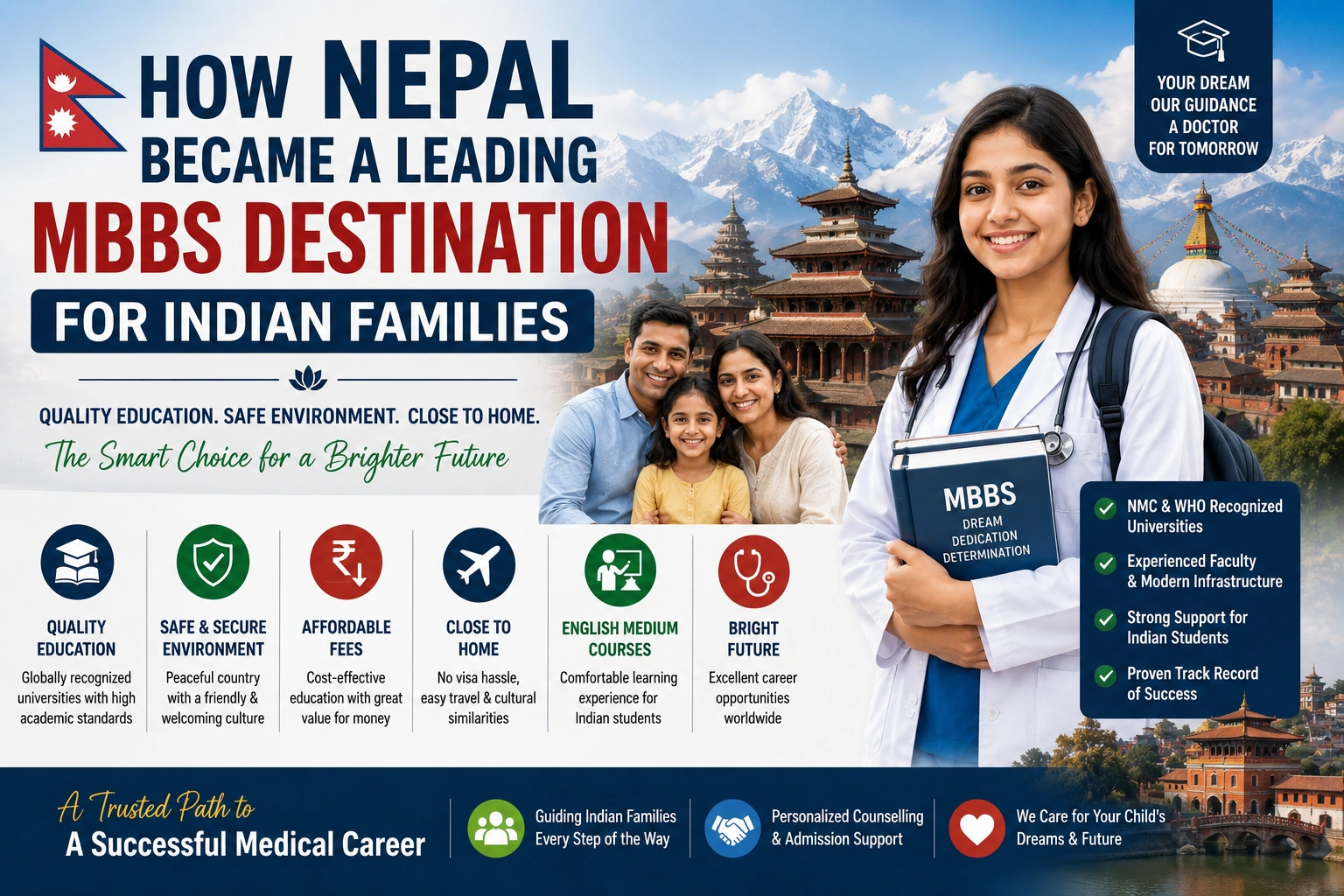
Introduction
In the past decade, MBBS in Nepal has become a popular MBBS destination for Indian families. Russia, Georgia, Kazakhstan, and Uzbekistan continue to attract many students, but Nepal has slowly built a reputation for medical education, cultural proximity, and ease of access. Indian students increasingly opt for Nepal because Nepal's education is integrated with India's medical systems and is coupled with internationally accredited medical degrees.
Increased competition for government medical seats and the steep cost of private medical colleges have compelled students to find alternatives outside the country. Nepal has established itself as the most preferred choice, combining modern infrastructure, excellent faculties, and higher academics, all within geographical proximity to India.
In this article, we cover how Nepal has established itself as a trusted MBBS destination for Indian families, the benefits, the admission process, the eligibility, the career prospects, and the reasons for the increased popularity among future doctors.
Why do Indian Students Choose to Study MBBS in Nepal?
Every year, lakhs of students in India appear for NEET, but only a handful of students get allotted government medical seats. The steep costs of private medical colleges have also made medical education unaffordable for many families.
Some advantages of choosing Nepal are:
- Lower tuition compared to Indian Private Medical Colleges
- Identical educational system
- English medium MBBS
- Early clinical exposure
- Convenient Indian food and familiar culture
- Short distance travel
- Mediante Indian food and familiar culture
- Internationally acknowledged Medical Colleges of Nepal
- Sri Lankan Colleges of Nepal
These factors attracted a lot of interest.
Strong Cultural and Geographical Connection
One of the highest reasons Indian families choose Nepal is its closeness with India.
Students do not have major cultural consequences because both countries have:
- Common and similar traditions.
- Common food habits
- Common festivals
- Common religious practices
- Common lifestyle
- Common social values
Parents also feel more comfortable sending their children to Nepal than to distant countries because travel is convenient and communication is not difficult.
The open and friendly relationship between India and Nepal also increases this confidence.
Affordable and Quality Medical Education
With the passage of time, the standards of medical education in Nepal have been improved.
Medical teaching universities have focused on:
- Modern teaching
- Learning and facilitating clinical training
- Research and have small faculty.
Universities have good labs, simulation labs, and digital libraries with hospitals for clinical practice.
CBT and Clinical Practice
Language is often a concern when studying abroad.
Fortunately, most medical universities of Nepal do their MBBS programs in English.
This has the following benefits:
- Easy understanding of medical concepts
- Better interactions in classroom
- Relaxed communication in clinical practice
- Easy preparation for licensing examinations and other exams
Curriculum Similar to India
The curriculum in Nepal is another reason for many Indian families to choose it.
The MBBS syllabus has many similarities to the Indian system.
Some of the subjects are:
- Community Medicine
- General Medicine
- Surgery
- Pediatrics
- Obstetrics and Gynecology
Because of these similarities, candidates also find it easier to prepare for the licensing examination and the postgraduate entrance examination.
Affordable Fee Structure
Medical education is expensive in India and Nepal has relatively affordable tuition, especially when compared to the Indian private medical colleges.
Also, the cost of Hostels, Food, Transportation, and other daily necessities are affordable in Nepal.
This is beneficial to families with limited income.
Clinical Exposure from Early Years
Education without practical experience is of little value.
Many of the Nepalese medical colleges incorporate:
- Early hospital learning and patient exposure
- Clinical case discussions
- Bedside teaching
This creates real confidence in the students.
Recognition of Medical Universities
Most of the Indian students are concerned about the medical colleges being recognized by the medical education regulatory authorities.
Many of the well-known medical colleges in Nepal are listed in the international medical directories and fulfill the eligibility criteria required by the countries for the graduates to practice or pursue further studies. Students should always verify the latest guidelines issued by NMC, check listings in WDOMS, and refer to the recommendations of WHO before making a final decision.
Travel Ease For Families
Convenient travel options would not be so obvious if this distance separated other countries with Nepal. Travel options for families visiting students include:
- Air travel
- Road transport
- Rail travel combined with road connections
Travel costs for visiting Nepal are less than those for visiting most of Europe or central Asia. The distance provides emotional comfort to students and parents.
Safe For Students
Safety is always a major concern of Indian parents. Nepal is an inviting place for international students. Medical Universities usually have:
- Secure hostels
- Hostel accommodation
- Student welfare departments
- International student coordinators
- Emergency support services
The large population of Indian students also aids adjustment for new students.
Availability Of Indian Food
Indian food is an integral part of student life. Most of the medical colleges in Nepal either have Indian food in hostels or have in the neighborhood:
- North and South Indian food
- Vegetarian food
- Jain food
- Halal food
Dietary problems can mostly be avoided.
Simple Admission Process
MBBS admission in Nepal is not as difficult as the admission process for medical colleges in India. The simple admission process involves:
- Eligibility requirement
- Qualifying the NEET exam (if applicable)
- Selection of a medical college
- Submission of required documents
- Confirmation of admission and payment of the required fees
- Travel to Nepal
The admission process is made simple and easy by the professional education consultants available.
Eligibility Criteria
While varying by institution, criteria usually include:
- Completion of Class 12
- Subjects: Physics, Chemistry, and Biology
- Marks as per requirement set by the university
- Qualified NEET score (applicable to Indian students)
- Passport or acceptable travel documents
The applicant needs to refer to the university for the most recent admission instructions.
Modern Infrastructure
Nepalese medical universities keep investing for the improvement of their educational facilities.
The students are benefitted with:
- Sophisticated labs
- Digital Classrooms
- Simulation centers
- Research Facilities
- Well Equipped Libraries
- Modern Teaching Hospitals
Having this infrastructure enhances both the theoretical and clinical skills of the students.
Experienced Faculty
Medical colleges in Nepal have well qualified and experienced teachers from the fields of medical sciences.
Faculty members focus on:
- Learning through Interaction
- Demonstrations
- Clinical Skills and Reasoning
- Patient-oriented skills
- Medical Ethics
Teaching and Learning is conducted in a student friendly manner.
The students are given academic support throughout the course offered.
Internship Opportunities
Internship year is an important component of the MBBS program.
The students are exposed to clinical practices in:
- Medicine
- Surgery
- Pediatrics
- Orthopedics
- Emergency Medicine
- Obstetric & Gynecological Medicine
- Community Medicine
This clinical exposure equips the students to practice independently and to take up specialization in the field of their choice.
Large Indian Student Community
Thousands of Indian students are pursuing MBBS in Nepal, which is an advantage because of:
- Safety and familiarity
- Student unions
- Easily available cohabitation for boarders
- Joint Celebrations
- Synergistic Academics
Newcomers are well received because the senior students offer guidance during the first few months.
Career Opportunities After MBBS
MBBS Graduates of the medical universities of Nepal gain numerous employment opportunities depending on the country’s medical practice laws.
Options may include:
- Sitting for licensing exams in India or elsewhere
- Engaging in postgraduate medical studies
- Practicing in hospitals post fulfillment of local licensing norms
- Pursue a career in research
- Make a career in public health, medical administration, or health care entrepreneurship
Students must ensure they are familiar with the licensing norms of the country where they plan to practice before enrolling into a medical school.
Things to Consider Before Enrolling
Students need to ensure before enrolling that the medical school of their choice has:
- Recognition
- Accreditation
- Adequate teaching hospitals
- Adequate clinical exposure
- Experienced faculty
- Quality hostels
- Affordable fees
- Positive reviews
- Good internship opportunities
- Good graduate outcomes
There are benefits if students ensure their choice of medical school is correct.
Common Myths Regarding MBBS in Nepal
Myth 1: Education in Nepal is of inferior quality.
Truth: There are Nepalese medical colleges that offer strong education with modern facilities and organized clinical training.
Myth 2: Language is a problem.
Truth: The majority of MBBS programs for foreign students are offered in the English language.
Myth 3: Adaptation is difficult.
Truth: There are Indian students, a familiar culture, and familiar food to help make adaptation truly easy.
Myth 4: Degrees are not acknowledged.
Truth: Recognition is dependent on the particular university and regulations in medical education. Students are strongly urged to verify that the university they select recently updated recognition and eligibility requirements for their intended practice.
Why Parents are Confident About Nepal
Parents take into consideration more than education when selecting a country and destination.
Nepal offers Indian families the opportunity of medical studies due to the multitude of factors detailed below:
- Proximity to India
- Reasonable cost of education
- Cultural similarity
- Safe campus
- Teaching hospitals
- English instruction
- Indian student community
- Easy travel and reasonable costs
These factors continue to build the long term confidence of Indian families with regards to education in Nepal.
Conclusion
Nepal has earned the confidence of Indian families with medical education due to an affordable, accessible, and quality education system with clinically advanced training and culturally compatible education. The Family can trust that the student can enter medical training without many of the obstacles that are created when the destination of medical education is far away.
Within the context of the previous statement the proper selection of the medical college is extremely important. Students are encouraged to investigate the recognition of the college’s curriculum and infrastructure, the college’s clinical facilities, and the college’s requirements prior to application. The conscious choice of education in Nepal can make it one of the safest and most trusted countries for Indian families seeking medical education abroad.