 Call Us:
  B3/51 Vibhuti Khand, Gomti Nagar, Lucknow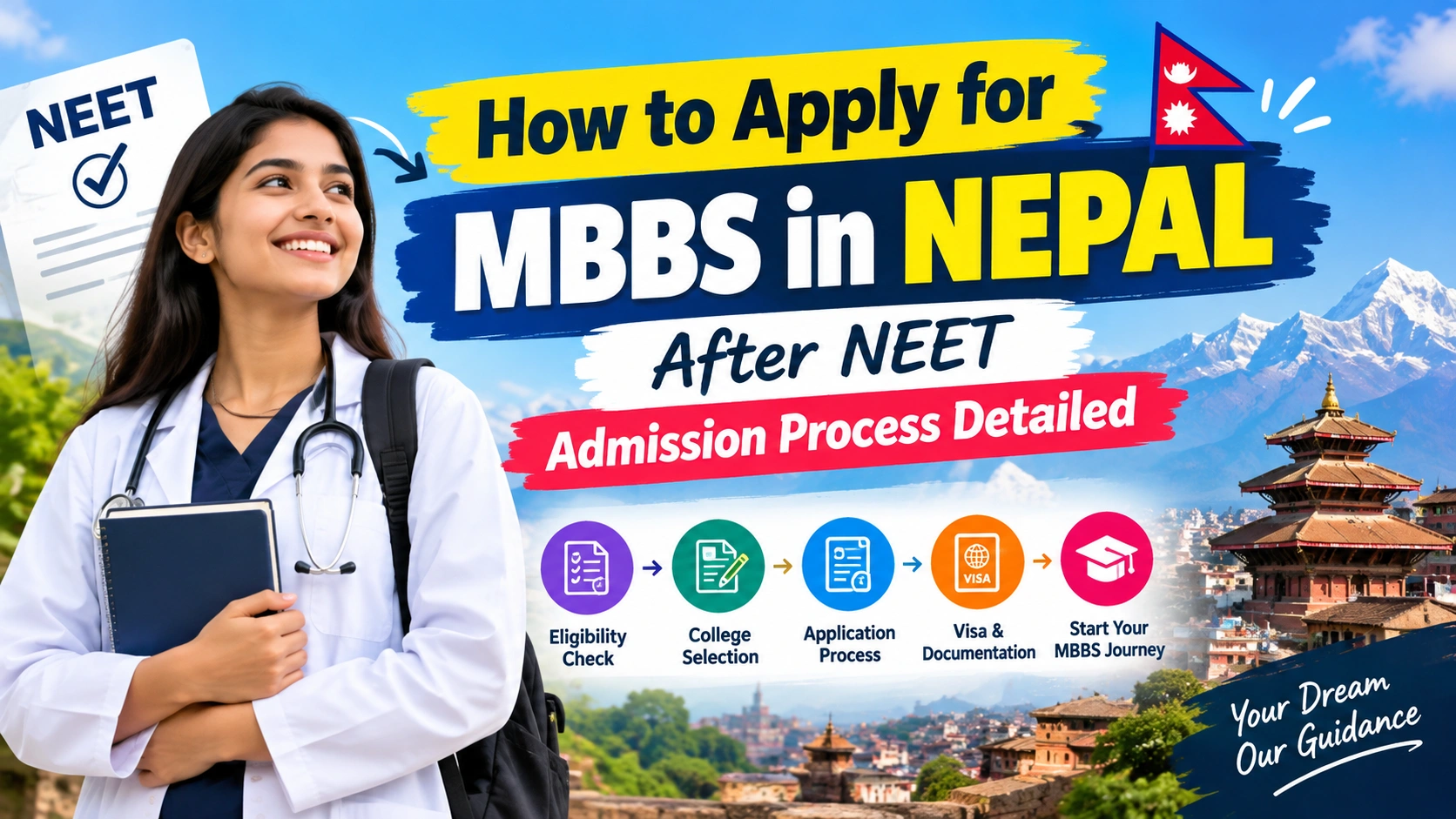
You have now accomplished NEET, and that doesn't mean you have to stop dreaming of becoming a doctor, even if you didn't get the MBBS seat in India. For lots of Indian students, due to proximity, availability of English medium medical education and a similar academic environment, MBBS in Nepal is a favorable option. But the real question is, after NEET, how do you apply? Which universities are on the list? How much will it actually cost? Most importantly, after you graduate, what will happen when you go back to India? This guide attempts to break the entire process without sounding like a prospectus of the university.
Can Indian Students Apply for MBBS in Nepal After NEET?
Definitely, Indian citizens can form one to all the way to pursue undergraduate medical education in Nepal. The National Medical Commission states the Indian citizens/OCI’s who are aspiring to pursue primary medical education outside India have to qualify NEET, provided they have to meet the eligibility criteria as applicable. Thus, that NEET score is not only significant for the counseling in India but also for their foreign medical education. Candidates are advised to check the official NEET website for the latest information on NEET instead of relying on consultancies or social media for updates.
MBBS in Nepal Eligibility Criteria for Indian Students
The criteria for MBBS in Nepal are pretty much the same as that for MBBS in India. Students should have completed 10+2 or an equivalent course with the subjects of Physics, Chemistry, Biology or Biotechnology, and English. There is an applicable age limit, and students also have to qualify NEET.
There is a general benchmark of 50% in the three subjects of Physics, Chemistry and Biology (PCB) for students of the general category, with applicable relaxations to the reserved categories as per the relevant rules. Students should, however, refer to the current admission notification of the respective university and the relevant rules for that academic year. In addition, you need to comply with the requirements of the foreign medical graduate requirements in India. NMC's current policy has certain stipulations with respect to the length, medium of teaching, the internship and clinical training, and other requirements of a foreign medical qualification. One small caution: Don’t select a college only because someone said: “You have qualified NEET; you will get admission.” It is not that easy.
NEET Score for MBBS in Nepal
There is no fixed NEET score for MBBS in all of Nepal's medical colleges. For Indian Students, the first question is whether the candidate has qualified NEET for that particular year. Beyond that, admissions depend on many factors like college, university, category, seats available, entrance or admission rules, and competition. This is the reason that the search for a “Nepal NEET cutoff” score is not the right approach. A student with a qualifying NEET score must shortlist colleges and check the current admission notice, seat category, and selection procedure for that college.
How to Apply for MBBS in Nepal After NEET - Stepwise Guide
It’s a relatively simple process to apply for MBBS in Nepal after NEET, but one missing document or an inadvertent error can lead to unnecessary delays.
1. Qualify NEET
This process involves the following steps, the first of which is the NEET. One must download their NEET score and keep printed and digital copies, as the score must be produced during applications and is required for admission procedures. As per the NMC, the NEET score is mandatory to qualify the Indian citizens and OCIs to seek primary medical education overseas.
2. Shortlist Medical Colleges
This is the stage at which most students misjudge the application process and make the most mistakes. The selection of the university should not be solely based on tuition costs. One should consider medical university affiliation, course length, clinical training facilities, and other pertinent factors. To see if a medical school is listed, utilize the World Directory of Medical Schools. However, WDOMS itself explains that a listing does not imply recognition or accreditation, and so forth. Thus, a listing in WDOMS is a helpful reference, but the only reference.
3. Verify NMC Conditions - Avoid Paying Otherwise
"NMC-approved foreign college lists" are oversimplified references that the National Medical Commission (NMC) doesn’t publish. The NMC has advised students on multiple occasions to check the venues for themselves and get authentic information on the course, fee structure, duration, and internship before going for overseas admission.Slightly more effort at this stage can save you a great deal of hassle in the future.
4. Submit the Application
Applications are submitted either directly to the university or admission authority, or through a specific channel, depending on the university and admission type. Standard documents include:
- NEET scorecard
- NEET admit card
- Class 10 certificate
- Class 12 marksheet and certificate
- Passport or relevant ID proof
- Birth certificate
- Passport-sized photographs
- Medical fitness certificate
- Migration/transfer certificate, and character certificate, if demanded, and any other documents specific to the university
Not every college will ask for the same documents, so don’t assume they will.
5. Receive Admission Confirmation
An admission or offer letter is sent after the application is accepted and the student meets the selection criteria. Important information like the tuition fee, the payment schedule, refund policy, hostel fee, deadlines, and extra fees are important and must be reviewed before any payment is made.
6. Pay the Required Fees and Complete Enrollment
The seat is officially taken and enrollment is done after the payment of the specified fee. Receipts are to be retained. All of them.
MBBS Fees in Nepal for Indian Students
Due to differences in institutions and the various admission types, fees will range and there won’t be a uniformity. For students planning to study in Nepal in 2026, tuition estimates are around ₹40 to ₹65 lakh for college courses based on published figures with some estimates providing higher and lower extremes. Costs for hostels, food, insurance, travel, and other academic expenses are generally not included. ([MBBS In Nepal][4])
Thinking about where to apply, the tuition at these institutions is generally in these ranges:
|
College/Institution |
Approx. Tuition Range |
|
B.P. Koirala Institute of Health Sciences |
₹30–35 lakh* |
|
Kathmandu University School of Medical Sciences |
₹35–40 lakh* |
|
Manipal College of Medical Sciences |
₹30–32 lakh* |
|
Universal College of Medical Sciences |
₹28–32 lakh* |
*Estimates for fees in 2026. Actual fees will vary by year, admission category, university policy, and exchange rates.It is reasonable to estimate expenses will be ₹45 to ₹75 lakh or more for the entire 5.5 years depending on lifestyle and the institution, with accommodation and subsistence included. When considering MBBS in Nepal vs. private medical colleges in India, you must consider the total costs of both, including hostel, food, travel, university charges, and other compulsory expenses.
How Long Is MBBS in Nepal?
The duration of an MBBS program in Nepal is typically around 5.5 years. This is inclusive of the in-country clinical training and the compulsory one year internship. This duration is significant for Indian students because the NMC’s Foreign Medical Graduate framework has stipulations related to the duration of undergraduate medical training and internship/clinical clerkship. Prior to applying, verify the precise curriculum and the structure of the internship at your selected college. Do not take the words “5.5-year MBBS” in the college brochure at face value.
Recognition: WDOMS, WHO and NMC — What Do You Need to Know?
This is the most confusing section for students. WDOMS is helpful to check if a medical school is in the World Directory of Medical Schools, but listing in WDOMS is neither recognition nor accreditation WHO also has information about health institutions and medical education activities in Nepal, but students should not consider the vague statement of “WHO recognized” on a website as sufficient justification for medical practice in India. WHO also has information on the institutions of medical education in Nepal.
For Indian students, the more prudent method is to check:
- The status of the medical school in WDOMS.
- Recognition/registration in Nepal.
- University affiliation.
- The duration of the course and the curriculum.
- The structure of the internship and clinical training.
- Current NMC Foreign Medical Graduate requirements.
The regulations can change. Verify the official NMC sources before enrollment and not after graduation.
What Are the Implications of FMGE or NExT After MBBS in Nepal?
Students need to be able to envisage the future. Students who obtain a medical degree abroad and wish to practice medicine in India must comply with the National Medical Commission's norms. Currently, the National Medical Commission maintains the Foreign Medical Graduate Licentiate Regulations and associated guidance, so students should refer to the regulations for the cohort that matches their admission and graduation. (National Medical Commission) The old regulatory framework referenced the FMGE screening test. However, the regulatory framework is transitioning to the NExT. Don’t make a five year educational decision based on an FMGE article you happened to find on Google. Make sure to check the NMC updates while you are in the course.
Additional Expenses to Account for in Your Budget
Tuition is only one part of the cost. Consider also budget for:
- Hostel and accommodation
- Food and mess charges
- Books and medical apparatus
- University registration charges
- Examination charges
- Local journeys
- India to Nepal travel
- Other personal expenses
- Internship-related expenses, if applicable
It is a good idea to have at least an additional ₹3-8 lakh on top of the total budget for the duration of the course, although this is highly dependent on your college and lifestyle.
Advantages and Disadvantages of Pursuing MBBS in Nepal
Benefits
- Proximity to India
- Culturally familiar
- English is the medium of instruction for medical education
- Minor language adjustment in a number of colleges
- Multiple good medical colleges
- Shorter travel compared to long distance options
- Possibly lower cost compared to some private Indian medical colleges
Considerations
- Wide variation in college fees
- Colleges may have different rules for admissions
- Check recognition thoroughly
- Varying preliminary medical training
- Budgeting for currency and fee changes can be tricky
- Need to meet NMC requirements to return to India
So, does pursuing MBBS in Nepal make sense? It can, if the recognition, curriculum, clinical training, and costs of the colleges you are interested in pass your evaluation.
Frequently Asked Questions
Is there a NEET requirement to pursue MBBS in Nepal for Indian Students?
Indian citizens/OCI desiring to pursue primary medical education overseas must qualify for NEET and fulfill the NMC requirements.
Can I apply to Nepal for further studies as soon as I get my NEET score?
Yes, as long as you meet all specified eligibility criteria for the respective colleges and they are open for applications. Admission schedules are typically different for each college.
How much does MBBS in Nepal cost?
Those looking to MBBS in Nepal for 2026 should estimate tuition between ₹40–65 lakh. These are only estimates. Food, boarding, and costs related to the program will cause the total cost to rise.
Is MBBS from Nepal valid in India?
An MBBS Nepal degree does not guarantee the ability to practice medicine in India. You will also have to fulfill the requirements and conditions for registration as prescribed by the NMC.
Is Nepal better than other countries for MBBS?
When seeking an MBBS abroad, Nepal is a valid option, especially for to-countries like India. However, we suggest that you evaluate all options available to you, including your budget, college preference and your academic and professional future.
Where can I check colleges and admission information?
When seeking an MBBS in Nepal, you should begin by looking for colleges and admission information on the MBBS in Nepal webpage. Additional information can be found on the NMC and NEET websites, as well as websites for the universities in Nepal.
Conclusion
There is more that can be accomplished with a NEET qualification than waiting for an Indian MBBS seat. Begin your research into an MBBS in Nepal by checking eligibility, college options, and cost comparison. Check for recognition WSODMS and Nepal along with the NMC regulation updates. Beware of agents and fast filling seats. It is a long term commitment. Select your college before anything else. The admission process will follow, and you will need to pay a hefty fee. Before doing anything, check everything from official sources. This habit will help you in your MBBS in Nepal immensely and make the process safe and simple.