 Call Us:
  B3/51 Vibhuti Khand, Gomti Nagar, Lucknow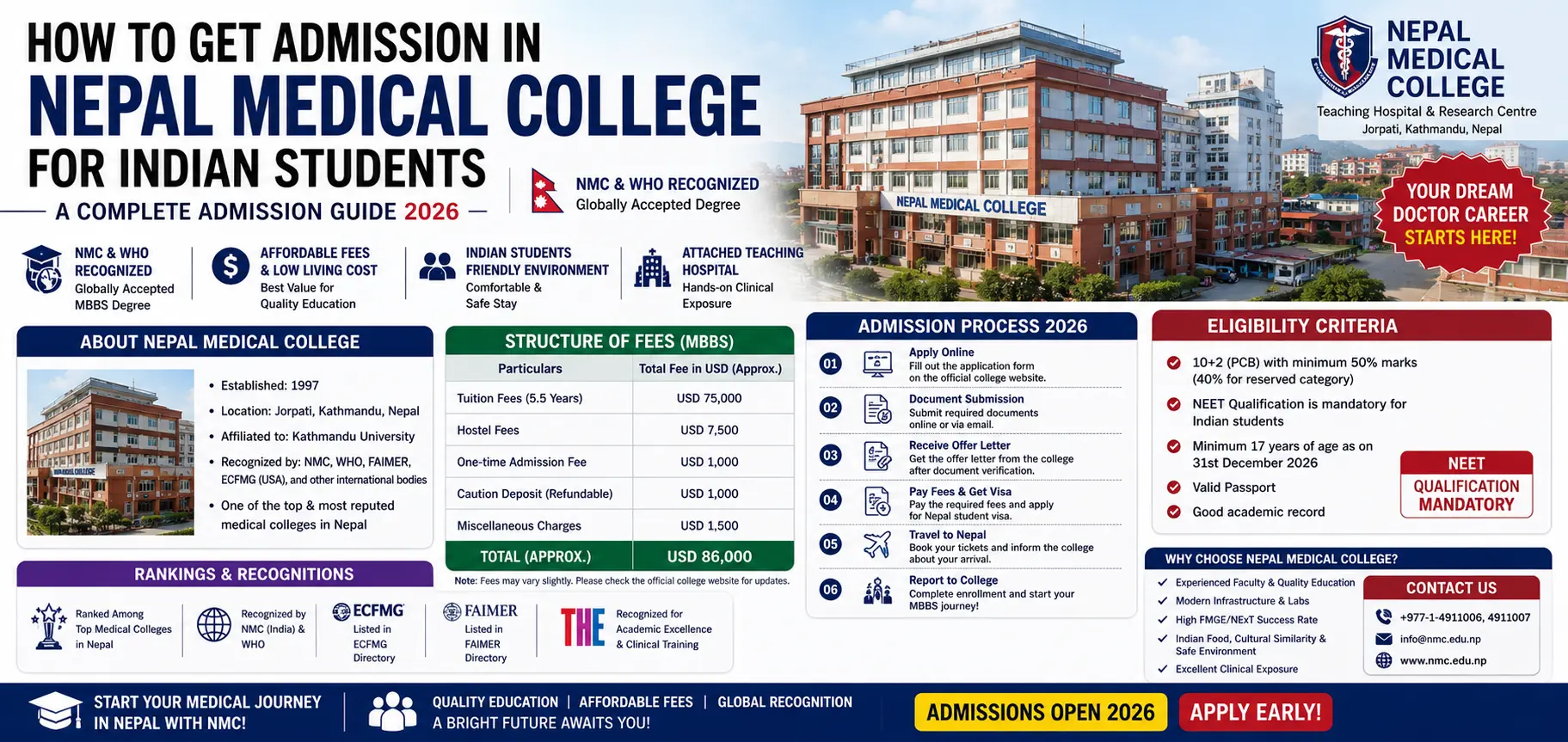
Nowadays, Nepal has become one of the top destinations for Indian students to pursue MBBS degrees overseas.
Its core appeal centers on low tuition fees, a similar cultural environment, and the widely recognized global accreditation of its medical schools.
This guide is created specifically for Indian students planning to apply for MBBS programs at Nepalese medical schools, and it organizes all core information strictly aligned with this group’s application decision-making logic.
🌟 Advantages of Nepalese Medical Schools
First, we introduce 7 exclusive advantages of Nepalese medical schools:
- Tuition fees are lower than those of private medical schools in India
- Courses adopt a full English-medium instruction model
- The curriculum is fully aligned with India’s medical education system
- There is no language barrier for daily communication
- The campus and surrounding living environment are safe and friendly
- School authorities specifically provide FMGE/NExT exam preparation support for Indian students
These institutions have full-chain authoritative accreditation backing:
- They are recognized by the National Medical Commission of India (NMC)
- Listed in the World Directory of Medical Schools (WDOMS)
- Supported by the World Health Organization (WHO)
The degrees they confer fully meet the requirements for medical practice certification in India and all countries around the world.
📚 Eligibility Criteria for Indian Students
Next are the eligibility criteria for Indian student applicants.
The academic requirement is completion of 10+2 level education, with completion of courses in four subjects:
- Physics
- Chemistry
- Biology
- English
General category applicants must score no less than 50% in the combined total of Physics, Chemistry, and Biology.
Reserved category applicants may apply for score waivers in accordance with relevant regulations.
In addition, all applicants must hold a valid NEET score from the year of application.
This mandatory requirement is uniformly set by India’s National Medical Commission for all Indian students pursuing medical education overseas.
📝 MBBS Admission Process in Nepal
We will break down the application process into individual steps.
So far, we have explained the first four steps:
- Complete institutional research and select a target school
- Submit the application form and all supporting documents
- Receive the official admission letter
- Pay the first installment of fees to reserve an enrollment spot
✈️ Step 5: Visa & Travel Process
We now move to the detailed explanation of Step 5:
For Indian students planning to pursue a Bachelor of Medicine and Bachelor of Surgery (MBBS) in Nepal, the first key upfront benefit is the simplified visa process stemming from friendly bilateral relations between India and Nepal.
Students can obtain their Nepal student visa quickly without undergoing complex qualification checks.
After completing all pre-admission procedures, you will enter the sixth step of the enrollment process: traveling to the Nepali university’s campus to complete final registration.
📂 Required Documents for MBBS Admission
Before this step, you must prepare all 7 required application materials:
- 10th and 12th grade academic certificates
- NEET score reports
- Passport and Aadhaar card
- Passport-sized photos
- Birth certificate
- Medical clearance certificate
It is recommended to prepare extra copies of all documents in advance for backup.
💰 Cost of Studying MBBS in Nepal
The core reason Nepal’s MBBS program is widely favored by Indian students is its high cost-effectiveness.
The total cost of the program is far lower than that of most private medical colleges in India.
Expenses mainly fall into five categories:
- Tuition fees
- Dormitory accommodation fees
- Meal costs
- Unified university charges
- Clinical training fees
All students must confirm the latest fee standards with the university or official admissions advisors in advance.
🌍 Benefits for Indian Students in Nepal
In addition, Indian students enjoy four core advantages when studying in Nepal:
- Strong compatibility with local culture and diet that enables quick integration
- Fully English-medium instruction that eliminates language barriers
- Access to sufficient clinical internship resources even during their studies
- A degree that is recognized by the World Directory of Medical Schools and India’s National Medical Commission, supporting a wide range of global career opportunities
🎓 Career Opportunities After MBBS in Nepal
After graduation, students can choose from five development paths:
- Return to India to take the FMGE/NExT exam
- Pursue a master’s degree in India or abroad
- Register for international medical licensing exams such as USMLE/PLAB
- Work in hospitals
- Work in clinics or scientific research fields
These opportunities are available because MBBS in Nepal adheres to international medical standards endorsed by the World Health Organization, allowing graduates to build successful global medical careers.
✅ Final Conclusion
Overall, Nepali medical colleges are an excellent choice for Indian students seeking overseas medical education with high recognition and high cost-effectiveness.
Before submitting an application, all students must verify the target institution’s qualifications, admissions eligibility standards, and fee structure to make a rational decision.