 Call Us:
  B3/51 Vibhuti Khand, Gomti Nagar, Lucknow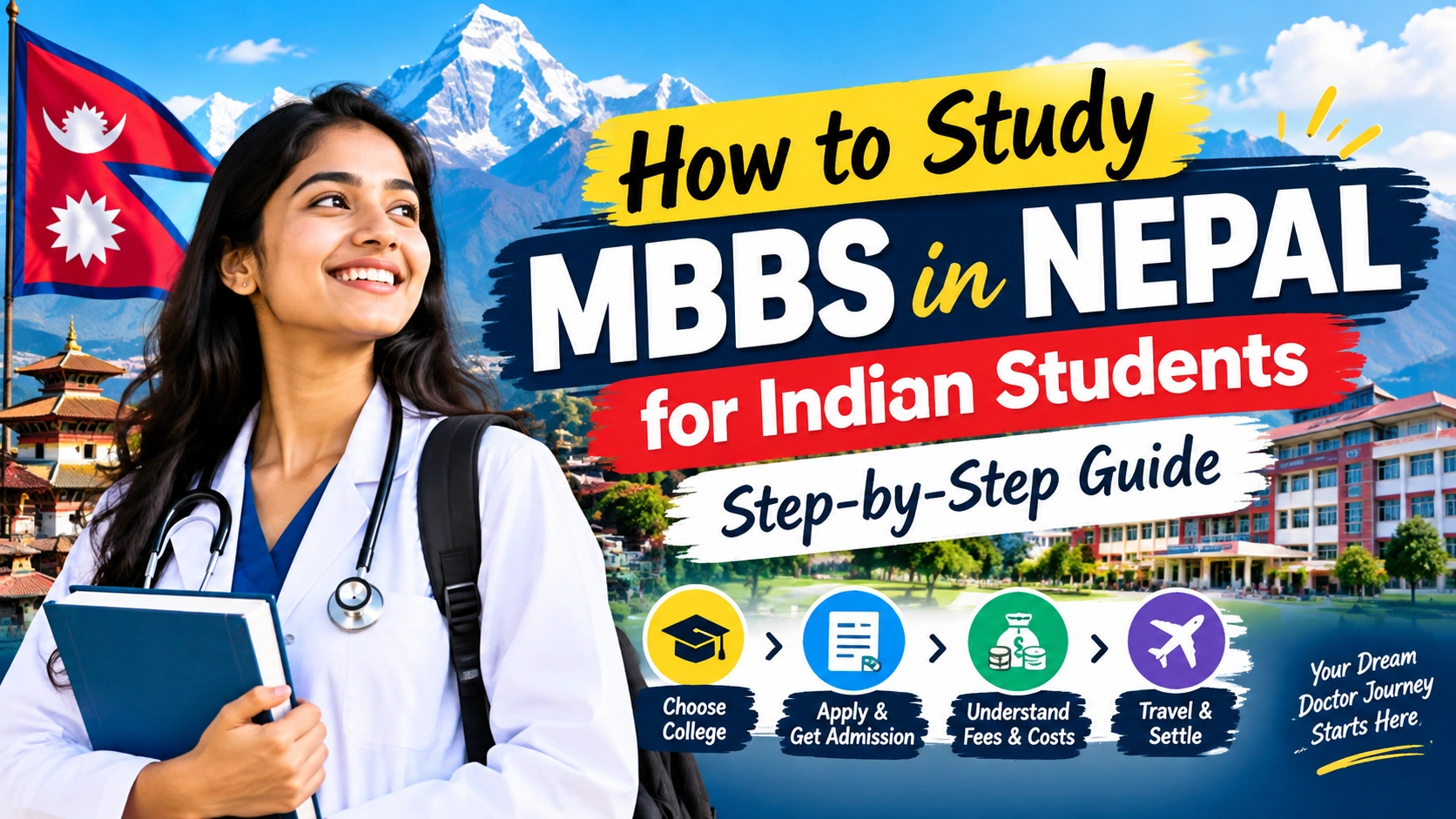
A student messaged me last week asking, "Where do I even start?" Not fees, not colleges — just, where do I start. That's usually the real problem. Everyone's drowning in scattered information from ten different YouTube videos and none of it lines up. So here's the whole process, laid out properly. Start to finish. MBBS in Nepal isn't complicated once you break it into steps — it's just that nobody actually does that for you.
Step 1: Appear for NEET First
Non-negotiable. Every single Indian student wanting MBBS in Nepal — or any country abroad, really — has to qualify NEET. No exceptions, no back doors, no "special quota" that skips this. Minimum qualifying percentile applies the same as domestic admissions. The general category usually needs 50th percentile, reserved categories a bit lower. If anyone tells you a Nepal college takes students without NEET, that's your cue to hang up the call.
Step 2: Understand Basic Eligibility
Beyond NEET, the eligibility list is fairly standard:
- 10+2 with Physics, Chemistry, Biology, English as core subjects
- Minimum 50% aggregate in PCB (45% for reserved categories, though this varies slightly by college)
- Age 17 years or above at the time of admission
- Valid, current NEET scorecard
Some of the government institutes — Institute of Medicine (IOM), BPKIHS — also conduct their own entrance round on top of NEET for the limited Indian-quota seats. Private colleges are more straightforward, mostly just NEET plus their internal counselling process.
Step 3: Shortlist NMC-Approved Colleges
This is where a lot of families rush and pick based on price alone. Don't. Before shortlisting anything, cross-check the college against the current NMC approved list. This list gets revised periodically, so last year's PDF someone forwarded you on WhatsApp? Not reliable. Check fresh. You'll also want the college listed under WDOMS — World Directory of Medical Schools — and ideally recognized by WHO as well. This is what licensing authorities actually check when you come back to India. Skip this step and you could end up with a degree that's essentially useless back home. Harsh, but true.
Popular names that keep coming up for Indian students: Kathmandu Medical College, Chitwan Medical College, Nepal Medical College, BPKIHS Dharan, and Manipal College of Medical Sciences (MCOMS) in Pokhara. Each has its own fee bracket and seat availability, so this isn't a one-size list.
Step 4: Compare Fees Before You Commit
Numbers matter here, obviously. Total cost for MBBS in Nepal across the full 5.5-year program — that's 5 years academic plus 1 year mandatory internship — generally falls between ₹45 lakh and ₹75 lakh, all-inclusive. Government colleges sit lower, roughly ₹35–50 lakh, but seats for Indians are extremely limited and competitive there. Private colleges range wider, anywhere from ₹45 lakh up to ₹75 lakh depending on the tier.
|
College Tier |
Approx. Total Fees (5.5 yrs) |
|
Government (IOM, BPKIHS) |
₹35–50 lakh |
|
Mid-tier private |
₹45–62 lakh |
|
Top-tier private |
₹55–75 lakh |
These are approximate ranges based on recent trends, not fixed figures — currency conversion and annual fee revisions shift things a bit. Always confirm with the college's current fee circular before you finalize anything.
Honestly, most people don't realize hostel and mess charges are often quoted separately. Budget another ₹1–1.5 lakh per year for that if it isn't already bundled into the total you're shown.
Step 5: Apply Through the Right Channel
You can apply directly through the university, or through a registered consultancy. Both work. What doesn't work is going through random "agents" who guarantee a seat before you've even qualified NEET — that's a scam pattern, seen to repeat too many times. Application windows typically open around July-September, right after NEET results are declared, though exact dates do shift year to year. Keep documents ready in advance — mark sheets, NEET scorecard, passport, photographs — so you're not scrambling at the last minute.
Step 6: Get Your Admission and Provisional Letter
Once the college reviews your application and confirms eligibility, you'll receive an admission or provisional offer letter. This is the document you'll need for your visa application next, so keep multiple copies. Physical and digital both.
Step 7: Apply for Nepal Student Visa
Visa processing for Indian students is comparatively smoother than most other countries — proximity helps, and paperwork requirements aren't as heavy. Still, don't leave it to last week. Processing time varies, and delays happen.
Step 8: Travel and Complete Local Registration
Once you land, there's a local registration process with the university and, depending on the college, with Nepal Medical Council as well. This part is procedural, mostly paperwork and orientation. Nothing dramatic, just don't skip any form.
Course Duration and What Comes After
The course runs 5.5 years total — 5 years of academics, 1 year compulsory rotating internship. English is the medium of instruction throughout, which honestly makes the whole transition easier than people expect. Once you're done and back in India, you'll need to clear NExT (National Exit Test) to practice — this has replaced the older FMGE screening exam for foreign medical graduates. Colleges that follow an India-aligned curriculum, which most established ones in Nepal do, tend to see better outcomes here since the syllabus overlap reduces the prep burden.
Hidden Costs to Plan For
- Visa and immigration charges, renewed annually
- Nepal Medical Council registration fee
- Study material, instruments, uniform
- Multiple flights home a year
- Living expenses, roughly ₹8,000–15,000 per month
None of these individually break the bank. Add them up over 5.5 years, though, and it's an extra ₹3-6 lakh minimum. Plan for it upfront instead of getting surprised in year two.
FAQs
Is MBBS in Nepal a good option for Indian students? Yes, for most students it's a solid, recognized alternative to expensive private colleges in India — provided you pick an NMC-approved college.
Can I get admission without NEET? No. NEET is mandatory, no exceptions.
How long does the whole admission process take? From application to travel, usually 2-4 months, depending on the college and visa processing time.
Is FMGE still required after MBBS in Nepal? FMGE has been replaced by NExT. You'll clear NExT to get your license to practice in India.
What's the total cost including living expenses? Roughly ₹50–80 lakh across 5.5 years once you add tuition, hostel, and personal expenses — figures vary by college, so verify current numbers directly.
Do all Nepal medical colleges accept Indian students? Not all. Only NMC-approved, WDOMS-listed colleges should be considered — always verified before applying.
Conclusion
The process for MBBS in Nepal isn't as messy as it looks from the outside — it's just rarely explained step by step. NEET first, eligibility check, NMC verification, fee comparison, application, visa, and you're in. If you're at the stage where you're comparing colleges and need someone to walk you through current fee structures and seat availability, reach out to a verified consultancy before locking anything in.