 Call Us:
  B3/51 Vibhuti Khand, Gomti Nagar, Lucknow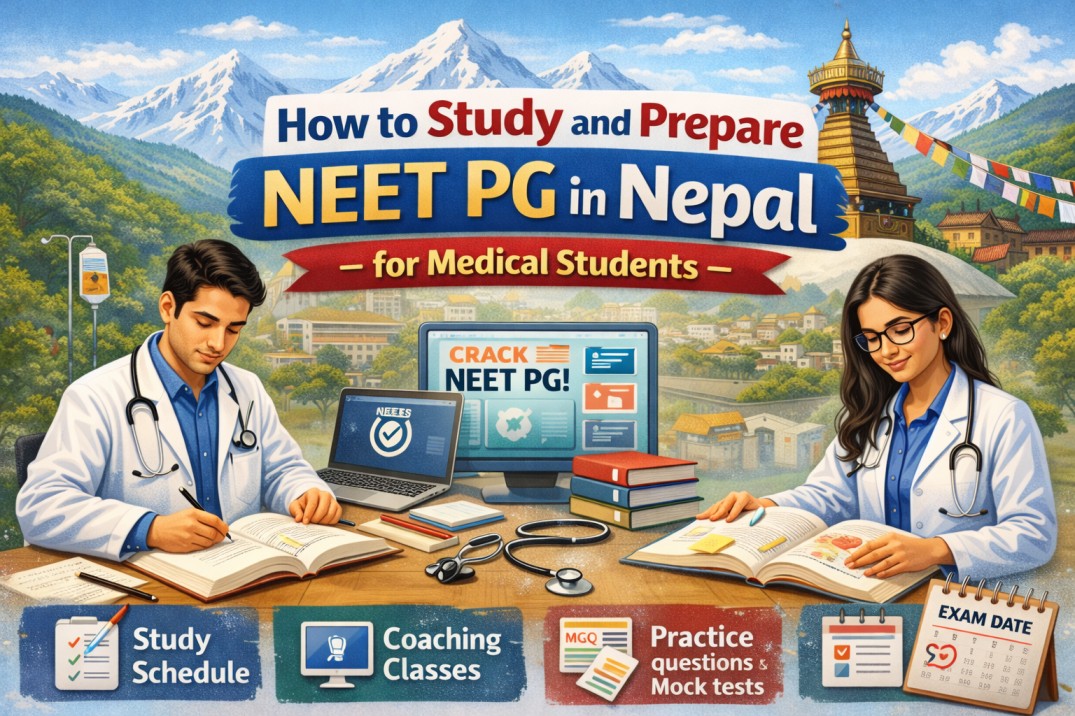
As more and more Indian students are now opting MBBS in Nepal, there will be a common problem which is how to manage their medical studies along with NEET PG preparation for securing postgraduate seats in India. Most of the medical colleges of Nepal have got curriculum that is globally recognized and ample practical exposure but doing good in college and NEET PG together takes a lot of planning, discipline and strategies.
For MBBS course and colleges in Nepal Visit, MBBS in Nepal. For more information on.
Understanding the Academic Framework
MBBS in Nepal is the stop for getting into a hotcake medical college and course following which there are quite striking similarities like:psychiatrics, anatomy, bio-chemistry etc are studied during 5.5 years duration including internship located inside Nepalese hospital. They have to adjust to this timetable by slowly preparing for NEET PG.
- Preclinical years (1st- 2nd year): -Emphasizing in Anatomy, Physiology and Biochemistry. The subject of early NEET PG preparation is revising these subjects throughout the academic sessions along with other classes.
- Para-clinical years (3rd year): Patho-physiology, Pharmacology, Microbiology and Forensic Medicine are concentrated on the most and constitutes maximum number of questions asked in NEET PG.
- Clinical years ( 4th – 5th year + internship ): The major clinical subjects being Medicine, Surgery, Obstetrics & Gynaecology, Pediatrics and Community Medicine . Students mix ward with NEET PG Preparation.
The curriculum is accredited by the National Medical Commission (NMC) and listed in WDOMS, which enables Indian graduates to apply for license exams and post graduate studies. The WHO international guidelines are also consulted during clinical training.
‘Morning: Early Research for Concept Retention
Usually, in Nepal, most of the MBBS students kick off their day around 5:30 – 6 a.m. utilizing this time for dedicated revision and preparation for NEET PG.
Morning Routine:
- Review of High-Yield Topics: Core topics (Anatomy/Physiology for preclinical students, Medicine/Surgery for clinical students.
- MCQs and flashcards: Little tests and flashcards help to work on memory.
- Plan for the day Assignment: Appropriate time allocation in lectures, ward duties and NEET PG study in evening.
One 3rd year MBBS student from India Meera says:
“Waking up early enables me to make NEET topics revisions without breaks and maintains consistency”.
Daytime: Class, labs and clinical time
“Fixed timings also include college academics as well as exposure.
-
Lectures and Tutorials:
Colleges function between 8:00 AM to 1:00 PM with a focus on subjects essential for both the MBBS exams and NEET PG studies. Many students keep notes (of NEET type) during lecture class then make a short note of any topic for each subject.
-
Practical Labs:
Tactile experience of Anatomygives the understanding of surgical procedures and is a strength where as Clinical Pathology, Biochemistry and Microbiology forms a base for NEET PG Questions. Students may also record in or take a summary from the practical session for their own subsequent use.
-
Ward Duties and Clinical Rounds:
Student contact with patients in the clinical years of 4th and 5th is for histories, physicals and minor procedures. Students relate these experiences with the NEET PG learning topics for better application-based learning.
Evening: Focused NEET PG Preparation
The nights are for hardcore NEET PG preparations.
- 5:00 PM – 8:00 PM – Practice questions, revising high yielding topics, going through previous year papers of NEET PG.
- Group discussions: Students participate in peer discussion, case-based learning and doubt removing classes.
- Clinical correlation: relating ward cases to NEET PG questions facilitates concept learning.
Many students also go to standard medical references and the global WHO guidelines for greater clarity.
Night: Consolidation and Rest
Evenings are for last-minute touch-up and relaxation:
- 8:30 PM – 11:00 PM –Second revision through weak topics, more practice solving MCQs and completing my notes.
- Rest: minimum of 6–7 hours sleep is necessary for long study and ward duty hours.
Regularity and continuity of the lifestyle is very important because you have to take care of both college studies as well NEET PG preparation.
Weekend Goal: PRACTICE MOCK and REVISION WEEKEND.
Weekends are often used for:
- Complete mock tests based on NEET PG pattern.
- Revisit weak topics and solve last years question papers.
- Attending departmental seminars or clinical discussions to reinforce applied knowledge.
This method leads to continuous progression in MBBS and NEET PG.
Tips for Students Balancing Both
- Time Management – Dedicate a fixed number of hours daily for NEET PG preparation and college studies.
- Synoptic approach : Integrate the ward cases and practical with high yield topics of NEET PG.
- Regularity over intensity: A short focused session every day is better than an occasional long session.
- Refer to good sources Trust MCQ Banks and standard reference books or study portals online.
- Confirm college recognition: Ensure that the college is recognised by NMC and included in WDOMS for being eligible Indian PG.
Conclusion
Studying for NEET PG while studying MBBS in Nepal To strike a balance between the MBBS education and preparation of NEET PG in Nepal, one needs discipline, planning and hard work. With the combination of morning study, mid-morning academics and evening NEET practice with mock tests on weekends all the four can be managed well by a student.
For full detail on MBBS admission, college and preparation guidelines please visit MBBS in Nepal. Standardising the learning format according to Global standards as laid by NMC, WHO, and WDOMS would make Indian graduates well versed with not only postgraduate studies but also medical practice within and outside India.