 Call Us:
  B3/51 Vibhuti Khand, Gomti Nagar, Lucknow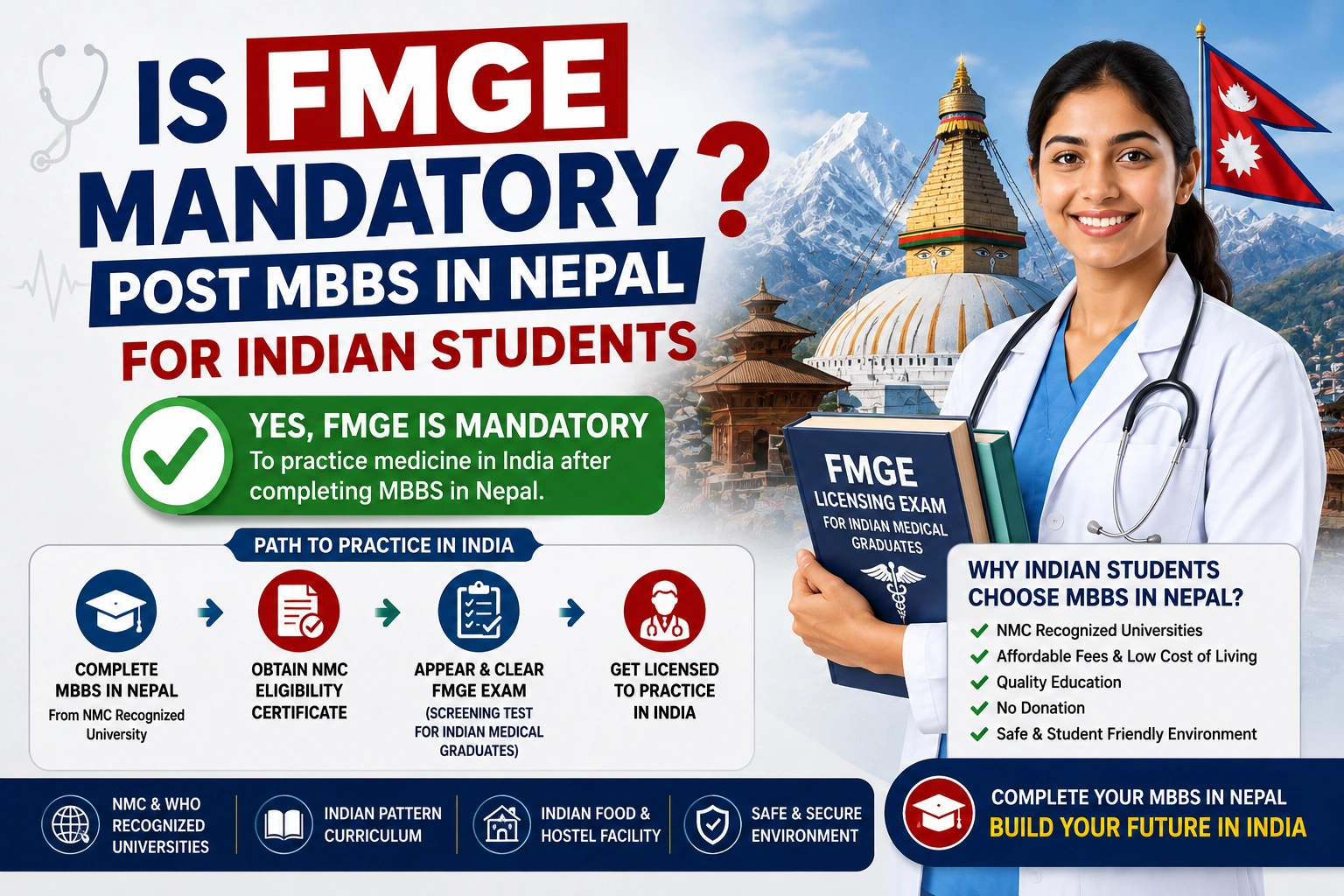
As per the regulations applicable to their admission and graduation, Indian students completing their MBBS or equivalent primary medical qualification in Nepal must clear the Foreign Medical Graduate Examination (FMGE) to obtain registration to practice modern medicine in India.
The proximity of Nepal to India or the possible recognition of a Nepali medical qualification for the practice of medicine in Nepal does not, of itself, exempt an Indian national from the requirements of licensing of Foreign Medical Graduates (FMG) by the National Medical Commission (NMC) of India. An individual obtaining a primary medical qualification in a foreign country, including Nepal, is considered an FMG by the NMC.
Thus, understanding FMGE prior to MBBS admission is crucial for Indian students intending to undertake MBBS in Nepal as it affects the choice of college, the structure of the course, the arranged internships, registration and eventual practice of medicine in India.
Why do Indian Students require FMGE After MBBS in Nepal?
FMGE conducted by the National Board of Examinations in Medical Sciences (NBEMS) in India is the licensing/screening examination for eligible foreign medical graduates. NBEMS states that its function is to conduct the screening examination, publish the result, and send the result to the NMC and the State Medical Councils.
The logic underlying this is simple; an Indian student who earns a medical degree from a foreign country has studied medicine in a foreign country and, therefore, must comply with the requirements of the country before the right to practise in the country is granted.
The NMC's current definition for an FMG is an individual who has not received their basic undergraduate medical qualification from an Indian medical institution and applies to practice medicine in India.
MBBS in Nepal → Foreign Medical Graduate → Meets NMC requirements → FMGE/Mandated Licensing Examination → Indian Registration → Practice of Medicine in India
The pathway can vary based on regulations that apply to the student's batch and the date when the foreign medical education was undertaken.
Does Nepal Get Any Special Exemption From FMGE?
Merely having Nepal on the border with open trade, education, and cultural interactions does not provide any special exemption to FMGE.
The Embassy of India in Kathmandu has, in the past, informed Indian students seeking medical degrees from Nepal that foreign medical qualifications do require the Indian screen test before registration is permitted for practicing medicine in India. That guidance definitively described the need for the foreign medical graduate screening test.
The NMC also made it very clear in its Screening Test Regulations that the screening-test requirement applies to Indian citizens who earn medical qualifications from foreign medical institutions. The NMC has very specifically addressed the Nepalese medical colleges in this regard.
Therefore, medical students cannot assume that an MBBS degree from Nepal allows them medical registration in India.
What Are the Current NMC Requirements for Foreign Medical Graduates?
For Foreign Medical Graduates under the Foreign Medical Graduate Licentiate Regulations, 2021, the requirements are more comprehensive than just a passing examination.
The NMC regulations mandate a 5-year foreign medical degree, a foreign medical internship of at least one year, English instruction, and study of the compulsory subjects. The graduate must also be registered with the professional regulatory authority in the country where the medical degree was awarded and complete the supervised internship in India.
This means an Indian student cannot just assess a medical college in Nepal based on tuition fees and course location. The structure and compliance with Indian requirements is equally important.
The NMC's June 2026 FAQ also confirms the minimum 5-year foreign medical degree requirement and the English-medium instruction requirement under the FMGL framework.
Is FMGE the Only Requirement After MBBS in Nepal?
No.
This is one of the primary concerns of Indian students.
Passing FMGE is a big first step, but there may be additional requirements within the NMC framework that you have to comply with. For those under the 2021 FMGL Regulations, the following are the requirements:
At least 54 months of Foreign Medical Education
A minimum of 12 months of Internship at the same Foreign Institution
Medical Education taught in English
Medical Education and Training in prescribed subjects
Registration / Licensure by the Medical Regulator in the country of qualification
An internship in India
Passage of the National Exit Test (or any other test prescribed by the Commission)
According to the 2021 regulations, foreign medical graduates cannot practice medicine in India until they obtain permanent registration as permitted by applicable regulations.
However, the NMC has also clarified that the FMGL Regulations do not apply to candidates who acquired their foreign medical qualification or were pursuing their Foreign Medical Education before the FMGL Regulations were published on 18 November 2021. Such candidates will be bound by the regulations applicable to them.
So, the regulations are batch-wise.
What About Students Who Started MBBS Before November 2021?
This is a very significant exception. According to the NMC’s FAQs, the FMGL Regulations do not apply to foreign medical graduates who acquired their foreign medical qualification prior to the effective date of these regulations, or to those candidates who were pursuing their undergraduate Medical Education abroad prior to the publication of these regulations, subject to the same exceptions. Such candidates will be bound by the earlier applicable Regulations.
Thus, a candidate from the Nepal MBBS batch preceding November 2021 cannot be classified under all the same assessment criteria as a candidate who has joined after November 2021.
Candidates must cross check their batch specific provisions regarding internships, licensing exams, and registrations with the NMC/NBEMS, before making their own assumptions.
Is NEET Mandatory to Study MBBS in Nepal?
Yes, as per the Indian laws, aspiring Indian students willing to pursue MBBS abroad need to clear NEET.
According to the NMC, Indian citizens and Overseas Citizen of India willing to obtain the primary medical qualification from a medical college abroad must clear NEET to study MBBS or equivalent abroad if they fulfill the necessary criteria.
The Embassy of India in Kathmandu has also shared with aspirants that, since 2019, qualifying NEET –UG is a pre-requisite for seeking admission for pursuing an MBBS or equivalent degree at a medical college abroad, and is also an eligibility criteria for the FMGE route.
Therefore, NEET and FMGE cannot be treated the same.
NEET = eligibility for pursuing medical education abroad
FMGE = licensing/screening requirement for eligible foreign medical graduates seeking to practice in India
Is the Nepal MBBS Degree Valid in India?
A medical qualification from Nepal is not considered the equivalent of an Indian MBBS to practice medicine in India.
The said qualification must meet the regulatory requirements of India. As per the FMGL framework, the primary medical qualification has to satisfy the required standards of the course, curriculum, duration, medium of instruction, and other related criteria.
Students should confirm the following before applying for admissions.
If the medical institution is recognized by the competent Nepalese authority.
If the qualification is ref-recognized and permits registration as a medical practitioner in Nepal.
If the course structure fulfills the NMC requirements.
If the course duration and internship conform to the Indian statutory requirements
If the college is providing the required clinical training.
If Indian students completing the course at the college have cleared the Indian licensing process.
The Medical Education Commission (MEC) of Nepal looks after the standards and the accreditation related issues of the medical education system of Nepal. Its current accreditation standards outline the requirements of the medical education programs and institutions.
How can Indian Students Verify Nepal Medical Colleges?
Before paying any admission fees, students should conduct the verifications themselves through the official sources and not wait for the consultancy advertisements.
Check Nepal’s Regulatory Status
The Medical Education Commission (MEC) publishes information in relation to medical education standards, accreditation and admissions. The official defense employment and ex-servicemen centrally controlled admission (DEE-EMoCA) system also publishes information in relation to foreign candidates and MBBS admissions.
Check Indian Regulatory Requirements
Students should check the latest version of NMC regulations and present FMGL FAQs (Foreign Medical Graduate Licentiate) before taking admissions. The NMC has an exclusive independent section for foreign medical education and publishes the Foreign Medical Graduate Licentiate Regulations and the related FAQs.
Check Degree Verification Requirements
As of now, the Embassy of India in Kathmandu states that applicants must have their medical degrees verified by the related university in Nepal and must be further made authentic by the Embassy's Consular Section under the relevant process.
This documentation will be important for graduates to validate their qualification at a later date.
Post-MBBS in Nepal:
An Indian student is typically required to follow several requirements to become eligible for practicing in India.
Required Medical Course:
Foreign Medical Programme requirements for the student’s respective batch must be completed.
Internship:
Internships must comply with the applicable Indian regulations. For students under the ambit of the FMGL Regulations, it states a 12-month minimum internship at the foreign medical institution in question must be completed along with the prescribed supervised internship in India.
Medical Registration in Nepal:
The FMGL Regulations state that the candidate must register with the relevant professional body, as per the applicable regulations.
Indian Licensing Examination:
India has a traditional FMGE route through which screening examinations conducted by NBEMS are cleared by eligible candidates. NBEMS confirms to the appropriate Indian authorities that it has conducted the FMGE screening examination and publishes the results.
It is advisable to monitor the NMC and NBEMS notifications on a continuous basis. This is due to the rapidly changing nature of India’s licensing framework.
Registration Requirements:
Once all examination and internship requirements are completed the graduate is authorized to approach the relevant authorities for registration.
Until such registration is obtained the graduate is not authorized to practice medicine in India.
Can Students Practice Medicine in Nepal Without FMGE?
FMGE stands for Foreign Medical Graduate Examination. It is not a test for practising medicine in Nepal.
An Indian graduate that wants to practice in Nepal must register and obtain a license from the relevant authorities in Nepal. The graduate must comply with the requirements of the Regulatory body in Nepal.
However, the students should consider the requirements of the NMC in India when they plan to practice medicine in India after completing their education.
Before admissions, students must check the curriculum, clinical training, and the placement of internships.
Is MBBS in Nepal a Good Option for Indian Students?
Looking at the map, NEPAL looks so close to INDIA. There is familiar culture and familiar travel connectivity. There are medical colleges that admit international students through special admission regulations. Recently, the Medical Education Commission in NEPAL published data on the MBBS admissions and matching for foreign candidates.
Affordability or proximity should not be the only deciding factors.
The most important question should be:
Is this particular medical program going to help me fulfill medical regulatory practices in India?
Students should analyze the total cost of the program, the quality and reputation of the medical education, hospital exposure, the internships offered, and the regulatory and license-granting recognition in India.
Common Mistakes Indian Students Should Avoid
Students doing MBBS in Nepal make the following mistakes:
- Assuming that NEPAL is so close to INDIA and assuming that they will get Indian registration automatically.
- Taking admission without qualifying NEET.
- Choosing a college based on low tuition fees
- Case a
- Using claim “FMGE is not needed for Nepal”
- Case b
- Overlooking the NMC's course duration and internship
- Case c
- Not confirming medical college's recognition
- Case d
- Not verifying all medical colleges in Nepal for continuity in clinical exposure
- Case e
- Not keeping original academic records
- Case f
- Not keeping original internship records
- Case g
- Not verifying the NMC/NBEMS licensing regulations
- Case h
- Reliance on education consultant’s verbal commitment
The Embassy of India in Kathmandu also advises students about agents and, in another context, states that it does not recognize applications submitted through unauthorized education consultants or middlemen.
Conclusion
Generally, Indian students can expect to clear the Indian foreign medical graduate licensing/screening requirement after completing MBBS in Nepal to practice medicine in India.
Nepal's closeness to India does not eliminate Indian licensing requirements. The NMC regulations define foreign medical graduates and prescribe conditions for obtaining registration in India.
For students admitted to medical colleges under the post-reform regulatory regime, possession of a medical degree from Nepal is not sufficient. They must ensure that the course duration, teaching medium, curriculum, internship, registration in Nepal, and Indian licensing requirements are in accordance with the rules of their respective batches.
Before confirming admission, students are advised to check real time information directly from the National Medical Commission (NMC),WDOMS, WHO, the National Board of Examinations in Medical Sciences (NBEMS), the Medical Education Commission (MEC) of Nepal, and the Embassy of India in Kathmandu, as the need arises.
The safest option for NEET aspirants from India is to select a medical college in Nepal only after confirming the college’s regulatory status and determining the implications of the college’s program on the existing Indian Foreign Medical Graduate framework. Regulations will eventually change, and therefore, the most recent official announcement should be used as the basis over claims made by consultants or other websites.