 Call Us:
  B3/51 Vibhuti Khand, Gomti Nagar, Lucknow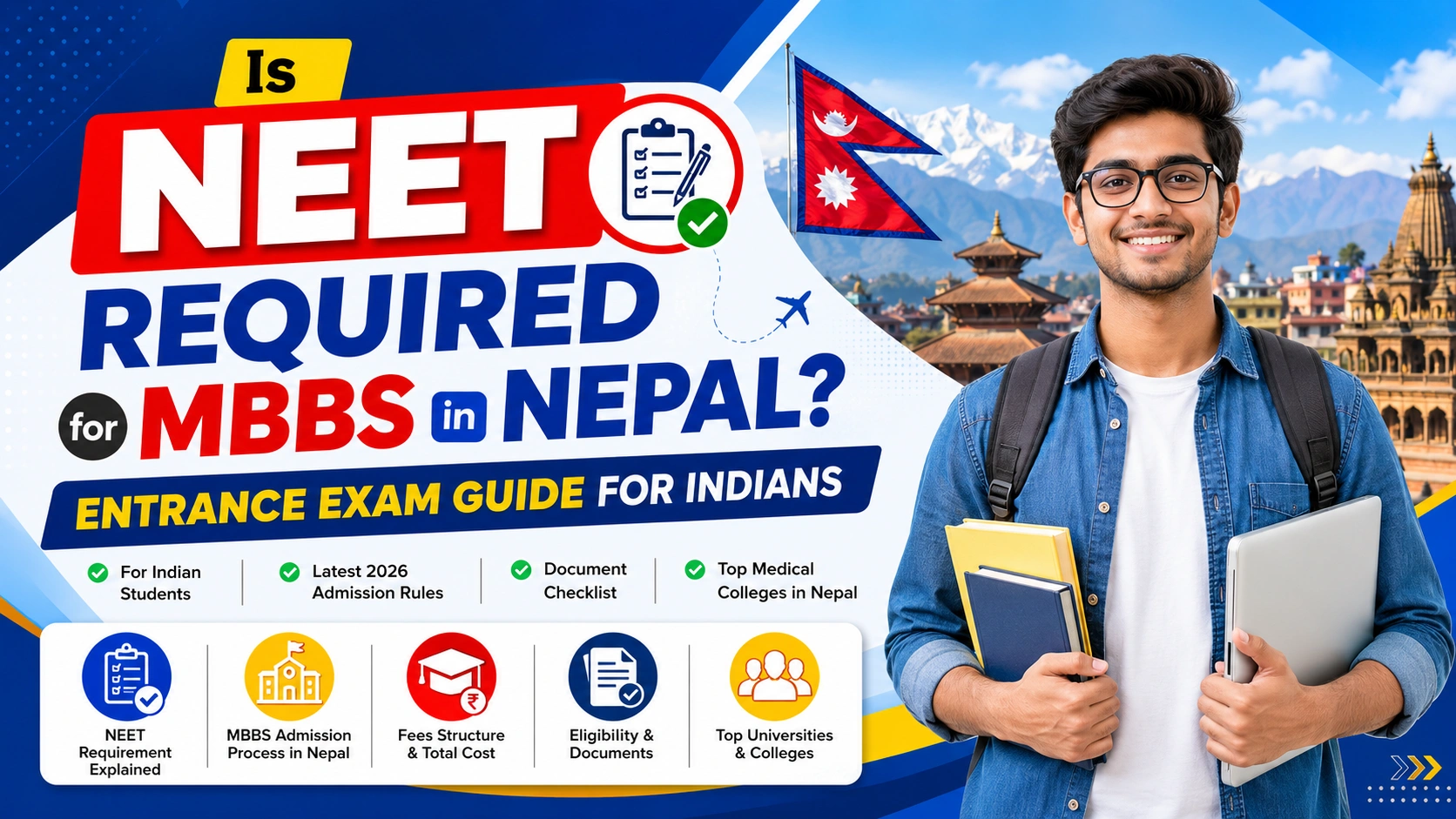
Many Indian students are now interested in studying medicine in Nepal because of Nepal’s proximity to India, a similar culture, an English language option in medical studies, and a familiar way of life. However, before applying, a question many students have is: Is NEET required for MBBS in Nepal?
Answer: Indian students must understand the admission criteria of the Nepalese medical schools and the criteria Indian students must fulfill to acquire the right to practice medicine in India after having earned their medical degree from abroad.There are some advantages to studying MBBS in Nepal. However, students must not base their decisions on low fees or easy admissions. The requirements for entrance examinations, university accreditation, course content, clinical practice, overall cost, and future licensing must be examined.There are several other relevant factors that students should consider. This guide will include everything from the criteria for NEET, admissions, costs, leading universities, advantages, disadvantages, and careers.
Is NEET Required for MBBS in Nepal?
For Indian nationals, qualifying NEET is a must if they opt to pursue MBBS abroad, and if they wish to follow their dream of serving and practicing medicine in their motherland, under the rules and regulations of the National Medical Commission (NMC). However, students should also check for university-specific requirements and the medical entrance/selection procedures of Nepal.Students are advised to check with the university, preferably the Nepalese authorities, and the National Medical Commission (NMC) that are concerned, for their latest requirements, before making an application.Students planning to obtain an MBBS degree from Nepal must understand that the NEET (national) examination is of utmost relevance and importance for those who plan to return to India to pursue medical registration or licensure.The official website of NEET is a crucial source for information related to the examination, and it provides information regarding the examination schedule, notifications, result, and other related information.
Qualifying NEET does not offer automatic admission to medical colleges in Nepal. Along with NEET, there are certain other requirements such as minimum marks, academic requirements, university admission requirements, entrance examination or merit admission, and the documentation requirements, and the candidates must also fulfill the medical fitness requirements.It is important for students to learn about the latest rules for admissions before they apply.While a medical university may have its own criteria for admission, Indian students should consider whether their qualification will meet the requirements for medical practice in India.
Eligibility Criteria for MBBS in Nepal
While individual university requirements can vary, Indian students are usually expected to meet academic requirements in science related subjects.
Basic Eligibility Requirements
|
Eligibility Factor |
General Requirement |
|
Educational Qualification |
Class 12 or equivalent |
|
Required Subjects |
Physics, Chemistry, and Biology |
|
Minimum Marks |
Depends on applicable university |
|
NEET |
Important for Indian students planning to apply for future eligibility in India |
|
Age |
Depends on the requirement of the university |
|
Medical Fitness |
Required by many institutions |
|
Passport/Documents |
Required for admission and travel purposes |
Are you passionate about studying mbbs in Nepal for Indian students? Please check the requirements carefully for your selected university.
Entrance Exam Requirements for MBBS in Nepal
The admissions process involves understanding the entrance exam and therefore, it has a lot of importance.
The way the medical education system of Nepal functions may require prospective students to appear for either a central level examination/admission procedure or individual institution-specific examinations. Based on the policy in force at a given time, prospective students should not assume that they can secure admission on the basis of Class 12 marks alone.
mbssubmissions
Researching the mbbs in Nepal fee should include a total financial estimate rather than just tuition.
Cost Estimates
|
Component |
Considerations |
|
Tuition |
Varies by university |
|
Hostel |
Varies by accommodation |
|
Food |
Lifestyle, location |
|
Books and study materials |
Additional academic costs |
|
Travel |
India-Nepal travel |
|
Personal |
Daily needs, mobile, transport |
|
Others |
Medical insurance, other charges |
Students must review the Nepal mbbs fees for indian students and should request a written fee structure from the universities.
Duration of MBBS in Nepal
The duration of the program includes both the academic and the clinical practice component.
When students research the mbbs in Nepal during the duration of the different programs, they must confirm the total duration, the internships, and the structure of the clinical practice with the respective institutions.
It is essential to appreciate that completing just the classroom component is not sufficient for the professional requirements. Therefore the entire program should be analyzed in detail.
Top Medical Universities in Nepal for Indian Students
There are a good number of medical institutions in Nepal that offer medical education and clinical practice. While selecting a university, students must conduct their own assessments beyond what is provided in the advertisements.
Some famous names in medical education in Nepal include:
- Tribhuvan University Institute of Medicine
- Medical institutions affiliated with Kathmandu University
- B.P. Koirala Institute of Health Sciences
- Patan Academy of Health Sciences
Prospective students are urged to check the admission and university information on the respective websites.
They can also look at the World Directory of Medical Schools (WDOMS) for their research into medical schools. However, students must understand that simply being in a listed directory is not an assurance of the right to apply for medical registration in any country.
Why Study MBBS in Nepal?
Studying in Nepal has many advantages that draw Indian students and families.
1. Convenient Travel
Nepal's proximity to India makes travel easy.
2. Similar Culture
Food, festivals, social culture, and lifestyle are similar and easy to adapt to.
3. Easy to Adjust to the Academic Environment
Many medical programs are taught in English.
4. Clinical Training Opportunities Available
Medical colleges allied to teaching hospitals will help students with practical clinical training.
5. Better Adjustment for Students
For many students, living in Nepal is easier compared to moving to a far-away country.
Students looking to study MBBS in Nepal will need to compare universities carefully to avoid making the mistake of assuming they are all the same.
Limitations and Drawbacks
Challenges do exist with the advantages.
1. Higher Education Costs
The costs of studying in Nepal tend to be higher compared to education in other nations.
2. Expanding the List
Feel free to elaborate on your thoughts and add more to this list.
As you can see, Nepal offers a number of great features. It also has some disadvantages that you may want to consider. Keep in mind though that international medical schools will also have their drawbacks that you will need to think about as well. Take the time to look into several international medical schools and then weigh the pros and cons of each.
Competitive Admission
Depending on the specific rules and regulations of the institution, some admission procedures can be competitive.
Limited Seats
Some medical institutions can be very popular and consequently have limited international seats.
Licensing Requirements
Returning Indian students should pay attention to the requirements that apply to them for practice in the medical profession when they return to India.International students can find ways to compare outcomes of the FMGE pass percentage Russia vs Nepal through the resources that are available, but the outcome of the medical exams should be interpreted with great care as results of exams can be due to many reasons, including the quality of students, the standard of universities, the preparation of students, and many other factors.
Recognition And International Medical Standards
Before choosing a medical university, students must check information that is provided on trustworthy portals.The World Health Organization (WHO) has information and resources on global health. On the other hand, the WDOMS directory provides information on the listed medical schools.Students must understand that various organizations have different functions. Just a listing on one site or reference in another directory does not mean that a medical school is recognized for licensing in other countries.
Always ensure that:
- University recognition is maintained.
- The duration of the course is acceptable.
- Instructions are provided in a language the student can understand.
- Clinical practice is part of the program.
- An internship is included.
- It meets the requirements of Indian regulations.
Career Opportunities After MBBS in Nepal
After completing the medical degree, prospective candidates may practice medicine in the country of their choice, subject to the laws and regulations of that country and licensing requirements.An Indian student has the options of either choosing the remaining part of the MBBS course in Nepal or pursuing a postgraduate degree in medicine after meeting the necessary requirements. They can enroll in postgraduate medical education, hospital jobs, basic medical research, public health administration, health services administration, medical education, etc.Returning Indian students should track the recent updates and changes made by the NMC and other relevant departments.
Is MBBS in Nepal good for Indian Students?
Nepal can be a good option for an Indian study destination for several reasons. These include the geographical closeness, cultural proximity, English-medium schools, availability of clinical facilities etc.However, a student should not consider the advertisements, rankings and offers of easy admissions while making the decisions.
An informed decision should depend on the following factors:
- NEET scoring
- University Admission standards - whether they require entrance exams separately as well
- Cost of the entire program
- Clinical training standards
- Course Duration
- Post-study professional needs
- Recognition of the degree by Regulatory bodies
These are some parameters which should be considered before making the decision to study MBBS in Nepal.
Frequently Asked Questions
Do Indian students need to give NEET for MBBS in Nepal?
NEET qualification is a requirement for Indian students to retain the right of practice of medicine in India (subject to the laws in effect at the time). Furthermore, Indian students may be required to sit for an entrance exam conducted by the university.
Are Indian students eligible to do MBBS in Nepal?
Students from India are eligible to apply for study seats in medical colleges of Nepal, provided they fulfill the eligibility criteria of those institutions.
Is there a separate entrance exam for MBBS in Nepal?
Admission procedures depend on regulations and the institution. Students are advised to look into the latest updated entrance and selection criteria.
What is the MBBS fee in Nepal for Indian students?
Fees and other expenses differ from university to university. Students are advised to contact their selected university for the latest official fee structure.
Is MBBS in Nepal taught in English?
Though many medical universities use English as a primary medium of instruction, students are advised to check the university’s language policy.
Can I practice in India after completing MBBS in Nepal?
Students have to meet the Indian licensing and regulatory requirements that are applicable at that time to apply for registration and medical practice. Students should also be aware of the latest official NMC regulations.For Indians, the prospect of studying MBBS in Nepal is attractive due to the proximity and similarity in culture and educational quality. However, it is advisable to make a decision only after checking verified details from the universities and regulatory bodies.Prior to university selection, always conduct comprehensive research and draw comparisons to choose the latest admission policy compliant medical program that will help you achieve your educational and career goals.