 Call Us:
  B3/51 Vibhuti Khand, Gomti Nagar, Lucknow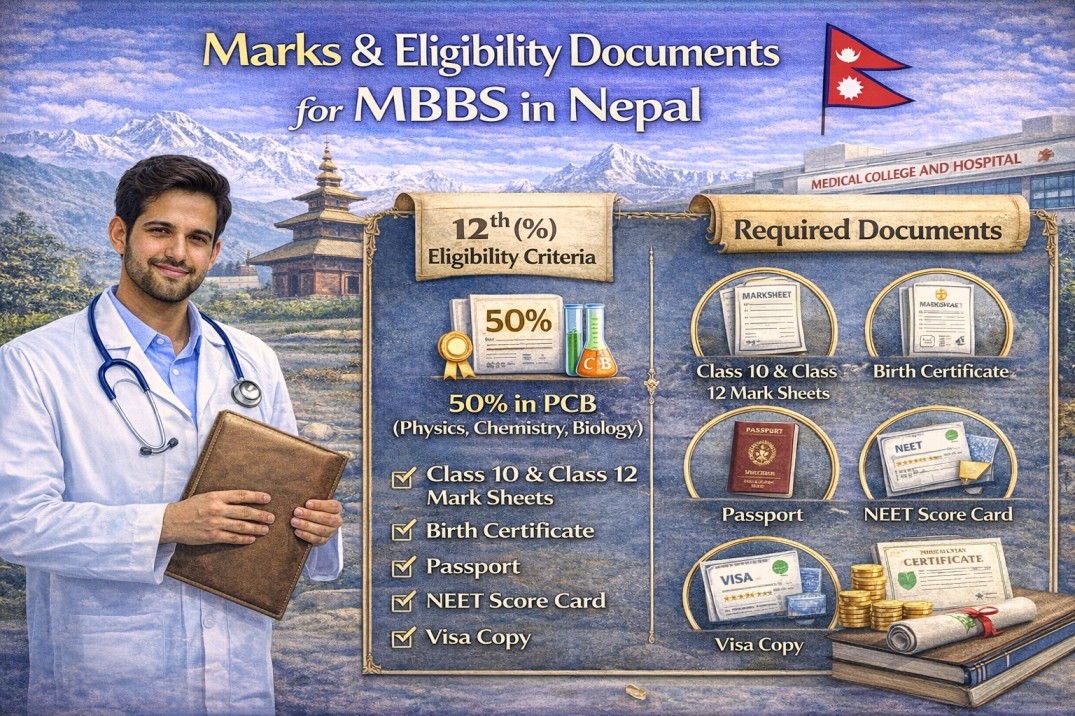
Nepal has become one of the most popular tourist destinations for Indian medical students seeking to study MBBS abroad. With a low fee structure and a similar schooling pattern to one in India with MBBS, Nepal stands out as a popular choice for Indian students wishing to become a Doctor. But before applying, students and parents need to be sure about the 12th mark eligibility for MBBS admission in Nepal and the required documents.
Illustrative of this is the complete details in the guide, which includes information on academic eligibility, NEET requirements, documentation, and regulatory approvals – to help you plan ahead for admission into 2025+ with confidence.
Why are the Eligibility Criteria Important for MBBS in Nepal
Universities of medicine in Nepal have a systematic selection system similar to global and Indian medical education. Proper eligibility ensures that students:
- Meet academic competency requirements
- Stay eligible for license exams in India
- Avoid issues during degree recognition
- Adhere to the protocols stipulated by bodies like the National Medical Commission (NMC)
Knowing who is and isn't eligible upfront could prevent rejection, delays, or future licensing issues.
Minimum 12th Marks Required For MBBS In Nepal
Academic Qualification
Indian candidates are required to have passed the following subjects in order to be eligible for MBBS in Nepal.
- Class 12 (10+2) or equivalent
- From a recognized board like(CBSE, ISC, Stateboard or any Equivalent Board)
Subject Requirements
The compulsory subjects of Class 12 are:
- Physics
- Chemistry
- Biology (Botany & Zoology)
- English
Each subtest must be passed separately.
Minimum Percentage Criteria
- General Category: 50% aggregate in PCB is essential.
- For Reserved Category (SC/ST/OBC) candidates: 40% in aggregate of PCBs.
These standards also coincide with NMC norms for Indian students going overseas for medical education.
Is it compulsory to qualify for NEET to study MBBS in Nepal?
Yes. NEET eligibility is a must for Indian applicants who would like to:
- Study MBBS in Nepal
- Graduated and work as a doctor in India
Even if the student gets admission in a university without NEET, they cannot practice medicine in India.
Key points:
- NEET Score Validity: 3 years (as per the latest norms)
- Minimum qualifying percentile required
- To be produced at the time of admission NEET scorecard
NEET is mandatory for application due to subsequent NMC rules and NExT government exam eligibility.
Age Criteria for MBBS Admission in Nepal
- Age: Minimum 17 years by 31 Dec of the admission year
- No upper age limit (as far as present guidelines)
Even if a student is performing at the minimum age-structured level, they are not eligible to attend.
List of Mandatory Eligibility Documents
To get admission in MBBS in Nepal, applicants need to be ready with the following documents:
Academic Documents
- Class 10 Marksheet & Certificate
- Class 12 Marksheet & Certificate
- School Leaving Certificate
- Migration Certificate
Entrance Exam Documents
- NEET Scorecard
- NEET Admit Card
Identity & Personal Documents
- O Passport (must be valid for at least 18 months)
- Birth Certificate (if required)
- Aadhar Card (optional but useful)
Medical & Legal Documents
- Medical fitness certificate
- HIV test report
- COVID, or vaccine certificate
- Police clearance certificate
Passport & Visa Documents
- Passport-size photographs
- Student visa documents
- Offer letter from the medical university
All papers will be in good, clear condition and correctly scanned.
University Recognition & Regulatory Approvals
It is very important to select an accepted college for the credibility of the degree, which will affect career prospects. Medical colleges in Nepal are popular because they are listed under:
- World Health Organization (WHO)
- World Directory of Medical Schools (WDOMS)
- Recognized for eligibility by NMC
Graduates of those schools are eligible for:
- NExT (India)
- USMLE (USA)
- PLAB (UK)
- Other international licensing exams
Why Indian Students Choose Nepal for MBBS
There are many reasons why Nepal is visited:
- No language barrier (English-medium education)
- Similar curriculum to Indian medical colleges
- Cultural and food similarity
- Affordable tuition fees compared to private Indian colleges
- Short travel distance and easy connectivity
These benefits, along with easy admission criteria is it no surprise that studying MBBS in Nepal is an appropriate and reliable option.
Common Eligibility Mistakes to Avoid
- Applying without a NEET qualification
- Not meeting PCB percentage criteria
- Submitting incomplete or mismatched documents
- Choosing non-recognised universities
- Ignoring passport validity timelines
By avoiding these errors, you can make the process of admission go a lot more smoothly and help to keep your licenses safe down the road.
Final Checklist Before Applying
Before submitting your application, ensure:
- Required PCB percentage achieved
- NEET qualified
- Passport ready
- Documents scanned and verified
- WHO and WDOMS medical university are congruent
- Eligibility in accordance with NMC standards
Conclusion
Knowing about the 12th marks criteria and eligibility documents for MBBS in Nepal is the first step towards a successful international medical career. With satisfactory academic merit, NEET marks , and other required documents in place, Indian students can easily opt for an MBBS in Nepal to get a global medical degree.
Nepal is and will remain the only safe, affordable, and academically viable destination for Indian medical aspirants - a brilliant buy for 2025 & beyond.