 Call Us:
  B3/51 Vibhuti Khand, Gomti Nagar, Lucknow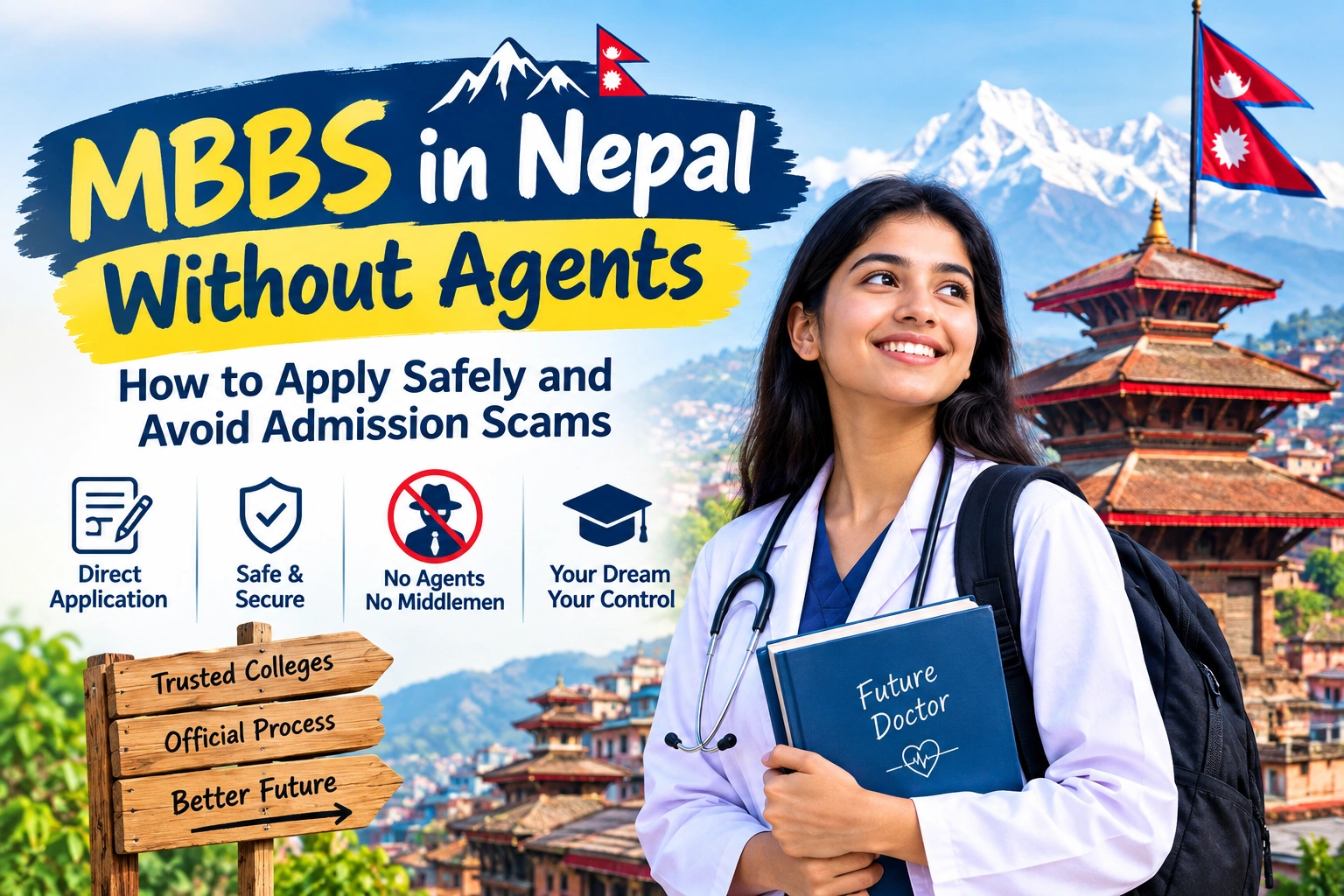
For many Indian students, studying medicine in Nepal looks straightforward. The country is close to India, several medical colleges offer MBBS programmes, English is widely used in medical education, and travelling home is much easier than from many other study-abroad destinations. But there’s one part students often underestimate: the admission process. A student may find a college through Google, WhatsApp, Instagram or a consultancy and then suddenly hear, “Pay the booking amount today or the seat will go.” That’s where things can get messy. The good news? You can apply for MBBS in Nepal without an agent if you’re willing to verify documents, contact the college directly and keep control of your payments. You don't need to depend on someone simply because they claim to have a “direct quota” or “guaranteed seat.” Here’s how to do it safely.
Can Indian Students Apply for MBBS in Nepal Without an Agent?
Yes, students can explore and apply directly, but the exact admission route depends on the medical college, university and applicable rules for the academic year. The safest starting point is the medical college's own admission office. Ask for the official admission notice, eligibility requirements, fee structure, required documents and payment instructions. Don't rely only on a PDF forwarded by an agent. For general information about studying medicine in Nepal, students can also explore MBBS in Nepal and then independently cross-check important details with the college. Honestly, this extra verification takes a little time. It can also save your family lakhs of rupees.
Is NEET Required for MBBS in Nepal?
For Indian students, NEET isn't something you should simply ignore because the college is outside India. The National Medical Commission has stated that Indian citizens/OCI candidates seeking admission to an MBBS or equivalent medical course outside India are required to qualify NEET, subject to the applicable regulations.
The official NEET UG website currently provides information for NEET-UG 2026 and confirms NEET as the common entrance examination for undergraduate medical education. So if someone tells you, “You don't need NEET for Nepal, just pay the admission fee,” stop there. Ask for the rule in writing. And check the latest NMC requirements before making any payment because regulations can change.
What Eligibility Should You Check?
Before contacting a college, keep your basic academic information ready.
Generally, an Indian MBBS applicant should check requirements related to:
- Class 12 or equivalent qualification
- Physics, Chemistry and Biology/Biotechnology
- English
- Minimum qualifying marks as applicable
- Age requirements
- NEET qualification
- Passport and identity documents
- Any Nepal-specific entrance or admission requirements
Don't assume that meeting one college's eligibility automatically means you meet every requirement for studying medicine abroad and later seeking registration in India. That's two different questions. Your college must accept you, and your degree must also fit the requirements applicable to foreign medical graduates in India.
How to Verify a Nepal Medical College Before Applying
This is probably the most important part of the entire process. Start with the college's official website. Check the name of the university, medical programme, campus address, teaching hospital, admission office contact details and current admission notice. Then check the institution through the World Directory of Medical Schools where applicable. WDOMS is a searchable directory of medical schools worldwide and provides institutional information, but being listed in a directory by itself shouldn't be treated as a blanket guarantee that a graduate automatically qualifies for medical registration in India.
The WHO also references the World Directory of Medical Schools as a resource within its health workforce information. For an Indian student, the more important question is still this: Does the college and your planned course satisfy the current NMC requirements for foreign medical graduates? Check the latest NMC regulations directly rather than trusting a sales pitch.
NMC Rules: The Part Students Shouldn't Skip
A foreign medical degree isn't automatically equal to an Indian MBBS for registration purposes. The NMC's Foreign Medical Graduate Licentiate framework includes requirements concerning the foreign medical qualification, duration, medium of instruction, clinical training and other conditions. The NMC's published FAQ, for example, specifies a minimum duration of 54 months and English as the medium of instruction under the applicable FMGL framework.
NMC's current rules-and-regulations section also lists the Foreign Medical Graduate Licentiate Regulations, 2021 and a newer FAQ dated June 2026, so students applying now should check the latest material rather than relying on an old YouTube video or a five-year-old consultancy article. And then there is the licensing stage after graduation. The exact pathway applicable to you needs to be checked against the rules in force at that time, including the role of NExT or other licensing requirements if applicable. Don't make your college decision only on tuition fees.
How Much Does MBBS in Nepal Cost Without an Agent?
The cost varies considerably by college, category and university. As a broad planning figure, Indian students may see total MBBS-related expenses in Nepal running roughly around ₹45 lakh to ₹75 lakh or more for the full course, depending on the institution and lifestyle. Treat this as a planning range, not an official fee quote.
Your actual budget can include:
- Tuition and university charges
- Admission or registration charges
- Hostel fees
- Food
- Examination charges
- Books and equipment
- Travel between India and Nepal
- Insurance or medical expenses
- Visa or documentation-related costs, where applicable
- Personal expenses
- Internship-related expenses, if any
A direct applicant has one advantage here: you can ask the college for a written fee schedule instead of accepting an agent's “all-inclusive” figure. Ask specifically, “What is included in this amount, and what will I have to pay separately?” That one question catches a lot.
How to Apply Directly: Step-by-Step
1. Shortlist the Medical Colleges
Start with three to five colleges rather than choosing the first one you see online. Compare the university affiliation, hospital facilities, clinical exposure, location, accommodation, admission requirements and total expected cost.
2. Contact the College Directly
Use the contact details published on the official college website. Send an email or call the admissions department. Ask for the latest admission brochure, application form and fee structure. If the person refuses to identify the college office or insists that all communication must happen through WhatsApp, be careful.
3. Verify Your Eligibility
Share your academic documents only through appropriate official channels. Confirm whether your NEET status, academic qualifications and other documents meet the current admission requirements.
4. Get the Offer or Admission Confirmation
Before paying, ask for written confirmation containing your name, programme, academic year, fee details and payment instructions. Read every line.
5. Pay Only Through an Official Channel
This is where students should be extremely strict. If the college says tuition must be paid to a specific institutional bank account, don't transfer the money to an individual's personal account simply because an agent says, “Sir, this is our manager's account.” No. Ask the college to confirm the account details by official email.
6. Keep Every Receipt
Save the application form, admission letter, fee receipt, emails, bank transaction details, passport copies and submitted documents. Create one folder on your laptop and another secure backup. It sounds boring. Later, you'll be glad you did it.
Common MBBS Admission Scams to Watch For
Some warning signs are surprisingly obvious once you know what to look for.
“Guaranteed Seat” Offers
A genuine medical admission process usually isn't something where an unknown person can magically guarantee your seat for an extra payment.
Fake Discount Deadlines
“Pay ₹5 lakh tonight or the fee becomes ₹10 lakh tomorrow.” Pressure is a classic tactic. Ask for the official fee notice.
Personal Bank Accounts
If you're told to transfer a large admission amount to a personal account, don't rush. Verify the payment instructions directly with the college.
Fake Admission Letters
A PDF with a college logo isn't proof that the document is genuine. Contact the college admissions office independently and ask them to verify the letter.
Unrealistic Fee Claims
If one person promises a complete MBBS degree for dramatically less than the figures quoted by the college itself, investigate before celebrating. Cheap isn't always fake. But an unexplained price difference deserves questions.
“NMC Approved” Without Proof
This phrase gets thrown around casually. Ask exactly what the person means. Is the institution recognised in Nepal? Is the qualification registrable there? Does the programme satisfy the current requirements relevant to Indian foreign medical graduates? Those are much better questions.
What Documents Should You Keep Ready?
A typical application may require documents such as:
- Passport
- Class 10 certificate
- Class 12 certificate and marksheet
- NEET scorecard
- NEET admit card, where applicable
- Birth or age proof
- Passport-size photographs
- Medical fitness documents, if required
- Migration or transfer certificate, if required
- Other documents requested by the university or college
Don't send original certificates through an unknown courier or intermediary without a clear reason and official acknowledgement.
Advantages of Applying Without an Agent
Direct admission isn't for everyone, but it has some real advantages. You communicate with the institution yourself. You see the actual fee structure. You can ask uncomfortable questions without a salesperson sitting between you and the college. You also reduce the risk of paying an unnecessary consultancy charge. But there's a trade-off. You have to do your own verification. For a student planning MBBS in Nepal, that's not necessarily a bad thing. In fact, understanding your college, university affiliation, fees and post-graduation requirements before joining is part of being a responsible applicant.
FAQs
Is it possible to study MBBS in Nepal without an agent?
Yes, students can approach medical colleges directly and follow their official admission procedures. Always verify the current admission process with the institution.
Can Indian students go to Nepal for MBBS without NEET?
Indian students should not assume that Nepal is an exception to India's NEET requirement. Current NMC rules require Indian citizens/OCI candidates seeking MBBS or equivalent medical education abroad to qualify NEET, subject to the applicable regulations.
Is WDOMS listing enough for an Indian student?
No. WDOMS is useful for checking medical school information, but students should separately verify the current NMC requirements and the institution's recognition and registration status.
How much money is required for MBBS in Nepal?
A rough planning range can be around ₹45 lakh to ₹75 lakh or more for the full course, but actual costs vary by college and personal expenses. Always obtain the latest written fee structure before paying.
Can an agent guarantee admission to a Nepal medical college?
Be suspicious of anyone promising a guaranteed seat in exchange for urgent payment. Verify admission directly with the college.
Is MBBS in Nepal a good option for Indian students?
It can be a practical option for some students, particularly because of geographical proximity and the availability of English-medium medical education. But the right college matters more than simply choosing Nepal. Check recognition, curriculum, clinical training, fees and the current Indian licensing requirements before enrolling.
Conclusion
Applying for MBBS in Nepal without an agent isn't about avoiding every consultant or trying to do everything alone. It's about making sure that you remain in control of the important decisions. Verify the college. Check WDOMS where relevant. Read the latest NMC regulations. Confirm NEET requirements. Get the fee structure in writing. Pay through official channels. Keep receipts. And if someone tells you that you need to pay immediately because “only one seat is left,” take a breath first.
A genuine medical admission decision deserves more than a rushed WhatsApp message. For students researching MBBS in Nepal, the safest approach is simple: use online resources to shortlist your options, then verify the final admission, fee and regulatory details directly with the medical college and the relevant official authorities before making any payment.