 Call Us:
  B3/51 Vibhuti Khand, Gomti Nagar, Lucknow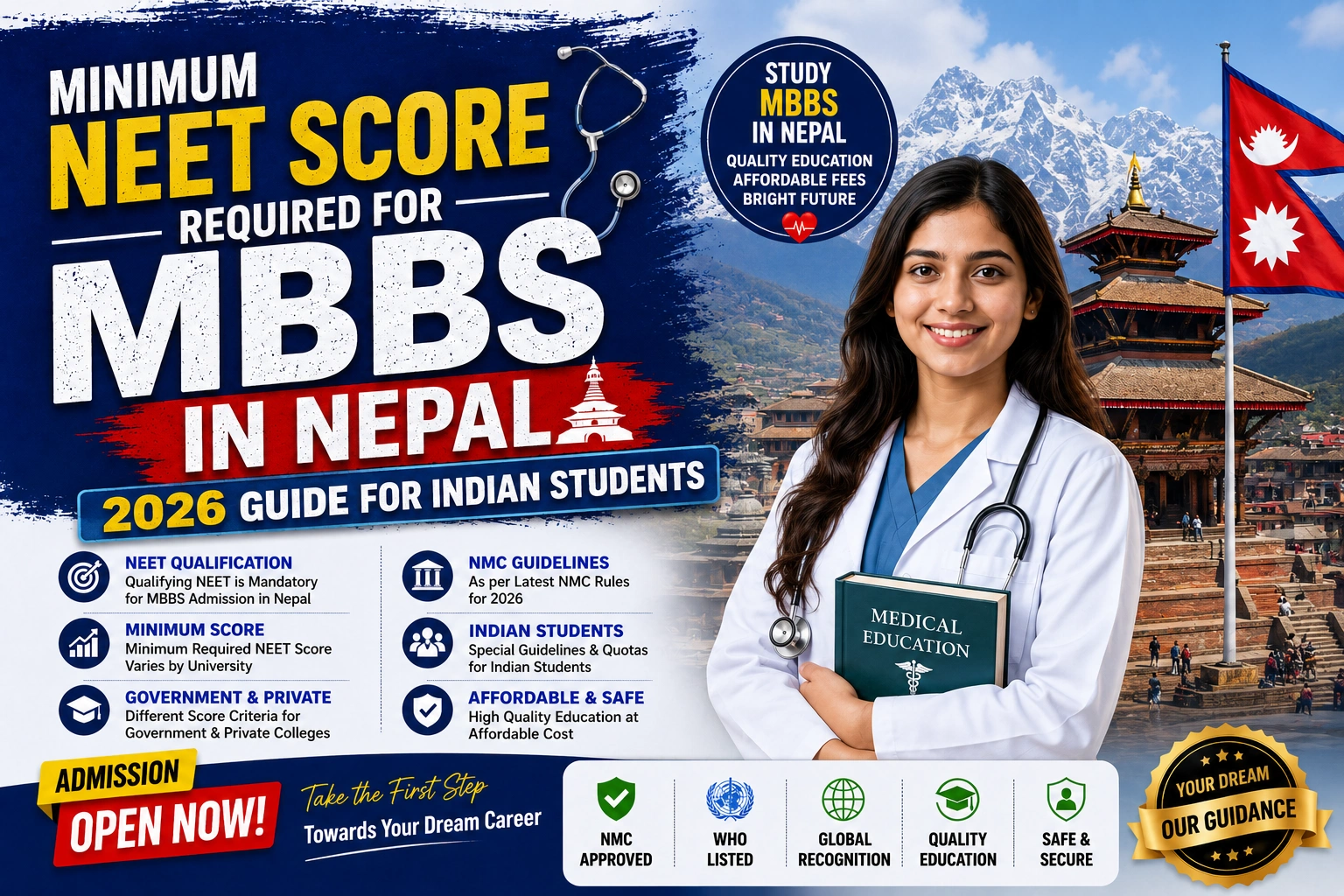
For Indian students planning to apply for undergraduate medical programs overseas, Nepal has long been the preferred destination to pursue an MBBS degree. The vast majority of students preparing to submit applications for the 2026 intake all raise the core question shared by all applicants: What is the minimum NEET score required to apply for an MBBS in Nepal for 2026?
First, it must be clarified that NEET is a mandatory requirement that all relevant applicants must meet. According to official regulations released by India’s National Medical Commission (NMC), all Indian students studying medicine in Nepal who plan to return to India to practice after graduation must pass the NEET exam. Without a passing NEET score, their Nepali medical degrees cannot obtain Indian certification for medical practice, nor can they participate in Indian physician registration or the subsequent national licensing examination for practicing doctors.
Next, we break down the logic of the minimum score requirement. The final qualifying threshold will follow the official NEET percentile line published in 2026, with corresponding official percentile requirements set for different candidate groups, including General, OBC, SC/ST, and other categories. It should be noted that the actual raw exam score corresponding to each percentile fluctuates annually, based on the difficulty of that year’s exam papers and the overall performance of all test-takers in that cohort.
We have compiled an estimated 2026 score range for reference only, and we specifically remind all applicants that this estimated score does not represent any guarantee of admission.
Many applicants also ask whether meeting only the NEET qualifying line is sufficient to submit a successful application. Currently, most private medical colleges in Nepal only require applicants to pass the NEET qualifying line, meet basic academic requirements, submit complete application materials, and that the college still has remaining enrollment slots to offer admission. Only a small number of top-tier medical colleges, when the number of applications far exceeds their planned enrollment quota, will prioritize admitting applicants with high NEET scores.
Applicants with higher scores also have more options when choosing which institutions to apply to.
NEET Score Requirements for MBBS in Nepal
Indian candidates planning to apply for the Bachelor of Medicine and Bachelor of Surgery (MBBS) program at Nepalese medical schools must first clarify the score matching rules for India’s National Eligibility cum Entrance Test (NEET).
India’s official MBBS admission system divides candidates into tiers based on their NEET scores.
Higher scores not only grant candidates priority to secure seats at top-tier medical institutions, but also improve their odds of being approved for various scholarships.
Beyond the core threshold of passing the NEET, Indian authorities also require applicants to meet stipulated age requirements, and complete all mandatory subjects during their 12th grade year.
Specifically, the combined total score for the Physics, Chemistry, Biology (PCB) subject group must reach 50%; only the score requirements for reserved category candidates may be relaxed independently by each admitting institution.
Against the backdrop of cutthroat competition for domestic MBBS seats in India, Nepal’s core advantage—its ability to accept candidates with mid-range NEET scores—perfectly fits Indian students who passed the NEET assessment but failed to secure a government MBBS seat in India.
Can Students with Different NEET Scores Apply?
Many candidates ask two core questions:
- Will Nepalese institutions administer a separate entrance exam?
- Can candidates with NEET scores across all score bands submit applications?
Specifically, candidates with scores of:
- 150
- 250
- 300
- 400+
all have matching Nepalese institutions suited to their profiles, and Nepalese authorities have not implemented any additional unified entrance exam.
The core factors that ultimately affect MBBS in Nepal include:
- Whether an applicant meets the minimum score requirement
- The number of remaining quota seats at the target institution
- Other related variables
Required Documents for MBBS Admission in Nepal
We will next sort out a complete list of required application materials.
All candidates must note a critical reminder:
- The basic requirements set by Indian authorities, cross-border enrollment rules established by Nepalese authorities, and the independent adjustment rules of each individual institution fall under separate regulatory jurisdictions.
- All applicants must verify the latest requirements of their target institution in advance to avoid missing required materials or making application errors.
- This article compiles the core content of a full-process application guide for Indian medical students intending to pursue an MBBS degree in Nepal.
- First, it sorts out 10 categories of basic application materials for the pre-application preparation stage, while clarifying the rule that different educational institutions may request additional supplementary materials based on their own requirements.
Why Choose Nepal for MBBS?
Next, it breaks down each module along the application decision path.
The school-selection motivation module summarizes 5 core advantages of Nepal that suit Indian medical students:
- The MBBS curriculum system is fully aligned with that used in India.
- Mainstream institutions offer full English-medium instruction.
- The small cultural gap between the two countries ensures strong life adaptability.
- The overall cost of living is lower than that of the vast majority of overseas study destinations.
- Students can gain access to clinical practice opportunities as early as possible after enrollment.
Tips to Improve Your MBBS Admission Chances
The admission enhancement module puts forward 6 actionable, practical application recommendations, with all compliance requirements strictly anchored to the official institutional accreditation rules of India’s NMC.
Common Mistakes to Avoid
The pitfall avoidance module organizes the 5 categories of most common high-frequency mistakes Indian students make during applications, which center on high-risk issues including degree recognition and compliance verification.
Frequently Asked Questions (FAQs)
The FAQ module focuses on responding to 5 frequently asked questions:
- The 2026 NEET score threshold rules.
- Whether an applicant with a score of 200 is eligible to apply.
- Whether applications can be submitted without a NEET score.
- Whether Nepali medical schools have any requirement for donation-based funding.
- The domestic recognition of Nepali MBBS degrees within India.
All judgments in this module are strictly based on official rules released by the NMC.
Conclusion
Finally, the article concludes that Nepal is the top cross-border study destination for Indian medical students pursuing a medical degree. The logic of all modules aligns with the full-link decision-making process from material preparation to application completion.
The information is presented with clear granularity, contains no empty, vague statements, and has extremely high practical utility.
Students applying to medical schools in India must, prior to submitting their admission applications, verify that their intended institution complies with NMC regulations, confirm that it is listed in the World Directory of Medical Schools (WDOMS), review international medical education guidance from the World Health Organization (WHO), review the latest admission guidelines, and ensure that their degree will be compliant and valid for use.