 Call Us:
  B3/51 Vibhuti Khand, Gomti Nagar, Lucknow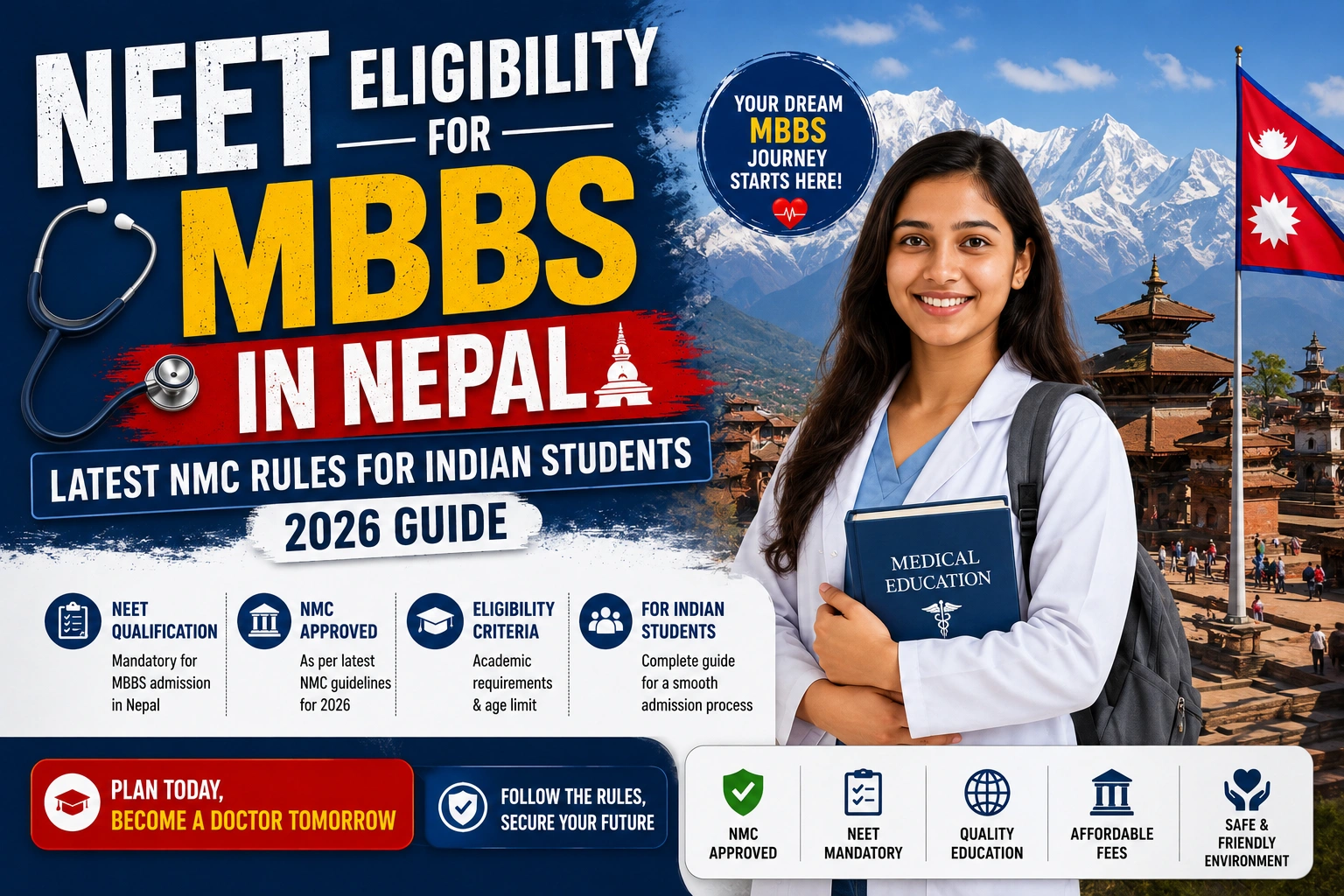
Nepal is currently the top overseas destination for Indian students pursuing a Bachelor of Medicine and Bachelor of Surgery (MBBS) degree. Supported by three core competitive strengths, it has become the first choice for most applicants. However, all students planning to apply must familiarize themselves in advance with the NEET qualification required to study in Nepal, as well as the latest 2026 regulations issued by India’s NMC. Many Indian students, misled by the close bilateral relations between the two countries, mistakenly believe that studying for an MBBS in Nepal exempts them from NMC requirements. In fact, as long as a student intends to return to India to practice medicine after graduation, they must comply with the same unified NMC regulations that apply to graduates of all other overseas medical schools.
This guide will cover core content including the latest eligibility criteria, NMC norms, admission requirements, and common application misconceptions.
Is NEET Mandatory for MBBS in Nepal?
Are Indian students pursuing MBBS programs in Nepal required to pass NEET? The answer is yes. This requirement only applies to Indian students who plan to return to India to register for medical practice after completing their studies.
Even if some Nepalese universities have their own independent admission processes, Indian students must still comply with NMC regulations and hold a valid NEET qualification. Otherwise, they will face serious problems when applying for medical practice registration in India after graduation.
Latest NMC Regulations for MBBS Abroad
India’s National Medical Commission (NMC) has introduced new regulations requiring all students who travel overseas to study medicine to obtain NEET qualification. The policy was originally introduced to maintain a unified national academic standard for medical education, and it explicitly lays out five core objectives.
This notice specifically reminds students planning to pursue an MBBS degree in Nepal to prepare this required qualification in advance.
India’s National Medical Commission (NMC) has explicitly stipulated that Indian students applying for the MBBS program in Nepal must obtain a qualifying NEET-UG score for their respective year of enrollment. Percentile thresholds are set for three categories of applicants, and the qualifying cutoff score fluctuates and adjusts each year in line with the officially designated cutoff.
Academic Eligibility Criteria
To apply for admission to Nepali medical schools, applicants must have completed Grade 12 or an equivalent academic qualification, met the requirements for all four designated core subjects including Physics, attained a minimum PCB score of 50% if they belong to the general admission category, while applicants in reserved categories are eligible for relaxed score requirements.
Minimum Age Requirement
All admission applicants must have reached 17 years of age by December 31 of the year they enroll.
Required Documents
Applicants to this medical cross-border overseas study program must submit the following valid supporting documents:
- NEET score transcripts
- 10th and 12th grade academic transcripts
- Compliant travel documents
- Passport photographs
- Certificate of medical fitness
NMC Guidelines for MBBS in Nepal
Among the new regulations issued by India's National Medical Commission (NMC) that all medical students are required to understand, admission eligibility rules are only one component; the full set of new regulations also includes regulatory requirements for overseas medical education.
All medical course durations must comply with NMC standards, which require the completion of at least 54 months of academic study and 12 months of mandatory internship. Nepal’s standard 5.5-year domestic MBBS program meets these requirements.
Internship Requirements
The Nursing and Midwifery Council (NMC) of India has classified its practical training rules as core rules.
It requires all students to complete mandatory internships in accordance with university-approved programs and NMC regulations. Failure to meet the required standards will create barriers to obtaining professional practice registration within India.
Classroom and Clinical Training Requirements
The National Medical Commission (NMC) of India has released clear compliance requirements for the undergraduate MBBS medical program. All medical courses must deliver regular in-person instruction, paired with adequate clinical training; any program that relies excessively on online-only instruction is ruled non-compliant. The NMC also requires that in-person compensatory courses be provided for students who have completed part of their academic coursework online.
Medium of Instruction
The author of this paper advocates that all MBBS programs implement English as the medium of instruction throughout their full curriculum, covering classroom teaching, practical courses, clinical training, and examinations. Programs following this model have already been launched in most leading medical schools in Nepal.
Curriculum Requirements
India’s National Medical Commission (NMC) has imposed a mandatory rule that all foreign universities running educational programs in India must align their medical courses with the country’s domestic MBBS standards, which cover 15 core medical subjects.
Courses that meet this compliance requirement can support students in preparing for the national medical licensing examination.
Importance of Clinical Training
Clinical training is extremely important for medical students. When choosing a medical school, one must evaluate five types of clinical resources, and clinical experience is the key factor that affects performance on the medical licensing examination.
Recognition of Medical Universities
Students who intend to pursue medical studies may only apply to universities recognized by the NMC. Before enrolling, they must verify that the chosen institution holds formal accreditation from its home country and is registered in the WDOMS.
Admission Process in Nepal
The majority of local medical colleges in Nepal require Indian applicants to not only hold NEET qualification, but also pass MEC’s CEE and complete the centralized counseling process. Relevant requirements may be adjusted based on the specific institution an applicant applies to and the respective admissions cycle.
Practising in India After MBBS from Nepal
Indian students who have obtained an MBBS degree in Nepal are fully eligible to practice medicine in India. To acquire official Indian medical registration, they must meet institutional compliance requirements, follow the designated registration pathway, and abide by the applicable procedural rules.
Advantages of Studying MBBS in Nepal
Nepal offers a range of benefits for Indian international students who travel to the country to pursue a Bachelor of Medicine and Bachelor of Surgery (MBBS) degree:
- Its curriculum is closely aligned with that used in India.
- Most leading medical colleges deliver all courses in English.
- Strong cultural compatibility and the widespread use of Hindi eliminate communication barriers.
- Affiliated teaching hospitals provide ample opportunities for hands-on clinical practice.
- Due to its geographical proximity to India, the convenience of traveling to and from Nepal far surpasses that of other overseas study destinations.
Documents Required for Admission
The admission application materials checklist for Nepal’s MBBS program includes 9 general mandatory materials. A passport is only required to be submitted if the host institution specifically asks for it, and applicants must also prepare any other additional materials that the institution may request.
Common Mistakes to Avoid
Many students applying for admission to Indian medical programs often unintentionally create hidden registration risks due to careless oversights, and must avoid six categories of common problems:
- Failing to pass NEET to qualify for enrollment.
- Failing to verify that their intended institution is NMC-compliant.
- Ignoring mandatory internship requirements.
- Enrolling in institutions with insufficient resources.
- Placing undue trust in unofficial consultants.
- Failing to check the latest official notices issued by the NMC.
Factors to Check Before Selecting a Medical College
When selecting a school for your application to Nepal’s undergraduate medical program (MBBS), you must verify 11 core dimensions. Conducting sufficient research can help you avoid all types of potential risks that may arise during the admission phase and the course of your studies.
Frequently Asked Questions
This section first addresses the five most frequently raised questions from Indian students applying for Nepal’s MBBS program, and provides clear, official-standard-compliant answers for each question one by one.
All compliance requirements are anchored in the current regulations of India’s National Medical Commission (NMC):
- First, the NEET exam is a necessary prerequisite for Indian students to apply for this program and subsequently practice medicine in their home country.
- Students who have not passed NEET do not hold any valid eligibility to submit a compliant application.
- The 5.5-year duration of Nepal’s local MBBS program fully meets NMC’s academic length requirements.
- All programs uniformly adopt English as the medium of instruction.
- Students who complete their studies in compliance with all rules can obtain the Indian government-recognized qualification to practice medicine in India.
Conclusion
As a popular overseas study destination for Indian medical students, Nepal’s core attractions include up-to-standard education quality, a familiar cultural environment, well-suited English-medium instruction, and convenient cross-border travel due to geographical proximity. However, when submitting applications, students must never choose a school solely based on cost-effectiveness and convenience. They must verify the official accreditation of their target institution in advance, ensure it aligns with WHO-supported international medical education standards, and strictly abide by the latest NMC regulations. Only by completing all application and academic procedures in full compliance can they successfully obtain Indian medical practice qualification, and effectively safeguard their rights and interests related to their overseas study and career development.