 Call Us:
  B3/51 Vibhuti Khand, Gomti Nagar, Lucknow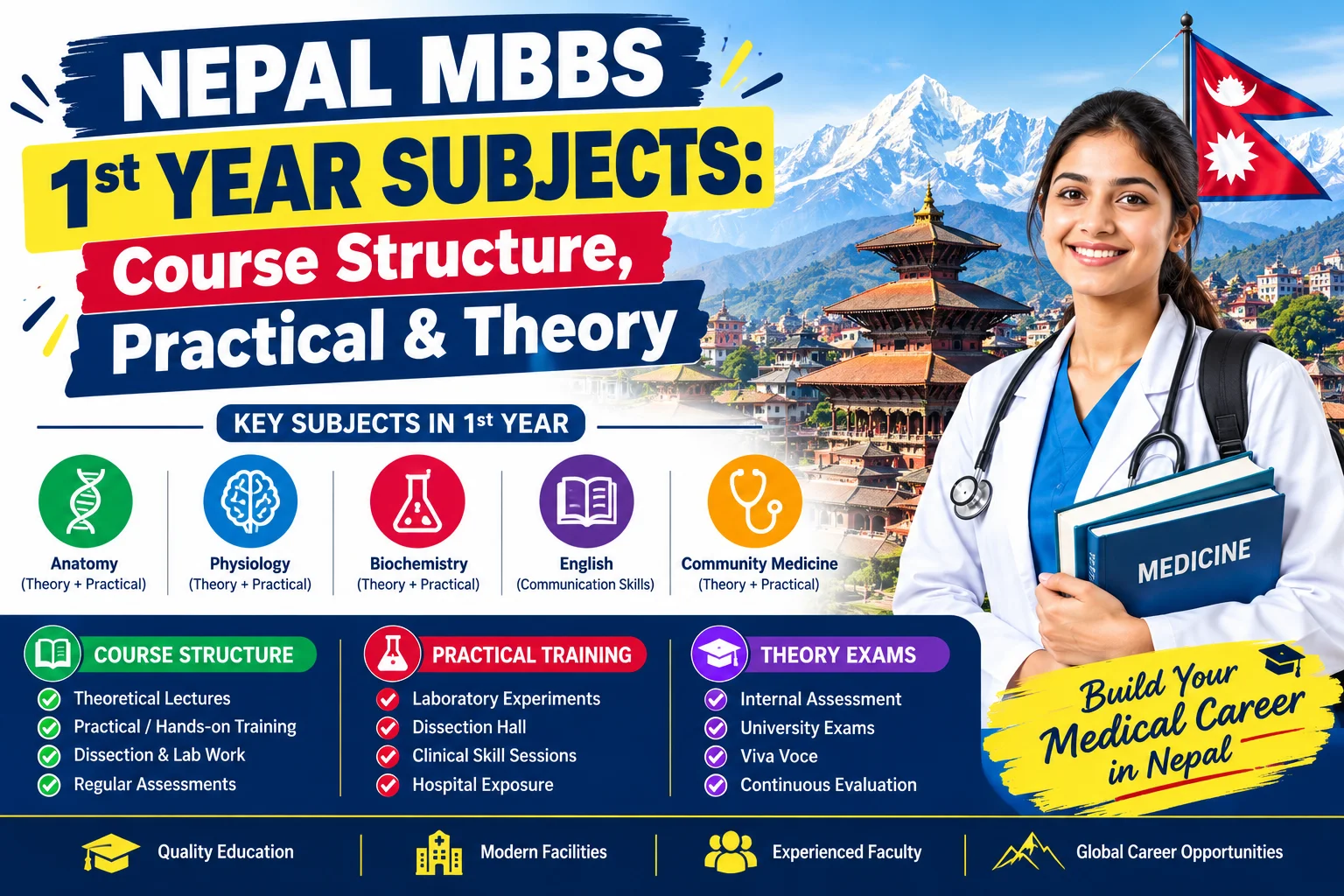
Ask a senior what first-year MBBS in Nepal felt like and they almost never start with lectures. They talk about the 8 a.m. dissection hall. The formalin smell that clings to your hoodie. Slide tests that seem to come every week whether you're ready or not.That's the real picture. First year is where a NEET aspirant turns into a medical student, and it's not a smooth transition. It's heavy, a bit gross at times, and honestly the most important year of the whole degree.So what will you actually study? How much of it is theory and how much is practical? And why do some students sail through the first professional exam while others are cramming in a panic two weeks before? Let's go through it.
How the MBBS is laid out in Nepal
The course runs about four and a half years, followed by a compulsory one-year internship. Tribhuvan University-affiliated colleges, Kathmandu University and a few others each follow their own curriculum document, and the details (semester or phase divisions, subject weightage, exam timing) differ from one to the next. So treat everything here as the common pattern, and check your own college's syllabus for the exact rules. Broadly, the degree splits into three stages. The first is pre-clinical: Anatomy, Physiology and Biochemistry. That's your first year, and in some colleges it runs a bit past twelve months. Next comes para-clinical, which covers Pathology, Microbiology, Pharmacology, Forensic Medicine and Community Medicine. Last is the clinical stage, with Medicine, Surgery, Obstetrics and Gynaecology, Paediatrics and the rest of the postings. The first year is the foundation. You won't be treating anyone yet, but every diagnosis you make in your fourth year depends on what you learn now about how a normal body is built and how it works. If you can't recognise normal, you won't recognise disease. A word for Indian students before we get into subjects. Sort out eligibility first. You need to clear NEET, and it's worth reading the official NEET eligibility and exam details before applying anywhere. Then there's the regulatory side: the National Medical Commission (NMC) guidelines lay out the rules for Indian students who study medicine abroad, including course duration, internship and eligibility conditions. Skipping this is probably the most expensive mistake families make. Also confirm that the college appears in the World Directory of Medical Schools (WDOMS), since that listing comes up later when you deal with licensing exams and registration.
The subjects at a glance
|
Subject |
What it covers |
Typical components |
|
Anatomy |
Structure of the human body |
Gross anatomy, histology, embryology, neuroanatomy, genetics |
|
Physiology |
How the body works |
Body systems, blood, nerve and muscle, special senses |
|
Biochemistry |
The chemistry behind life |
Biomolecules, enzymes, metabolism, molecular biology |
|
Supporting modules |
Context and early skills |
Medical humanities, early clinical exposure, community orientation |
Three big subjects, each with theory papers, practical sessions and a viva. Everything else sits around them.
Anatomy
Anatomy is the subject people fear, and it has earned that. It has the most content, the most memorising and the most hours on the timetable. It's also the subject that makes you feel like a doctor for the first time, usually in the morning you walk into the dissection hall.Gross anatomy is the bulk of it. Upper limb, lower limb, thorax, abdomen and pelvis, head and neck, back. In lectures you learn names, relations, blood supply, nerve supply and clinical relevance. In the dissection hall you see where everything actually sits, and no textbook prepares you for how different it looks from the diagram. Nerves are thinner than you expect. Vessels don't follow the neat pattern. Fat gets in the way. That's exactly why dissection matters: it trains your eyes.
Histology is tissues under the microscope. You start with epithelium, connective tissue, muscle and nerve, then move to organ slides like liver, kidney and lung. Lots of students write it off as "just pictures" and then lose easy marks at slide spotting. Learn what makes each slide identifiable, not just what colour it was.Embryology follows a single fertilised cell as it becomes a person. It matters beyond the exam because it explains congenital problems later. Cleft lip, heart defects and neural tube defects all make sense once you know how the embryo develops, and examiners love building clinical questions on it.Neuroanatomy usually shows up later in the year, and for most people it's the hardest part. Tracts, nuclei and pathways don't give you something solid to picture. Draw them, then draw them again. Nobody has found a shortcut.Genetics gets a smaller slice, but it's growing. Expect chromosome basics, inheritance patterns and common genetic disorders.
Anatomy practicals
Practical work covers dissection, bones and specimens, histology slides and surface anatomy. The practical exam typically includes spotters (name the marked structure), a short specimen or dissection discussion, histology slides and a viva.Bones are underrated. Learn the side, the landmarks, the attachments. An examiner hands you a bone and asks which side it is and what passes through that groove. If you've handled bones every week, that's a ten-second answer. If you haven't, it's ten minutes of sweating.
Physiology
If anatomy is "what's there," physiology is "what does it do and how?" A lot of students enjoy it more because it's logical. You can reason through much of it instead of memorising everything. Don't mistake that for easy, though. Mechanisms and numbers pile up quickly.The syllabus usually runs through general physiology (cell membrane, transport, homeostasis, membrane potentials), then blood (composition, RBC and WBC function, haemoglobin, blood groups, clotting). After that comes nerve and muscle physiology, including action potentials, the neuromuscular junction and contraction. The cardiovascular system covers the cardiac cycle, heart sounds, basic ECG and blood pressure control. Respiratory physiology deals with breathing mechanics, gas exchange, lung volumes and control of respiration. Renal physiology covers filtration, reabsorption, urine concentration and acid-base balance. The GI system takes in digestion, absorption, motility and secretions. Endocrinology brings hormones, feedback loops and the thyroid, adrenal, pancreas and pituitary. Reproductive physiology covers the male and female systems, the menstrual cycle and basics of pregnancy. And the central nervous system and special senses include sensory pathways, motor control, vision and hearing.
Physiology practicals
Here things get hands-on. A typical list includes haemoglobin estimation, RBC and WBC counts, bleeding and clotting time, blood grouping and ESR. You'll also practise clinical skills: recording pulse and blood pressure, examining the respiratory system, testing reflexes, and checking cranial nerves on a simulated patient.They look small. They're not. Taking blood pressure properly is the first real clinical skill you'll perform, and examiners watch your technique as much as your reading. Is the arm positioned right? Right cuff size? Do you pause before inflating? Those little things show who has practised and who has only read about it.One piece of blunt advice: don't treat your practical journal as paperwork. Yes, it gets signed. But the viva asks about the experiment, the principle and the normal values, and if you copied a friend's record, it shows within two questions.
Biochemistry
Biochemistry has a funny reputation. In the first month students call it boring. By the end of the year they call it scoring. Both are fair. Pathways and structures can feel miles away from patients. But the content is well defined and the questions are fairly predictable, so steady work pays off here more reliably than in most subjects. Expect biomolecules first: carbohydrates, lipids, proteins, amino acids and nucleic acids. Then enzymes, covering classification, kinetics, inhibition and clinical enzymology. Metabolism is the biggest chunk, with glycolysis, the TCA cycle, gluconeogenesis, glycogen, lipid and amino acid metabolism, and how they all connect. Bioenergetics follows (electron transport and oxidative phosphorylation), along with vitamins and minerals, their functions and deficiency diseases. Molecular biology takes in DNA replication, transcription, translation, gene regulation and recombinant DNA techniques. Finally there's clinical biochemistry, which covers liver and kidney function, acid-base balance and diagnostic markers.
Biochemistry practicals
This one feels like a chemistry lab. You'll do qualitative tests for carbohydrates, proteins and lipids, analyse normal and abnormal urine, run quantitative estimations like blood glucose, and learn the basics of colorimetry and spectrophotometry. Some colleges also demonstrate electrophoresis and chromatography.A small tip that matters more than it sounds: learn why each test works. If you understand why Benedict's test changes colour, you can handle any version of the question. If you only remember the colour, you're stuck the second the examiner changes one detail.
Everything else in first year
It's tempting to think the first year is just those three subjects. There's more happening around the edges. Many curricula now have early modules on communication, professionalism and medical ethics. They feel soft next to anatomy, but they shape how you'll talk to patients for the next forty years. Don't switch off.Some colleges also send first-years into wards or community settings. You might sit in on patient interviews, visit a health post or shadow a clinician. It's a short taste of the real thing, and for plenty of students it's the reminder of why they're putting up with the dissection schedule. A few programmes add introductory community medicine, field visits or health education work. How much you get varies a lot, so ask the college directly what's included.Teaching is in English at Nepal's medical colleges, and most international students manage the switch fine. Still, give yourself a few weeks to get used to the vocabulary and the pace of lectures.
Theory, practical and how you're assessed
This is what students ask about most, so here's the usual setup.Theory is written papers. Each major subject normally has its own paper or papers, with short answers, long answers and MCQs. Examiners like structure: a definition, an explanation, a diagram where it helps, and a clinical correlation if one fits. Practical assessment usually has three parts: spotters or OSPE-style stations, a performance task (a blood test, a dissection exercise), and a viva. You're being tested on whether you can do the work and explain it while someone stares at you. Internal assessment counts too. Class tests, practical records, attendance and general performance all feed into it. These marks aren't a gift. In many systems you need a minimum internal score just to be allowed into the final exam. Then comes the first professional exam, normally at the end of the first year or phase. The thing to know is that you usually have to pass theory and practical separately. A great theory score won't save a failed practical, and the reverse is true as well. Pass marks and weightage are set by each university, often around 50 percent per component, but check your college handbook rather than trusting a senior's memory.And attendance. Please don't shrug it off. Many universities require a minimum percentage in both theory and practical classes before you can sit the exam, and students who treated it as optional have found out too late that they weren't eligible.
What a normal week feels like
Timetables differ, but the rhythm is similar almost everywhere. Mornings usually start with a practical: dissection, histology or a physiology lab. Late morning and early afternoon are lectures, typically one or two of the big three each day. Late afternoon might bring a tutorial, a small-group discussion or a quick test. Evenings are free on paper. In practice they go to revision. Most students spend a couple of hours going back over the day's anatomy, because once a week of dissection piles up unrevised, you're basically starting again.It's a tiring schedule, no argument. But it's predictable, and that makes it easier to plan around.
Study habits that actually help
You've heard generic study advice already, so here's what's specific to this year.Treat anatomy as a daily job. A body region can't be crammed the night before. Go over that day's dissection the same evening, with an atlas open next to your notes.Draw things. Neuroanatomy tracts, metabolic pathways, the nephron. If you can sketch it from memory, you understand it. If you can only recognise it on a page, you don't, not yet.Use the dissection hall like a workplace, not a social space. Walk in with a list of structures you want to find, and badger your demonstrators with questions. They're often your best resource. Practise vivas with a friend. Sit across from each other, fire questions, answer out loud. Knowing a thing and saying it clearly under pressure are two separate skills.Don't ignore the "easy" subjects. Plenty of students pour everything into anatomy and let biochemistry slide until two months before the exam. Biochemistry rewards steady effort more than almost anything else, and neglecting it is a common cause of avoidable failures.Sleep, eat, move around. The first year is long, and people who burn out in month four have a miserable second half.One more thing nobody enjoys hearing: a mock test is worth more than a fifth read of your notes. Testing yourself shows the gaps. Rereading hides them.
Picking a college that does first year well
Where you study changes this year a lot. A good college has a proper dissection hall, enough cadavers for small groups, working labs and teachers who actually engage. A weak one packs a big batch around one table and treats practicals as a formality. Look beyond the brochure. Ask about the student-to-cadaver ratio in anatomy. Check whether the physiology and biochemistry labs have real equipment. Find out who the teaching staff are and whether they're around. Confirm the college's recognition and compliance with the relevant regulators, including the National Medical Commission (NMC) guidelines for Indian students, and its listing in the World Directory of Medical Schools (WDOMS). It also helps to see how the training compares with World Health Organization (WHO) standards for medical education and the health workforce.If sorting through all this feels overwhelming, you're not alone. Lots of families stall right here. A consultancy like MBBS in Nepal can help you compare colleges, understand eligibility and avoid the paperwork traps that catch first-time applicants. Whichever route you pick, check the claims yourself. A decent advisor won't mind.
Mistakes worth avoiding
Most of these are avoidable. Starting late is the big one. The syllabus is huge from day one, and two slow months leave a backlog that's hard to clear. Memorising without understanding is next, and it fails fast in physiology and biochemistry the moment a question gets twisted. Then there's skipping practical records and viva prep, which is exactly where careless students drop marks they should have had. Comparing yourself with everyone else wastes energy too, since everybody learns at a different speed. And treating attendance as negotiable is a mistake, because universities do enforce it.
Conclusion
First-year MBBS in Nepal is demanding, but the logic is simple. Anatomy, Physiology and Biochemistry are the core, backed by early exposure to medical humanities, community health and clinical thinking. Theory gives you the concepts. Practicals teach you to use them. The first professional exam checks both separately, so neither one gets a pass. If you remember one thing, make it this: consistency beats intensity. The students who do well aren't the ones who study twelve hours the night before. They revise a little every day, turn up for every dissection, and practise vivas long before anyone asks them to. Before you commit to any college, do the groundwork. Confirm your eligibility through the official NEET eligibility and exam details, read the current National Medical Commission (NMC) guidelines, check the college's entry in the World Directory of Medical Schools (WDOMS), and see how its training lines up with World Health Organization (WHO) standards. And if you'd like a second opinion along the way, MBBS Advisor can help you decide with fewer surprises. The first year won't be easy. But it's the year that teaches you how to be a medical student, and everything else gets built on top of it.