 Call Us:
  B3/51 Vibhuti Khand, Gomti Nagar, Lucknow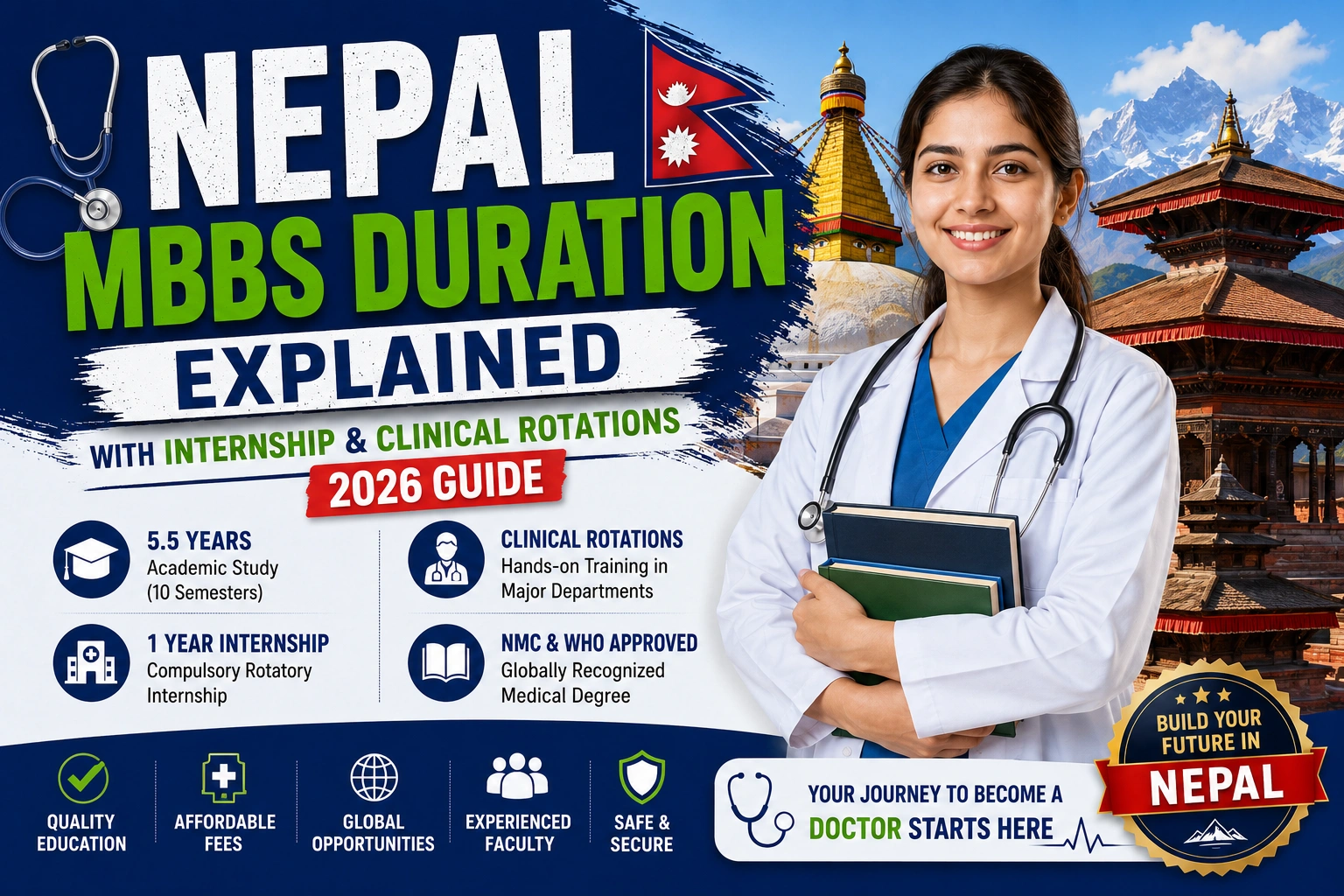
Nepal’s MBBS course duration and the structuring of clinical training are common questions for many Indian students interested in studying MBBS in Nepal. Nepal’s medical system is similar to India’s, which is one of the many reasons Indian students prefer Nepal, as it retains similar systems, is taught in English, has affordable tuition, and is universally accepted.
Understanding the Nepal MBBS duration and the internship and clinical rotation requirements is important before the admissions decision is made. During medical training, clinical practice is vital to mastering many skills, including communication and management.
This document is designed for Indian students and describes the total duration of an MBBS course in Nepal, the semester structure, the internship and clinical rotations, and information required for prospective applicants.
What is the Total Duration of MBBS Courses in Nepal?
The MBBS course duration in Nepal is around 5.5 years and comprises:
- 4.5 years of academic study
- 1 year of compulsory rotating internship
The curriculum is aligned with international standards of medical education and is designed to start with theory and progress towards clinical practice.
Most of the medical colleges in Nepal have designed the curriculum in such a way that students can solidify a foundational knowledge of medicine before they participate in hospital-based clinical training.
Standard Course Structure
|
Course Phase |
Duration |
|
Basic Sciences |
2 Years |
|
Clinical Sciences |
2.5 Years |
|
Rotating Internship |
1 Year |
|
Total Duration |
5.5 Years |
This duration is in compliance with the National Medical Commission (NMC) guidelines on foreign medical education, as long as the medical college fulfills the eligibility requirements.
Why Is The MBBS Duration In Nepal Equivalent To That In India?
There are many similarities between the MBBS programmes of India and Nepal such as:
- The initial years focusing on anatomy and physiology with the subsequent years focusing on clinical sciences
- The inclusion of hospital-based learning
- One year of compulsory internship
- Teaching medical ethics
- Teaching community medicine
- Providing patient-centered clinical training
Due to the above reasons, Indian students mostly find it easier to acclimatise.
Year Wise Breakdown Of The MBBS Programme
First Year - Basic Medical Sciences
The first year mainly focuses on the development of the students’ understanding of the biological sciences.
The subjects that are included this year are:
- Anatomy
- Physiology
- Biochemistry
- Medical Ethics
- Introduction to Clinical Medicine
Most of the students spend their time in the:
- Anatomy Dissection Hall
- Physiology Laboratory
- Biochemistry Laboratory
- Demonstration Room
Practical sessions are conducted from the very first semester.
Second Year - Pre Clinical And Para Clinical Subjects
In the second year, students learn the principles of disease, diagnosis, and associated clinical practice.
The major subjects that are included in this year are:
- Pathology
- Pharmacology
- Microbiology
- Community Medicine
- Forensic Medicine
- Hospital visits
- Community surveys
- Laboratory diagnostics
- Case discussions
Clinical practice has begun to increase.
Third Year - Start Of Clinical Rotations
The third year marks the start of learning in the hospital.
The subjects that are included are:
- Clinical Medicine
- Clinical Surgery
- Pediatrics
- Obstetrics and Gynecology
The following clinical activities are included:
- Ward rounds
- Clinical demonstrations
- Case presentations
- History taking
This is the first year that students interact with patients.
Fourth Year - Further Clinical Rotations
The focus in the fourth year is on clinical practice and major areas of clinical decision making.
The subjects that are included are:
Rotations in the following specialties are conducted:
- Internal Medicine
- Surgery
- Orthopedics
- ENT
- Ophthalmology
- Dermatology
- Psychiatry
- Emergency Medicine
Learning is primarily based in hospitals after this point.
Final Professional Examination
After the completion of the training program, candidates take final exams that consist of the following:
- Written exams
- Practical exams
- Viva
- Clinical case assessments
Successful candidates are enrolled in the compulsory internship.
What Is the Internship Duration in Nepal?
The internship duration is 12 months. The internship is compulsory for all MBBS students, as it is part of the degree program. It covers clinical teaching in all major specialties.
During the internship, students work with a number of doctors and are involved in:
- Diagnosis of patients
- Ward management
- Emergency duties
- Minor surgical procedures
- OPD duties
- Night duties
The internship aims to prepare students to bridge the gap between their acquired knowledge and skills and their ability to independently practice medicine.
Departments Covered During Internship
Internship training is done in a number of major departments:
The following major departments are usually included during the internship:
- General Medicine
- General Surgery
- Obstetrics & Gynecology
- Pediatrics
- Orthopedics
- Emergency Medicine
- Community Medicine
General Medicine
The department of General Medicine provides training in the following skills:
- Diagnosis of patients
- Taking clinical history
- Clinical examination
- Management of clinical conditions
- Writing prescriptions for patients
General Surgery
Exposure in the General Surgery department includes participation in the operation theater and involvement in the following:
- Assessment of patients prior to surgery
- Care of patients after surgery
- Surgical dressing
- Minor surgical procedures
Pediatrics
During the internship, teaching in the department of Pediatrics includes management of the following:
- Child health
- Neonatal health
- Immunization
- Nutritional disorders
- Pediatric emergencies
Obstetrics and Gynecology
Teaching in the Obstetrics and Gynecology department includes management of patients during the different stages of pregnancy and includes participation in the Labor and delivery as well as the following:
- Observation of surgical procedures in Obstetrics (Cesarean sections)
- Gynecologic surgical examinations
Clinical education is different. Instead of having classes to learn theory, students experience real medical cases every day.
Your Third Year Is When Clinical Rotations Start
Many assume that the first time they experience real medical cases is when they start their internship.
This assumption holds for students in Nepal.
Clinical Rotations can start as early as the third year.
Year on year students visit:
- Teaching Hospitals
- Specialty Clinics
- Surgical Theatres
- Emergency Departments
- Intensive Care Units
- Diagnostic Laboratories
Having this practical exposure at an early stage makes a considerable difference.
Teaching Hospitals
Most medical colleges in Nepal have an affiliation with a large, multispecialty teaching hospital.
Medical students have practical exposure in the following departments:
- Cardiology
- Pulmonology
- Neurology
- Oncology
- Nephrology
- Gastroenterology
- Radiology
- ICU
The heavy patient flow even allows exposure to virtually all medical conditions.
What a Normal Day Looks Like During Clinical Rotations
A clinical day may have all of the following:
Morning:
- Ward Rounds
- Case Discussions
- Patient Examinations
Afternoon:
- Lectures
- Clinical Demonstrations
- Laboratory
Evening:
- Self-study
- Prepare Cases
- Typed Assignments
Students learn to practice clinical disciplines with confidence.
What You Learn While Rotating
Clinical Rotations and Internships teach students:
- Patient history
- Clinical Exams
- Case Diagnosing
- BP and Clinical Measurements
- Injections and Suturing
- Interpreting ECGs and X-Rays
- Writing Prescriptions
- Managing Medical Emergencies
- Medical Records
All of these skills build a student's confidence and qualify their practice with an understanding of the medical field.
Is the Indian Student's Internship Compulsory?
Yes.
For Indian students who have completed their MBBS in Nepal, they must have completed their compulsory internship for the University.
In accordance with the recent NMC regulations, students must have completed their internship to practice and for the MBBS degree.
Students should always check if the medical college they want to enroll in is according to the recent NMC rules.
Language Used During Clinical Rotations
English is the main language of instruction in Nepalese Medical Colleges. But during hospital postings, patients could be speaking in:
- Nepali
- Hindi
- Regional Languages
Indian students find it the easiest to communicate with patients during hospital postings in Nepal as Hindi and Nepali are linguistically close.
Evaluation During Clinical Training
Indian students are assessed continuously throughout their clinical training based on:
- Clinical examinations
- Practical assessments
- Vivace
- Ward performance
- Logbooks
- Attendance
- Case presentations
For clinical training in the next level, students are expected to perform consistently.
Advantages of Clinical Rotations in Nepal
Medical education systems in Nepal are based on early clinical education. Major benefits include:
- Direct interactions with patients
- High patient turnover
- Excellent bedside teaching
- Faculty with ease of teaching
- Faculty with ease of teaching
- Practical orientation
- India and Nepal share common disease patterns
- Education in English
- Better preparedness to take licensing examinations
All of these factors lead to the production of competent medical professionals.
Does Nepal Follow NMC Guidelines?
Several medical colleges in Nepal provide MBBS education within the framework of NMC eligibility guidelines for Indian students. However, recognition is solely based on the medical college as well as the medical school’s latest NMC compliance.
Students are encouraged to check the:
- Recognition of Medical College
- Duration of the Course
- Structure of Internship
- Teaching Medium
- Clinical Training Opportunities
- Accessibility to Licensing Examinations
For the students’ sake, these factors should be ensured to avoid unnecessary problems in their professional career.
Things to Consider for Indian Students When Choosing an MBBS College in Nepal
Before finalizing your admission, examine the following:
- Make sure that the university is accredited.
- Check that the MBBS program has a duration of 5.5 years, internship included.
- Make sure the college has a teaching hospital with good patient inflow.
- Look at the quality of the offered clinical rotations and internships.
- Make sure you know the language of instruction.
- Know the tuition and cost of living.
- Look at the hostel accommodations and student services.
- Talk to students and alumni to see what they say about the programs.
Understanding these points may help you have a better educational experience.
Frequently Asked Questions (FAQs)
What is the MBBS duration in Nepal?
The MBBS course in Nepal is 5.5 years, consisting of 4.5 years of study and 1 year of compulsory internship.
When do students begin clinical rotations?
Students typically begin clinical rotations in the 3rd year and continue them for the rest of the program.
Is a compulsory internship done in Nepal?
Yes, a compulsory 12-month rotating internship is part of the MBBS program.
Are clinical rotations done in teaching hospitals?
Yes, most medical colleges in Nepal are affiliated with teaching hospitals for clinical training.
Is it good for Indian students to study in Nepal?
The similarities between the curricula, English as a medium of instruction, the short distance, similar culture, and large exposure of teaching hospitals have made Nepal a favorable choice for students.
Conclusion
The MBBS program duration in Nepal has been designed to ensure that all medical graduates have included all required elements including academic studies, laboratory work, hospital clinical work, and a compulsory rotating internship of one year.
The 5.5-year program fully integrates theory with ample practical experience in actual healthcare environments.
Nepal has multiple benefits for Indian students; it has a similar curriculum, offers classes in English, has an early exposure program, and is home to well-established teaching hospitals. However, students should check that their chosen university meets the regulatory standards for clinical training so they are not at a detriment in the future. Before taking admission, verify the institution through WDOMS, understand international medical education guidance from the WHO, and ensure you have qualified NEET as required for Indian students. The right choice guarantees that students have a thorough education and are more prepared for any licensing examinations and to enter their profession.