 Call Us:
  B3/51 Vibhuti Khand, Gomti Nagar, Lucknow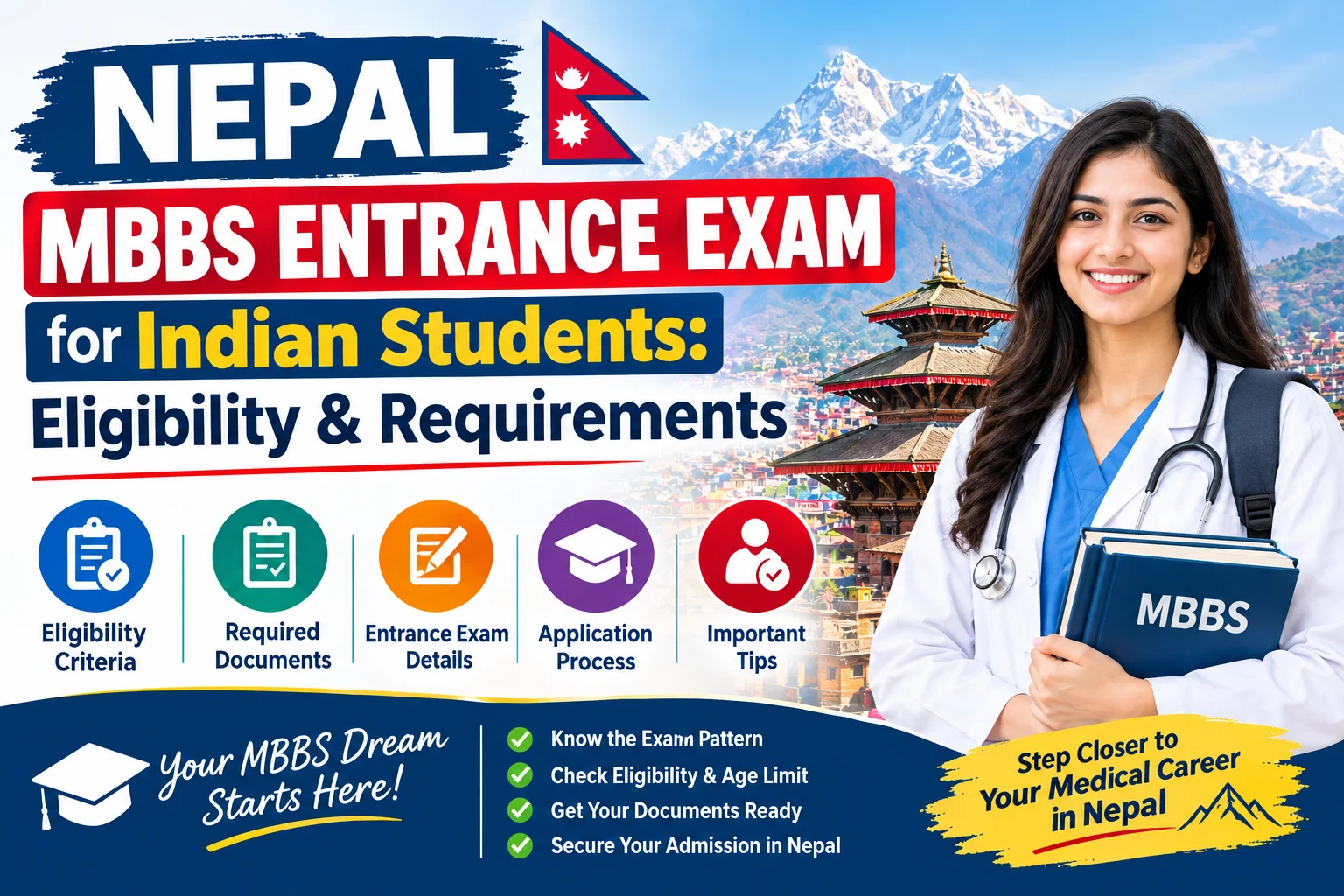
Let's clear up the biggest misunderstanding first. A lot of Indian families hear "Nepal MBBS entrance exam" and assume their child has to prepare for a separate Nepali test, sit in Kathmandu, and compete with thousands of local students. That's not how it works for you.For Indian students, the real gatekeeper is NEET-UG. Qualify in that, and the door to Nepal's medical colleges opens. Skip it, and no college worth considering will take you, no matter how much money you're willing to pay.Here's the full picture, from the exam question to the paperwork to the mistakes I see students make again and again.
Is there an "entrance exam" for Indians in Nepal?
Short answer: not in the way you'd think.Nepal does run its own medical entrance test for its citizens, conducted under the country's Medical Education Commission. Nepali students compete for a limited number of seats through that process. Indian applicants, though, are generally admitted through the foreign or international student quota in private medical colleges, and the qualifying benchmark on the Indian side is your NEET result.So when someone says "Nepal MBBS entrance exam for Indian students," what they usually mean is this: which exam do I need to clear, and what do I need beyond that? The answer is NEET, plus a handful of academic and document requirements. Colleges also do their own admission screening, but it's mostly about verifying your credentials, not testing you again.You can find the official details on NEET eligibility and exam details, and I'd recommend checking that page yourself every year. Dates, forms and fine print shift.
Why NEET is non-negotiable
Not so long ago, Indian students could go abroad for MBBS without sitting NEET at all. They'd get an eligibility certificate and head off. Those days are over. The National Medical Commission (NMC) guidelines now require Indian citizens who want to study medicine abroad to qualify NEET-UG first. If you skip it and join a college overseas anyway, you'll have a bigger problem when you come home. You won't be eligible to appear for the screening test that foreign medical graduates must clear to practise in India. Think about that for a second. Five-plus years, a large chunk of your family's savings, and at the end you can't legally practise at home. That's the risk. And here's something people don't realise. You don't need a rank that gets you a government seat in India. You just need to qualify, meaning meet the minimum cut-off percentile for your category. For many students that's very doable, even when a government MBBS seat in India isn't.
Academic eligibility: who can apply?
The requirements are fairly straightforward, and they mirror what NEET itself expects. Age. You need to be at least 17 years old by December 31 of the year you're taking admission. There's no strict upper limit that stops most applicants, but check the current NEET rules for anything that applies to your situation. Education. You must have completed Class 12 (or an equivalent exam) with Physics, Chemistry, Biology or Biotechnology, and English as subjects. Students who skipped Biology in school can't just add it later and expect it to count. It has to be part of your 10+2.
Marks. The usual minimum is 50% aggregate in Physics, Chemistry and Biology for General category students. For reserved categories (SC, ST, OBC) and students with benchmark disabilities, the threshold is lower. Check the exact figures against the latest NEET bulletin, because they get revised from time to time and I don't want you relying on a number that's out of date.NEET qualification. This is the one that trips people up. Appearing isn't enough. You must have actually qualified. A scorecard showing you cleared the cut-off is what colleges and later the regulator will look at.That's it for the academic side. No separate Nepali exam, no language test, no interview marathon. English is the medium of instruction, so you won't need to learn Nepali to study (though you'll want to pick up some of it for patient interaction later, and you'd be amazed how quickly it comes).
The documents you'll need
Admissions in Nepal move quickly once you've picked a college, and missing paperwork is the number one reason students lose a seat. Get these ready early:
- NEET-UG scorecard and admit card
- Class 10 certificate and marksheet (proof of date of birth)
- Class 12 marksheet and passing certificate
- Passport (valid) or other government photo ID. Indians can travel to Nepal without a visa, but you'll want a passport for the long run, especially if you plan to travel elsewhere or need it for future verification.
- Recent passport-sized photographs
- Birth certificate
- Medical fitness certificate
- Character certificate / transfer certificate from your school
- Migration certificate where applicable
Some colleges ask for a few extras, like affidavits, income proof or a medical test report, so always get their checklist in writing. Self-attested copies are usually fine at the application stage, but you'll need originals when you physically join.One practical tip: scan everything now and keep a clean digital folder. You'll be sending the same documents to multiple colleges, and you don't want to be hunting for your Class 10 certificate at 11 p.m. the night before a deadline.
The course structure: what five and a half years actually looks like
Nepal's MBBS runs for four and a half years of academic study, followed by a one-year compulsory rotating internship. That's 5.5 years in total.Why does that matter? Because the NMC expects foreign medical graduates to have completed a minimum course duration, and to have done their internship at the same institution or country where they studied. Nepal's structure fits this requirement, which is one reason it's popular with Indian families.The curriculum itself follows the usual pattern. You start with basic sciences like anatomy, physiology and biochemistry, move into pathology, pharmacology and microbiology, and then spend the later years in clinical postings across medicine, surgery, paediatrics, obstetrics and the rest. The teaching hospital attached to your college is where you'll build real skills, so it's worth asking about patient load. A college with a gorgeous campus but a quiet hospital isn't doing you any favours.
Why so many Indian students pick Nepal
Let's be honest about why it's attractive, because the reasons are practical rather than glamorous.Proximity is the big one. You can get home within a day. For a parent worried about sending an eighteen-year-old to a country they've never visited, that matters more than any brochure.Then there's the culture. Food, festivals, climate and even language feel familiar. Hindi works fine in most day-to-day situations. Students who go to Russia or Kazakhstan have to adjust to winters, new alphabets and very different food. Nepal is a softer landing.The curriculum and medical environment also feel familiar, and the disease patterns students see in Nepal overlap substantially with what they'd encounter in India. That helps enormously when preparing for the screening exam back home.And yes, cost. Nepal isn't cheap, and I'll say more on that below, but for many families it sits in a middle zone, higher than some Central Asian options, usually lower than private MBBS in India.
What does it cost?
I'm going to be careful here, because fees vary a lot by college, and I'd rather give you a range than a number that misleads you. Total costs for the full programme at private colleges in Nepal generally run well into the tens of lakhs of rupees, and they're often quoted in US dollars or Nepali rupees depending on the institution. On top of tuition, budget for hostel and food, books, travel back home, and annual fee increases that some colleges build in. Always ask for the full fee structure in writing, including every year's fees, caution deposits, hostel charges and any "development" or "registration" fees. If a college or agent can't give you a clear breakdown, that's a warning sign, not a detail to sort out later.
Choosing a college: what to check before you pay anything
This is where students make their costliest mistakes. A college can look great online and still be a poor choice. Before you commit, verify these things. Is it recognised? The college should be approved by Nepal's regulatory bodies and affiliated with a recognised university. Beyond that, check whether it appears in the World Directory of Medical Schools (WDOMS). Listing there is a baseline for international recognition, and the NMC looks at it when assessing foreign degrees. Does it meet global standards? Medical education quality isn't only about local approval. Look at how the institution aligns with World Health Organization (WHO) standards for medical education and training. Ask about faculty strength, the student-to-patient ratio, lab facilities and library resources. What's the teaching hospital like? Visit if you can. If you can't, ask to speak with current Indian students, and not the ones the admissions office hand-picks. Message a few seniors on your own. What are the FMGE results like? Ask the college how many of its Indian graduates have cleared the screening test, and ask for specifics. Vague answers like "most of our students do well" tell you nothing. Who's handling your admission? If you're using a consultancy, make sure they're transparent about fees and don't push you toward a single college. A reliable advisory like MBBS in Nepal can help you compare options, check documents and avoid fake admission offers. Whoever you choose, never pay large sums before you've seen an official admission letter from the college itself.
Step-by-step: how the process actually works
Here's the sequence most Indian students follow.First, appear for NEET-UG and qualify. That's step one, and nothing else matters until it's done.Second, shortlist colleges once your result is out. Don't wait. Seats in popular colleges fill up, and the best ones aren't always the cheapest.Third, apply directly or through an authorised representative. You'll submit your documents and, in most cases, pay an initial registration amount.Fourth, receive your admission or offer letter. Read it carefully. Check the fee schedule, refund policy and course duration.Fifth, complete the remaining paperwork, pay the first instalment, and arrange travel. Since Indian citizens can cross into Nepal without a visa, this part is simpler than for most other countries, but carry your ID and original documents.Finally, join your college, complete registration with the university, and begin classes.
The thing nobody tells you: coming home
Getting the degree is only half the journey. To practise in India, you'll need to clear the screening exam for foreign medical graduates, and the pass rate has historically been tough. A lot of students underestimate this. Here's my honest advice: start preparing for it from the first year, not the last. Pick your textbooks, join study groups with other Indian students, and treat your MBBS exams as stepping stones toward that screening test rather than separate hurdles. Students who coast through five years and then panic in the final months are usually the ones who struggle. Also keep an eye on how India's licensing rules are evolving. The NMC has talked about changes to the licensing exam structure, and policies can shift between the time you join and the time you graduate. Check the National Medical Commission (NMC) guidelines periodically so there are no surprises.
Common mistakes to avoid
Some of these are painfully common.Joining without qualifying NEET. It sounds obvious, but it happens, often because an agent said "it'll be fine." It won't.Trusting verbal promises. If it isn't in writing, it doesn't exist. This applies to fees, hostel facilities and "guaranteed" placements alike.Picking a college purely on price. The cheapest option can cost you more in the long run if it hurts your clinical exposure or your chances of passing the screening exam.Ignoring the internship rules. Make sure your internship will be completed in a way the NMC accepts. Ask the college how this works before you enrol.Leaving documents to the last minute. Delays in getting a certificate attested or corrected can cost you the seat.
So, is Nepal the right call for you?
It depends, and anyone who tells you otherwise is selling something.If you've qualified NEET, you're not getting a seat in India, your family can handle the cost, and you want a familiar environment close to home, Nepal is a sensible option. If you're counting on it being a cheap shortcut, or you haven't done your homework on the college, it can go wrong fast. Start with the basics. Check the latest NEET eligibility and exam details, confirm the college through the World Directory of Medical Schools (WDOMS), and measure what you find against World Health Organization (WHO) standards for medical education. Then talk to people who've actually been through it.
Conclusion
Nepal can be a smart route into medicine for Indian students, but only if you go in with your eyes open. There's no separate Nepali entrance test to sweat over. What matters is NEET-UG: qualify, and the path is open. Skip it, and you risk a degree you can't use at home, which is the one outcome no family can afford. Beyond the exam, the rest comes down to homework. Confirm your eligibility, get your documents in order early, verify the college properly, and get every fee and promise in writing. Plan for the screening exam from year one, and keep checking the National Medical Commission (NMC) guidelines as the rules change. If you'd like a second pair of eyes on your shortlist, a transparent consultancy like MBBS in Nepal can help you compare options without the pressure. Choose carefully, start early, and the five and a half years ahead will work in your favour.