 Call Us:
  B3/51 Vibhuti Khand, Gomti Nagar, Lucknow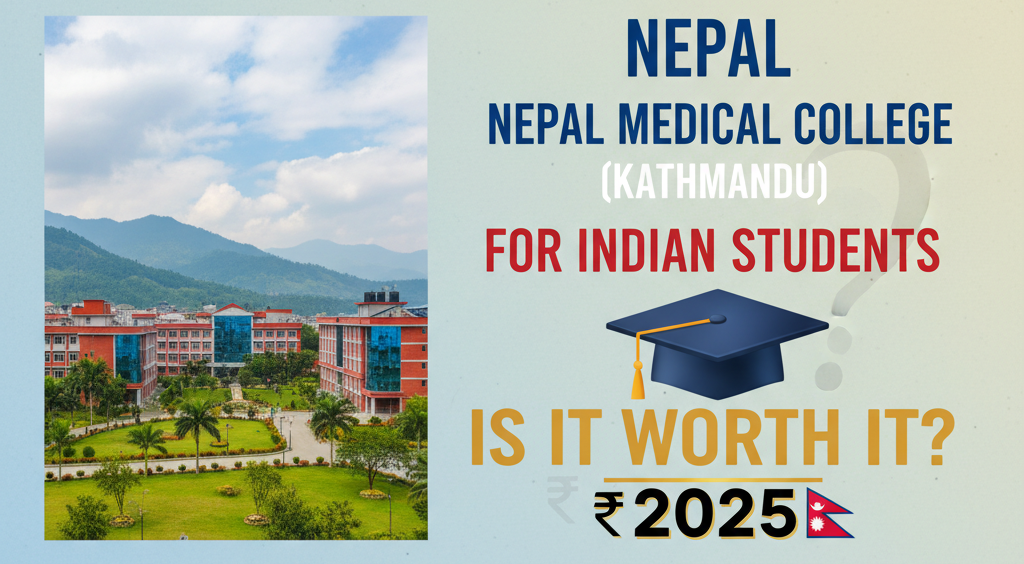
If you’re an Indian aspirant exploring MBBS abroad, the Nepal Medical College in Kathmandu often comes up as a viable option. But before you commit your time, money and future, it’s important to evaluate whether the choice is truly worth it in 2025. We’ll break down the key factors – recognition, cost, academics, campus life – to help you decide.
1. Recognition & Career Fit
One of the most critical checks for any Indian student studying abroad is whether the degree will allow you to practise in India or progress academically. At Nepal Medical College (Kathmandu):
- It is affiliated with a recognised university in Nepal and appears among listed institutions that Indian aspirants consider for foreign‑MBBS.
- That said, not all Nepal colleges are automatically eligible for practise in India. You should verify recognition by the National Medical Commission (NMC) of India and eligibility to appear for the licensing or screening exam in India.
- Also ensure the MBBS curriculum, internship and hospital exposure align with Indian regulations so your transition (back to India or abroad) is smooth.
If you check these boxes, then yes, the college passes the first major hurdle of recognition.
2. Cost & Financial Considerations
Cost is often the driving reason students look at Nepal. For Nepal Medical College:
- The reported total fee for Indian students is around ₹ 55–60 lakhs (roughly) for the full MBBS programme.
- Additional costs – hostel, food, travel, living‑expenses – will add further.
- Compared with many private medical colleges in India, this cost may still be lower or at least more predictable.
So financially: if you can afford the fee and you’ve factored in living costs and return on investment (career after MBBS), it can be a worthwhile option.
3. Academic & Campus Experience
What about quality of education, campus life and clinical exposure? For Nepal Medical College you should review:
- Does the college provide English‑medium teaching (critical for Indian students)?
- Is the hospital attached to the college large enough (beds, patient flow) to give you real and meaningful clinical training?
- Are the faculty, labs, library, hostel and student support infrastructure up to standard?
- How comfortable will you feel living in Nepal – accommodation, food, safety, cultural adaptation?
If the college ticks the above, then the academic experience can be quite decent and comparable to alternatives.
4. Advantages for Indian Students
Choosing Nepal Medical College may bring several advantages:
- Cultural & geographic proximity: Easier travel back home, less language barrier, somewhat familiar environment.
- Predictability: Fees and admission process may be clearer than ambiguous “capitation fees” in some private Indian colleges.
- Recognition (if confirmed): A degree that allows you to return to India and practise (if you fulfil eligibility) or pursue further studies.
- Alternative route: If your NEET rank is lower for India’s top colleges, this option gives you access to medical education rather than waiting or dropping.
5. Caveats & Things to Consider
No situation is perfect — and Nepal Medical College has its set of things you must check:
- Even though the degree is recognised, you may still need to clear India’s licensing exam (like FMGE/NExT) or fulfil other certifications to practise in India.
- The cost, though relatively lower in some cases, is still high. You must consider whether the career outcome justifies it.
- Adapting to life in a different country — while Nepal is close to India, there are still differences in administration, culture and student services.
- Ensure you are not paying hidden charges beyond published fees. Some students report unexpected expenses or administrative delays.
- While the college reputation may be good, verify recent student outcomes, pass rates, hostel life, and any alumni feedback.
6. Is It Worth It in 2025?
Putting it all together: If you are an Indian student who has cleared NEET (and meets eligibility), and you are considering options beyond Indian private colleges, then yes — Nepal Medical College (Kathmandu) can be worth it in 2025. Especially if you have:
- Checked and confirmed NMC‐recognition and ability to practise in India.
- Budgeted for full cost including living expenses.
- Are comfortable relocating for several years, and adapting to college life in Nepal.
- Consider the college’s infrastructure, hospital exposure and student support strong.
If any of those boxes are unchecked, you might want to compare with other alternatives (Indian or abroad) and choose the option with better return on investment and comfort.
Conclusion:
The key to making the decision is research and alignment. Do your homework: admission details, fees, recognition, outcomes. A platform like MBBS in Nepal can provide assistance for Indian students navigating this process. With the right preparation, choosing Nepal Medical College for your MBBS could be a smart, realistic and rewarding path.
If you’d like, I can also pull up recent alumni reviews, FMGE pass‐rates and hostel/fee breakdowns for Nepal Medical College (Kathmandu) so you can see how it looks from a student‑perspective.