 Call Us:
  B3/51 Vibhuti Khand, Gomti Nagar, Lucknow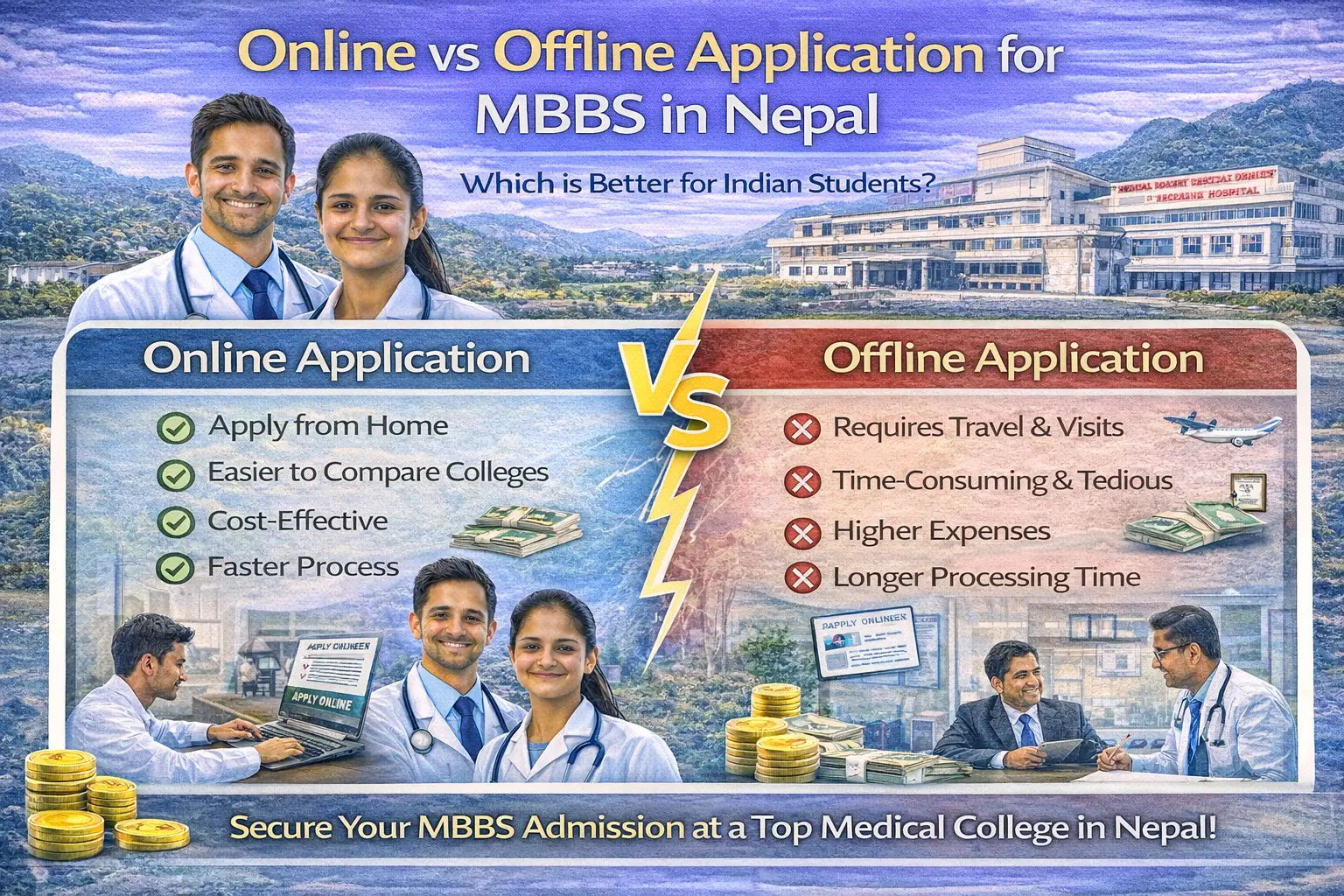
MBBS in Nepal is the most preferred choice among Indian students because the medical programs offered by Nepalese Medical Colleges are cost-effective and tuition-free. The first step on this journey is to decide whether or not one should apply online or offline. Get to know the pluses and minuses of each so students can make an informed decision for the class of 2025–26.
Online Application for MBBS Study in Nepal
Almost all the popular medical colleges of Nepal provide an online form through their official site.
Advantages of Online Application:
- Ease: Applicants can apply from anywhere without physically visiting the campus
- Quick Application Handling: Online applications are handled quickly, saving time.
- Document/Photo Uploading: You can upload NEET score cards, passport copies, and academic transcripts directly
- Real-Time Notifications: Students get alerts and updates through email or portal notifications
How to Apply Online:
Browse the official site of the college of your choice
Enter personal, academic, and NEET details
Attach the needed documents,such as passport photos
Make an application fee of $80 USD (non-refundable) payment online
Get a conditional admission letter on completion of document verification
Online programs are especially appealing for Indian students who cannot travel because of time or distance issues.
Offline Process for MBBS in Nepal
In some colleges, the offline mode of application, where a form from the website or prospectus is accepted through post, though rarely at the entrance office.
Advantages of Offline Application:
Personal Touch: Students can interact with college staff and clear their doubts
Document Verification: Physical submission reduces the incorrect uploading of documents
Fee Payment Method: Bank draft or in person
Limitations of Offline Application:
Sluggish: Postal delays or travel to collect the funds can take time
Number of slots: Fewer slots may be available for your offline submission, compared to the online application
Less Convenient: Physical effort and scheduling when to turn the essay in
3. Comparison of Online vs Offline Application
|
Aspect |
Online Application |
Offline Application |
|
Convenience |
High – apply from home |
Moderate – requires travel/post |
|
Processing Speed |
Fast |
Slower |
|
Document Handling |
Upload online |
Submit physical copies |
|
Confirmation |
Instant email/portal updates |
Manual notification |
|
Error Rectification |
Easy to edit online before final submission |
Harder once submitted physically |
So, for Indian students, it is preferable to go with online applications, considering they are fast, convenient, and lead to less travel. The offline application could be useful and is a more viable option if learners want instant help or are worried about the errors that occur due to online submissions.
Key Documents Required
Whether using the online or offline method, students need to send:
- NEET scorecard (NMC compliant)
- Passport copy
- 10th and 12th mark sheets
- Passport-sized photographs
All documents must be correct and up-to-date to prevent any delays with your application.
Recognition and Compliance
Indian students must ensure that the college chosen is recognized by NMC, listed in WDOMS, and follows WHO standards. This guarantees:
Eligibility for FMGE/NExT (India) exams
International recognition for further study or training
Worldwide acceptance and recognition of the MBBS degree
Tips for Indian Students
✔ You should apply well in advance to get into good colleges
✔ Verify that all documents are prepared before submitting them
✔ Choose an online manner that is easy unless strongly necessary, then apply offline mode
✔ Monitor admission deadlines and fee payment dates
Conclusion
Both offline and online applications have their merits, but for most Indian students who are looking to study MBBS in Nepal, the option of an online form is faster and more convenient, with less possibility of delays. Ensuring submission to colleges recognized by NMC, listed in WDOMS, and compliant with WHO standards ensures a smooth admission process and a globally valid medical degree. Choosing the right mode of application is the first step toward a successful medical career abroad.