 Call Us:
  B3/51 Vibhuti Khand, Gomti Nagar, Lucknow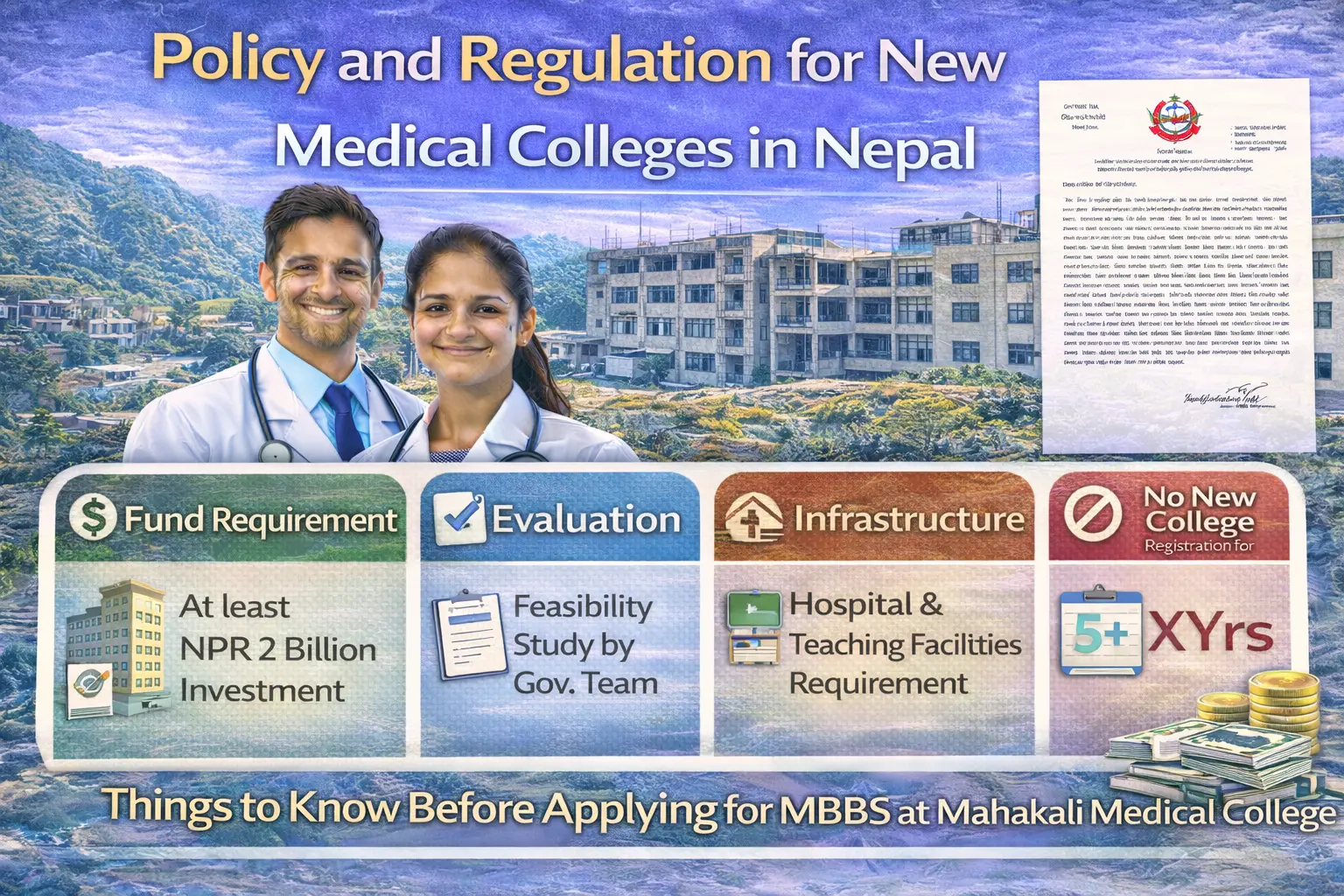
This way Nepal gradually develops its medical education field to support the desire for health & attract international students, and build a career for those who are seeking MBBS in Nepal. To preserve the standard of education and the level of care that is offered to patients, the government has set the most stringent requirements for opening up and managing new medical colleges. Such guidelines are there to ensure colleges have adequate infrastructure, faculty, hospital training, and global recognition.
Regulatory Authorities
Medical schools in Nepal are regulated by the national regulatory bodies to maintain educational standards. These bodies oversee curriculum design, building new facilities, hiring faculty, and hospital training sites. For Indian students, it is an added bonus if the foreign medical degree matches up to the norms laid down by the National Medical Commission (NMC) so that they can practice in India after completing their course abroad.
Process of Approval for Establishing a Medical College
To get a new medical college going, schools must obtain government permission in the form of an extremely lengthy approval process that includes:
- Submit the feasibility report and project report.
- Verification of financial capacity
- Inspection of infrastructure plans
- Faculty recruitment details
- Hospital tie-up or ownership proof
Inspections are carried out by the authorities before permission to admit students is given.
Infrastructure Requirements
According to the government guidelines, here is a rundown of the minimum facilities needed:
Academic Infrastructure
- Auditorium seating with audio-visual capacity
- Anatomy, Physiology, Biochemistry, Pathology, and Microbiology labs are well furnished.
- Library with updated medical literature
- Skill labs for practical learning
Clinical Infrastructure
- An attached teaching hospital
- Adequate bed strength
- Diagnostic labs and emergency services
- Operating theatres and ICU units
These infrastructures are also firmly institutionalized to be relied on, so that you get a well-rounded education both in studies and clinical practice.
Faculty and Staffing Norms
New medical schools have to recruit faculty members in all departments, such as:
Professors and associate professors
Clinical specialists
Lab technicians and nursing staff
Faculty quality adheres to the world standard for medical education as evidenced by institutions associated with the World Directory of Medical Schools (WDOMS).
Teaching Hospital Requirement
In fact, for every medical college, a teaching hospital is mandatory. The hospital must:
- Offer multi-specialty services
- Handle inpatient and outpatient cases
- Allow students real-time exposure to patients
- Support internship training
That means medical graduates will be more well-skilled by the time they finish their degree.
Curriculum and Academic Structure
A structured schedule from medical colleges and schools is supposed to comprise of the following topics:
- Pre-clinical training (Anatomy, Physiology, Biochemistry)
- Para-clinical subjects (Pathology, Pharmacology, Microbiology)
- Ward rotations (Medicine, Surgery, Pediatrics, Obs & Gyn)
The curriculum mirrors global health education approaches informed by WHO benchmarks.
Quality Assurance and Inspections
Colleges are inspected on an occasional basis to verify that:
- Academic standards are maintained
- Hospital facilities remain functional
- Faculty positions are filled
- Student learning outcomes are satisfactory
Schools that don’t adhere to norms may be penalized or lose their approval.
Recognition and International Listing
For worldwide recognition, new medical colleges want to be in the World Directory of Medical Schools (WDOMS). Recognition is also crucial for graduates to further study or sit licensing exams in other countries.
Indian students are required to follow NMC eligibility criteria and qualify NEET UG before joining MBBS in India or abroad.
Admission and Ethical Guidelines
There should be transparent admission processes and ethical practices to be followed in colleges regarding:
- Student selection
- Fee policies
- Academic conduct
- Research activities
These standards safeguard students and the integrity of medical education.
Conclusion
Within the context of what they refer to as government standards for infrastructure and academic criteria for new medical colleges in Nepal, Lesse and Shrestha make a strong argument that it is necessary to establish regulations through which institutions are required to provide clinical exposure, quality medical education, and an ethics-based academic environment.
Students aiming to pursue MBBS in Nepal should select colleges having infrastructure which matches the norms, possess teaching hospitals, have good faculty, and prefer recognition from WDOMS. Apt Mci White listed institutions' Spain Compliance with NMC rules and qualification in NEET UG are necessary for Indian students, education that is according to WHO principles means acceptance of their medical degree internationally.