 Call Us:
  B3/51 Vibhuti Khand, Gomti Nagar, Lucknow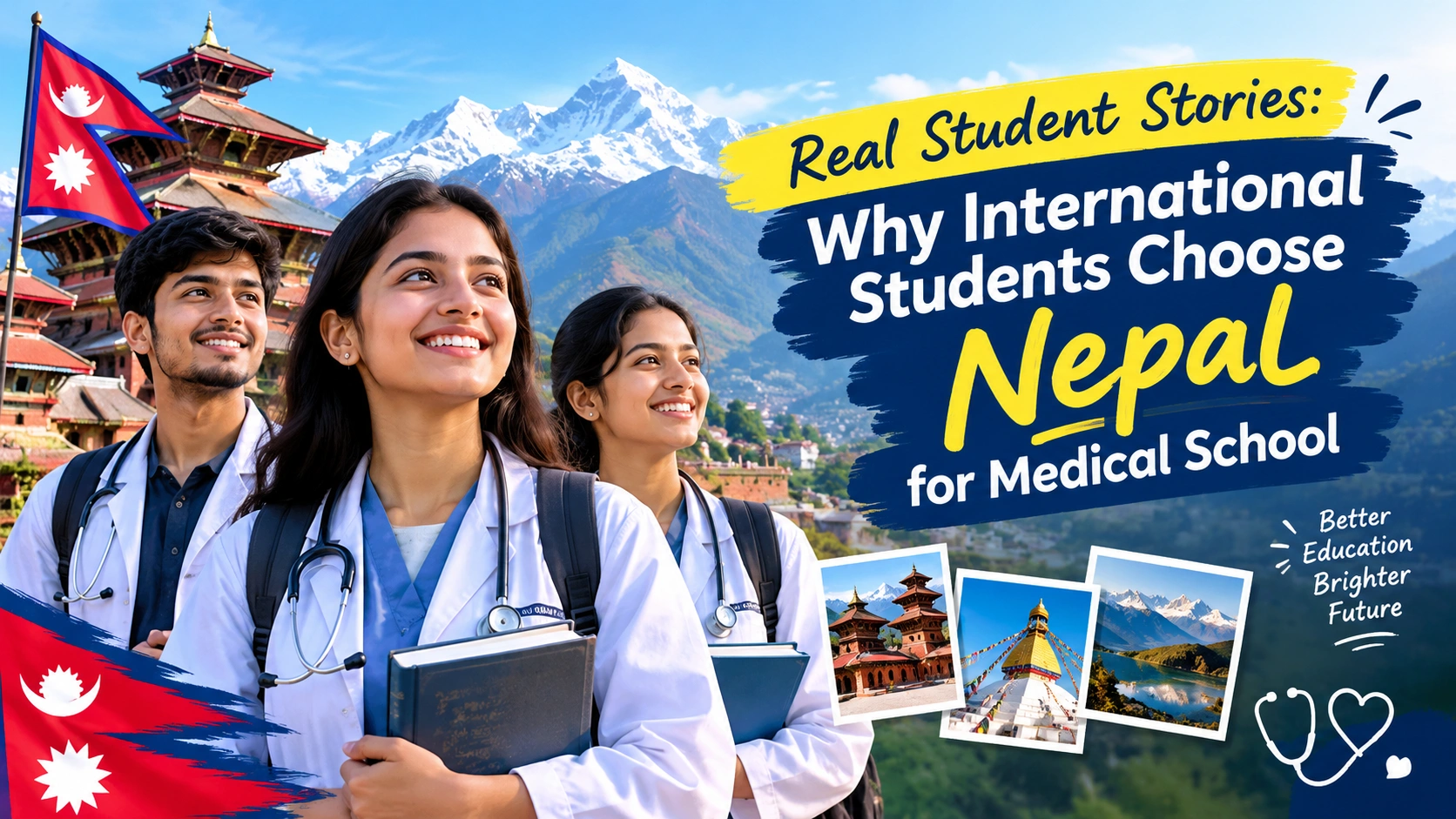
For many international students, choosing a medical school isn't simply about finding the lowest fee. It's about finding a place where they can actually see themselves living for five or six years, studying in a language they understand, getting regular clinical exposure, and still staying reasonably close to home.
That’s one reason MBBS in Nepal keeps appearing on the shortlist of students from India and other South Asian countries. Nepal feels familiar, but the medical education system is different enough to offer students another route into medicine. Students often talk about the same things after comparing their options: location, English-medium teaching, living costs, university affiliation, hospital exposure and the overall comfort of the environment. And then there’s the practical side. Nepal is next door to India. For a student who doesn’t want to be thousands of kilometres away from family, that matters.
Student Story: “I Wanted to Stay Close to Home”
A student from northern India might have several countries on the table — Russia, Georgia, Kazakhstan, Bangladesh, Nepal and others. On paper, they may all offer medical education. Life outside the classroom is where the differences start becoming obvious. One common reason students choose Nepal is simple: distance. A student can travel between India and Nepal without dealing with the kind of long-haul international travel required for many other destinations. Flights are available between major cities, while road travel is also possible from several parts of North India.
For families, that brings some peace of mind. One student’s decision may basically come down to this: “I wanted to study medicine abroad, but I didn’t want abroad to mean extremely far away.” Fair enough. Nepal also has medical schools affiliated with established universities, including Tribhuvan University and Kathmandu University. The World Directory of Medical Schools lists institutions such as the Institute of Medicine, Tribhuvan University and Kathmandu University School of Medical Sciences as operational medical schools offering the MBBS qualification.
“English Was a Big Factor for Me”
Imagine spending five and a half years learning medicine and constantly struggling with the language of instruction. That can become exhausting. For international students, English-medium medical education is therefore one of the first things they check before applying. Students choosing MBBS in Nepal generally look for programmes where medical subjects are taught in English, while local languages naturally become useful during everyday life and patient interaction.
That second part is actually worth thinking about. You may study anatomy, pathology, pharmacology and other subjects in English, but hospitals involve real people. Patients may speak Nepali or another local language. Learning a few practical phrases can make clinical communication much easier. It’s not just about passing exams. You’re preparing for patient-facing work.
Student Story: “The Fees Were Manageable, But I Checked Everything”
Cost is probably the biggest reason Nepal gets attention from Indian families. But the phrase “cheap MBBS” can be misleading. Depending on the medical college, university affiliation, student category and current fee structure, the overall cost for an international student can vary considerably. A broad planning range often discussed for the complete MBBS journey in Nepal is around ₹45 lakh to ₹75 lakh, once tuition, accommodation, food, travel and personal expenses are considered.
That’s an estimate, not a quotation. A private medical college can cost substantially more than another institution, and hostel or living expenses also differ by location. Students should always ask the college for the latest fee schedule before paying an admission amount. One student may see a ₹45–50 lakh estimate online and assume that's the final bill. Then accommodation, examination charges, food, transportation, insurance, deposits and other expenses appear. Not fun. So make a complete budget before admission. The MBBS in Nepal fee should be only one part of that calculation.
University and College Choice Can Change the Experience
Two medical colleges in Nepal can offer the same basic MBBS qualification while giving students a very different day-to-day experience. For example, College of Medical Sciences, Bharatpur is listed by WDOMS as a private medical school affiliated with Kathmandu University, with MBBS among its current programmes. Kathmandu University School of Medical Sciences is another example and is listed as a public school with access to clinical teaching facilities. That’s why students shouldn’t choose a college simply because somebody says, “This one is cheaper.”
Check:
- University affiliation
- Current recognition and regulatory status
- Teaching hospital
- Clinical exposure
- Hostel facilities
- Internship arrangements
- Total fee
- Refund policy
- International student admission rules
- Documentation requirements
Honestly, these details can matter more than saving a few lakh rupees.
What About NEET?
For Indian students, this question comes up almost immediately: Do I need NEET for MBBS in Nepal? Yes, Indian citizens and OCI candidates planning to pursue undergraduate medical education abroad need to pay close attention to the NEET requirement and the applicable NMC rules. NMC guidance states that Indian/OCI candidates seeking admission to MBBS or equivalent medical courses outside India are required to qualify NEET, subject to the applicable regulations. The current NEET UG website also publishes the latest NEET information and the 2026 information bulletin. So don't rely on an old YouTube video saying, “NEET isn't needed for Nepal.” Rules can change. Always check the latest official notice before applying.
How Long Does MBBS in Nepal Take?
The standard medical education pathway is not a quick three- or four-year programme. A typical MBBS curriculum in Nepal is around 5.5 years, including the academic and internship components, although exact programme structures should be confirmed with the individual institution. For example, WDOMS lists a 5.5-year curriculum duration for Karnali Academy of Health Sciences' MBBS programme. For a student planning a medical career, that timeline isn't unusual. You spend several years building the basics, move into clinical subjects, and then get practical exposure through hospital-based training. The exact structure varies by university and college.
The Recognition Question Students Shouldn't Ignore
This is where students need to slow down. Before joining any foreign medical college, check whether the institution and qualification meet the requirements applicable to your future practice destination. For Indian students, the National Medical Commission publishes regulations covering foreign medical graduates, including the Foreign Medical Graduate Licentiate framework. NMC's current rules and notices should be checked before admission because requirements can change. The World Directory of Medical Schools is another useful place to verify whether a medical school is listed and to review basic institutional information. But here's the catch: a WDOMS listing by itself shouldn't be treated as a guarantee of Indian registration or future licensure. Yahan thoda dhyan dena zaroori hai. If your long-term plan is to return to India, understand the NMC requirements before you pay the first instalment.
FMGE or NExT: What Should Students Expect?
The rules around foreign medical graduates have changed over time, so students shouldn't build their entire career plan around an old “FMGE experience” from someone who graduated ten years ago. NMC currently maintains regulations for foreign medical graduates and has also issued notices and FAQs concerning the applicable framework. The practical lesson is simple: if you study medicine outside India and later want to practise in India, you need to meet the licensing and registration requirements applicable at that time. Don't assume the medical degree alone automatically gives you permission to practise in India.
What Does the Admission Process Usually Look Like?
The process can vary between colleges, but international applicants generally need to prepare their academic documents, identity documents, entrance eligibility documents and other paperwork requested by the institution.
A typical process may involve:
- Checking eligibility and NEET requirements.
- Shortlisting suitable medical colleges.
- Checking university affiliation and recognition.
- Comparing the complete fee structure.
- Submitting the application and required documents.
- Receiving an admission or eligibility confirmation.
- Paying fees according to the official schedule.
- Completing enrollment and joining the programme.
Admission timelines can vary by institution and academic year, so don't assume that every college follows exactly the same calendar.
The Hidden Costs Students Discover Later
Tuition gets all the attention. Living expenses don't. A student should also budget for hostel charges, food, local transportation, books, medical equipment, clothing, mobile and internet expenses, travel home during holidays, visa or administrative costs where applicable, and unexpected personal expenses. Even an additional ₹50,000–₹1 lakh per year can become a meaningful amount over five years. A sensible approach is to keep an emergency fund rather than spending the entire available budget on tuition.
Why Students Ultimately Choose Nepal
After speaking with students and families, the reasons tend to become less complicated than the admission brochures make them sound. They want medical education without moving extremely far away. They want English-medium instruction. They want access to established medical institutions and hospitals. They want a familiar regional environment. And, for many Indian families, they want a foreign medical degree without the lifestyle shock that can come with moving to a completely different continent. That doesn't mean Nepal is perfect for everyone. Some students may prefer another country because of budget, university choice, climate, lifestyle or future career plans. Others may find the admission requirements or total cost unsuitable. That's normal. The right choice depends on the student, not just the country.
FAQs About MBBS in Nepal for International Students
Is Nepal a good option for Indian students studying medicine?
Nepal can be a practical option for Indian students who want to study medicine outside India while remaining relatively close to home. Students should still compare individual colleges, fees, clinical facilities and current NMC requirements before choosing.
Is NEET required for Indian students going to Nepal for MBBS?
Indian students should qualify NEET according to the applicable rules for studying medicine abroad. The latest NTA and NMC information should always be checked before admission.
How much does MBBS in Nepal cost?
A broad planning estimate for the complete course can be around ₹45 lakh–₹75 lakh, but actual expenses vary significantly by college and student. Always request the latest official fee structure before making a payment.
How long is MBBS in Nepal?
The MBBS programme is generally around 5.5 years, including the internship component, although students should confirm the exact curriculum with their chosen university or college.
Can Indian students practise in India after studying MBBS in Nepal?
They must satisfy the medical licensing and registration requirements applicable to foreign medical graduates in India. NMC regulations should be checked before admission and again closer to graduation because requirements can change.
How should I choose a medical college in Nepal?
Don't compare only tuition fees. Look at university affiliation, recognition, teaching hospital, clinical exposure, hostel arrangements, total expenses and the rules that will apply to you after graduation.
Conclusion
The most interesting thing about students choosing MBBS in Nepal is that their reasons aren't always dramatic. Sometimes it's simply a family saying, “We want our child to study medicine abroad, but not too far away.” Sometimes it's the student who has compared five countries and likes Nepal because the academic environment feels more familiar. Sometimes, yes, it's the budget.
And sometimes it's all three. If you're considering MBBS in Nepal, start by comparing colleges carefully rather than rushing toward the first admission offer. Check the current NMC rules, verify the institution through reliable sources such as WDOMS, understand the complete cost and then make the decision. For more guidance on colleges, fees, eligibility and admission planning, explore MBBS in Nepal and build your shortlist before making any payment.