 Call Us:
  B3/51 Vibhuti Khand, Gomti Nagar, Lucknow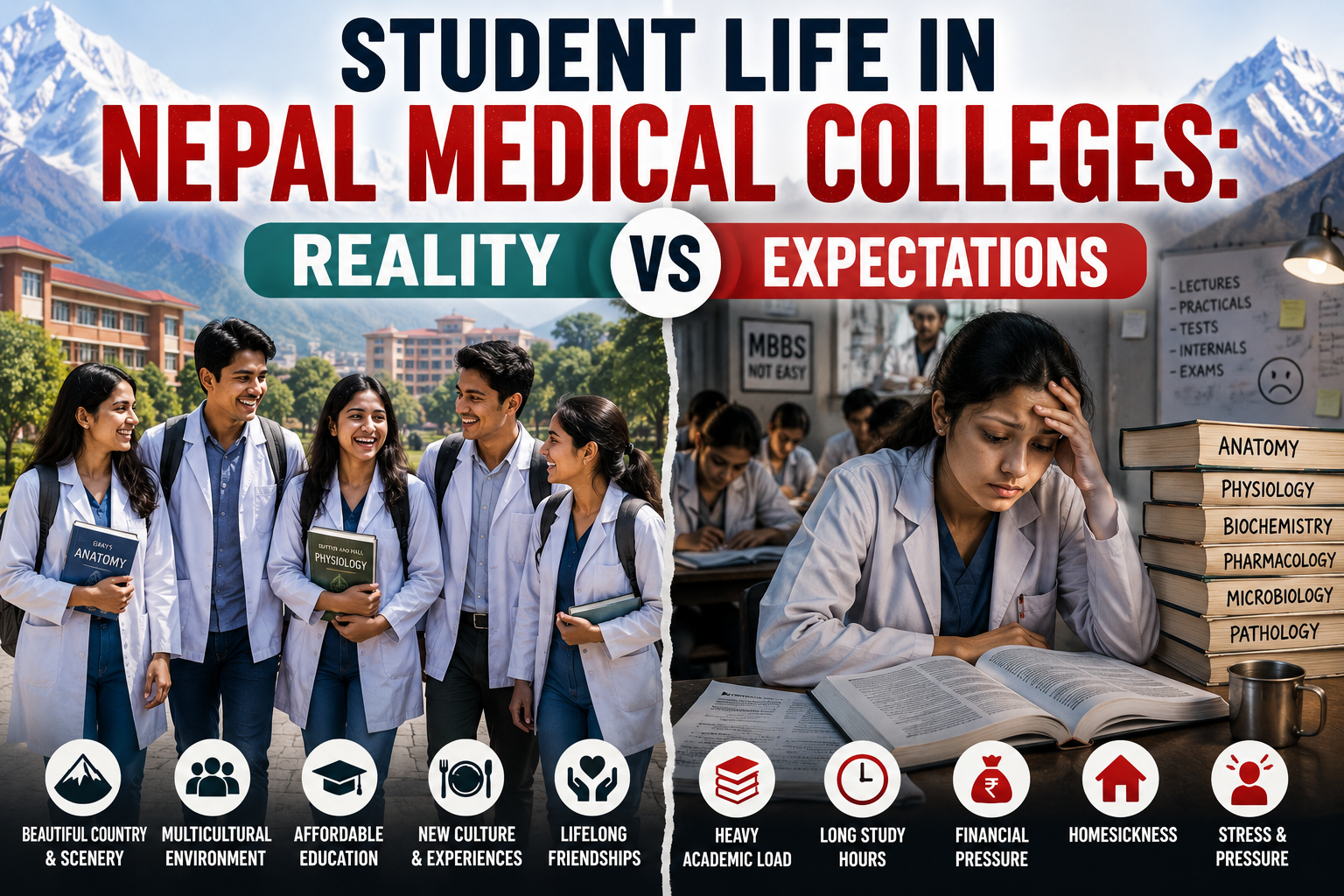
Introduction
Having a qualifying NEET score paves the way for many opportunities in medical education for Indian students. MBBS in Nepal has become one of the most popular destinations for Indian students due to the prominent colleges with good quality education, affordability, and cultural proximity.
Most students consider admission procedure, fees, and ranking of colleges. Student life is another important aspect that most students forget to consider. While life abroad can be challenging; at times it can also be very stressful. Most of the time, reality is somewhere in the middle.
Students entering medical schools have a lot of expectations. These expectations include hostels, food, academic and personal freedom, friendships, clinical lessons, and life on the campus. An understanding of the real life on campus provides medical aspirants with the knowledge and skills to be ready for the transition.
The objective of this article is to explain the real student life in Nepal medical colleges in comparison to expectations, and the reasons that thousands of Indian students obtain admission for MBBS in Nepal, every year.
Why Student Life Matters
Medical education goes beyond the classrooms and the examinations.
The students get to spend many years in a totally new place, learning and growing. The experiences that they get during this time determine:
- Personal development
- Professional development
- Confidence
- Adaptability
- Communication skills
- Relationships
Life on campus is as important as the curriculum to a medical student.
Expectation 1: Life Abroad Will Feel Completely Different
Reality
Of the many surprises for Indians studying MBBS in Nepal, the most surprising is how familiar everything is.
Nepal has much in common with India culturally, such as:
- Festivals
- Culinary traditions
- Lexicons
- Social norms
- Religious customs
This commonality helps students adapt from India more easily than from other countries that are culturally and socially dissimilar.
It has been reported that many Indian students feel completely at ease within the first few weeks of arriving.
This is usually a much easier process than what was originally expected.
Expectation 2: Lesser Academic Pressure
Reality
Like India, Nepal also has a high demand for medical education.
The belief that traveling abroad always equates to less difficult study requirements is untrue. Medical colleges in Nepal have maintained high educational standards.
Lectures, lab sessions, clinical postings, and a series of assessments including internal and practical tests, are all part of the medical curriculum.
Those who envision less academic pressure have been met with the surprising reality of more.
Academic Life in Nepal Medical Colleges
Well Organized Educational System
Most Colleges have a well structured educational system that includes:
- Lectures
- Practicum
- Clinical training
- Group discussion
- Tutorials
The rigidity of this system instructs students on the importance of discipline and commitment.
Similar Curriculum as India
MBBS in Nepal is also a popular degree choice amongst Indian students due to its similarities in curriculum.
Subjects such as:
- Anatomy
- Physiology
- Biochemistry
- Pathology
- Pharmacology
- Medicine
- Surgery
are taught in a similar format to their Indian counterparts.
This encourages quicker adaptability.
English-Medium Instruction
Most of the medical colleges instruct in English, allowing seamless communication in the classroom for the Indian students.
There is no need for students to grapple with an unfamiliar academic language for lectures and examinations.
Expectation 3: Hostel Life Will Be Tough
Reality
Some students are concerned about adjusting to hostel life.
To accommodate students, the hostel facilities at the Nepalese medical colleges are designed with comfort as well as focus on academics in mind.
Many hostels offer:
- Furnished rooms
- Security services
- Study rooms
- Internet
- Dining facilities
Though there is an adjustment to hostel life, most students enjoy the independence and friendships hostel life offers. Living away from home often becomes the most enjoyable and memorable aspect of their medical life.
Making Friends
A Diverse Community of Students
Medical colleges in Nepal have students from:
- Nepal
- India
- Other international countries
This diversity encourages students to converse and interact with people of all different backgrounds.
A Large Indian Presence
Every year, there is a large influx of Indian students pursuing their MBBS in Nepal.
As a result, new students are likely to not feel lonely or isolated.
Seniors often help guide their juniors on:
- Academics
- Hostel life
- Exams
- Clinical postings
These networks provide support to help students settle in.
Expectation 4: The Food Will Be Entirely Different
Reality
Food can often be one of the biggest worries for students and parents.
Thankfully, Nepal is one of the countries where there are food options very much aligned with Indian meals.
Common offerings are:
- Rice
- Dal
- Chapati
- Vegetables
- Curry
- Snacks
Many hostel messes and nearby restaurants serve Indian meals.
It is generally easy to adapt to the local meals even if students initially miss home made food.
Clinical Training: Expectation and Reality
Expectation
Many students think that clinical exposure starts in the later years of the MBBS.
Reality
Some of the Nepalese medical colleges have students exposed to the world of hospitals very early on.
- Clinical observations
- Patient interactions
- Ward visits
- Case discussions
All of these increase in intensity during the academic advancement of the student.
This is one of the prime differentiators associated with pursuing an MBBS in Nepal.
Importance of Hospital Exposure
Learning Beyond the Classroom
Mastering the art of medicine is not possible with just theory.
Clinical training provides students the opportunity to:
- Survey patient care
- Identify and comprehend various disease manifestations
- Hone their verbal communication and diagnostic skills
Patient Diversity
Clinical training is made even more effective by the vast, diverse patient population.
Because of the sheer volume of patients, students are exposed to varying disease presentations and complexities of the healthcare system.
This becomes an essential building block for the future practice of medicine.
Expectation 5: There Will Be Few Opportunities for Extracurricular Activities
Reality
Even though academic pursuits take a primary importance, the student lifecycle is not made up of academics alone.
Most colleges have:
- Sports events
- Cultural Events
- Medical Conferences
- Awareness Programs
- Community Outreach
These initiatives promote a healthy lifestyle and the development of requisite skills.
Participation in these initiatives also builds skills associated with teamwork and communication.
Student Independence
To many, the personal biggest advantage of the MBBS abroad program is personal independence.
Students learn how to:
- Budget
- Plan
- Prioritize
- Balance work and life
This contributes to the overall maturity of the individual and many students report becoming more confident during their MBBS years.
Expectation 6: It Will Be Hard to Communicate
Reality
This is usually an incorrect assumption with minimal challenges to communication.
Language skills of the medical population will be sufficient to address patient concerns and aid in daily activities.
Safety and Security
Student Concerns
Parents have high concerns for their child’s safety when they study abroad.
Reality
Nepal is safe and generally known to be a student-friendly nation.
Most medical colleges have:
- Hostel security
- Campus security
- A student assistance program
Students feel safe on and off campus.
There is an even more comforting presence of many Indian students.
Mental Health and Academic Stress
Reality of Medical Education
Studying MBBS is a strenuous academic pursuit in any country.
Students can be prone to:
- Stress from exams
- Homesickness
- Poor use of time
The good thing is that students are provided with communication from family and faculty that help them through.
Study habits must be healthy and well developed for success.
Recognition and Career Planning
Nepal’s MBBS students are concerned about college recognition and placement within the World Directory of Medical Schools (WDOMS) as it impacts future opportunities.
Then, as they maintain traveling and learning, Indian students are assisted by colleges that comply with the NMC.
Students must check the recognition of their college before they apply.
Expectation 7: Student Life = Vacation
Reality
One of the most unrealistic expectations is that students that study abroad have a laid back life.
Students have to understand that medical studies are very serious and tough.
Students must spend a lot of time on:
- Book work and lectures
- Practicals
- Study for exams
- Clinical work and training
Students learn to balance the challenges of studying with time for entertainment and personal growth.
Benefits of Studying in Nepal
Nepal is popular among students because of its:
- Familiar Culture
- Similar Academic Structure
- Intensive Clinical Training
- Proximity
- Friendly Atmosphere
Familiar Culture
The inclusion of Indian culture and social structures provides a familiar atmosphere.
Similar Academic Structure
The syllabus is almost identical to the Indian medical education structure.
Intensive Clinical Training
There is great exposure to hospitals and clinics.
Proximity
The distance between India and Nepal is manageable.
Friendly Atmosphere
The large population of Indian students is inviting.
Common Experiences
In addition, while undergoing medical education, students learn that:
- Discipline and consistency are more important than intelligence.
- Clinical skills and patience go hand in hand.
- College and medical school are great places to meet friends.
- Independence is a great confidence booster.
These lessons are imperative for personal and professional growth.
Prospects
Students who graduate from medical schools in Nepal that are recognized are offered many career options including:
- Medicine
- Post-graduate education
- Research
- Public Health
- Opportunities abroad
When choosing a medical school, students are urged to check that the school is on the WDOMS list and meets the NMC requirement.
Final Thoughts
Student life in Nepal is more fulfilling than known and expected. Culture and environment make medical education more bearable without compromising quality.
For Indian students who qualify in NEET, studying MBBS in Nepal is more than just acquiring a medical degree. It is a gateway to valuable friendships, personal and professional growth, and adequate clinical training in a familiar environment.
Student life in Nepal can actually be quite demanding; students usually have a plethora of academic commitments. Life as a student can be challenging with commitments like class attendance and extra work to perfect your grades. To succeed in this profession of lifelong learning as a future doctor requires the ability to balance all these challenges with personal and professional development.