 Call Us:
  B3/51 Vibhuti Khand, Gomti Nagar, Lucknow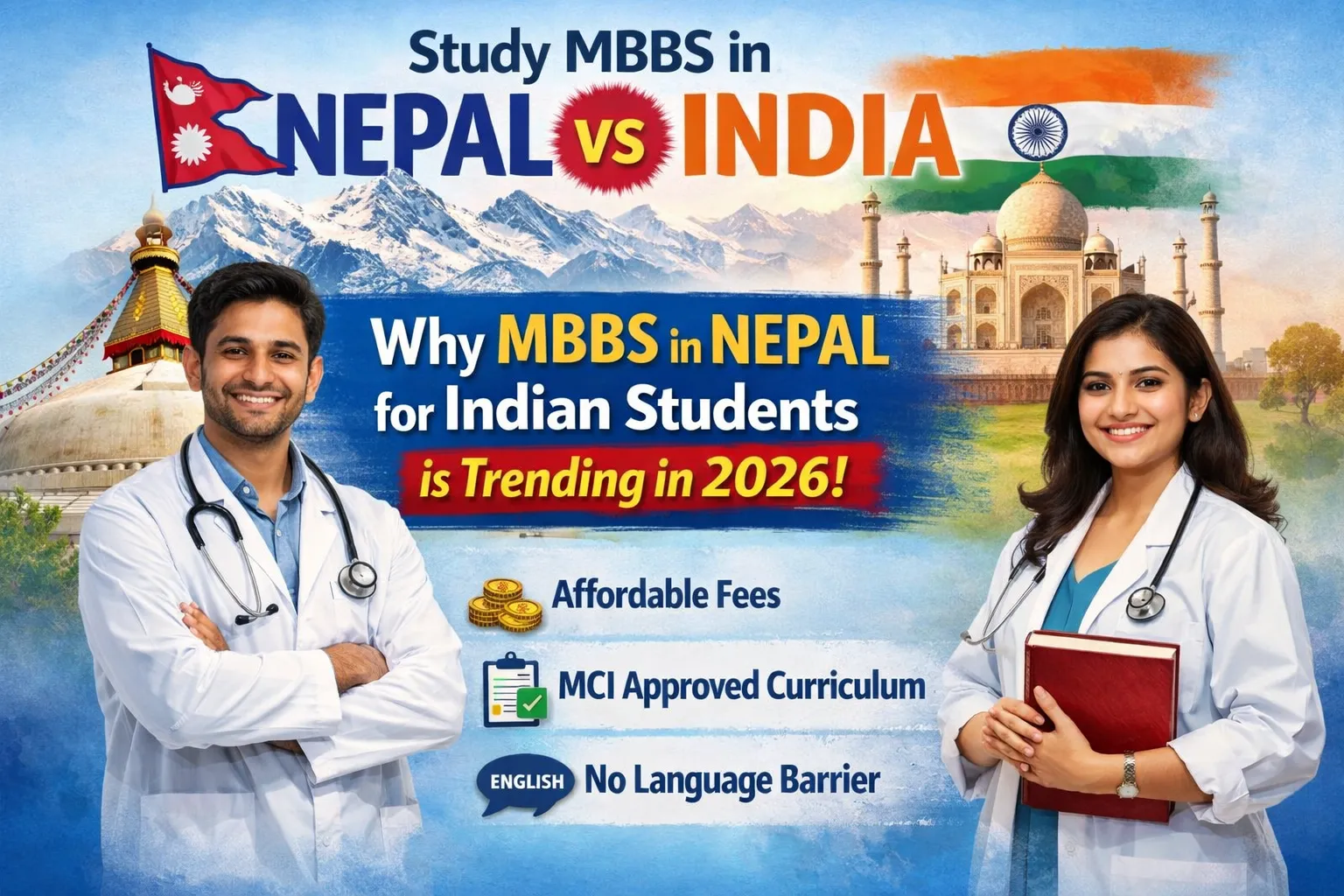
Introduction
For Indian medical aspirants, deciding to study in India or abroad is a crucial decision. Due to increased competition and limited government seats, a lot of students are seeking alternatives. This makes MBBS in Nepal an emerging choice among them.
In 2026, while seeking a balance between affordability, quality education, and career opportunities, more students are comparing study MBBS in Nepal vs India. Compared to private colleges in India, Nepal has an identical medical course that is delivered in English and at lower fees.
Medical universities in Nepal are listed in directories backed by the World Health Organization, and National Medical Commission guidelines ensure valid and globally recognized degrees.
In 2026, why is Nepal trending among Indian students: a complete comparison of MBBS in Nepal vs India.
Nepal vs India MBBS: A Quick Comparison
Factors
MBBS in Nepal vs MBBS in India
- Course Duration
Nepal: 5.5 Years
India: 5.5 Years - Medium of Teaching
Nepal: English
India: English - Entrance Exam
Nepal: NEET Required
India: NEET Required - Tuition Fees
Nepal: ₹40–70 Lakhs
India: Govt: ₹1–10 Lakhs / Private: ₹80L–₹1.5 Cr - Donation
Nepal: No (in most cases)
India: High in private colleges - Curriculum
Nepal: Similar to India
India: Standard Indian curriculum - Recognition
Nepal: NMC + WHO listed
India: NMC recognized - Competition
Nepal: Moderate
India: Extremely High
In 2026, Why MBBS in Nepal Is Trending
High Competition in India
NEET applicants flock to India's limited number of government medical seats. Admission is highly competitive as lakhs of students compete for a limited number of seats every year.
This compels students, including those with good scores who have been competing for government seats, to now opt for MBBS in Nepal as an alternative.
Affordable Alternative to Private Colleges
Private colleges for MBBS in India charge very high fees, often above ₹1 crore. That makes them out of reach for many middle-class families.
The same process to study MBBS in Nepal would only cost roughly around ₹40–70 lakh, making it a much more viable and economical option.
Similar Curriculum and Study Pattern
The academic structure in Nepal is similar to India, which is one of the major benefits for Indian students.
Students study:
- Pre-clinical subjects
- Para-clinical subjects
- Clinical training
This resemblance also makes it easier for students to prepare for licensing exams conducted by the National Medical Commission.
NMC Recognition and Global Validity
One of the biggest concerns for students studying abroad is whether their degree will be recognised in India.
Medical universities in Nepal follow a curriculum aligned with the National Medical Commission, so students can appear for FMGE/NEXT and become eligible for licenses.
Moreover, established universities listed in World Health Organization-supported directories enable students to pursue careers internationally.
English-Medium Education
MBBS in Nepal is conducted in English, similar to India. This is beneficial for Indian students.
This helps students:
- Understand concepts easily
- Use standard medical textbooks
- Communicate effectively during clinical training
Hence, MBBS in Nepal for Indian students is a more convenient choice compared to countries with different languages.
Cultural and Lifestyle Similarity
Nepal has strong cultural similarities with India, which helps students adapt easily.
Students benefit from:
- Similar food and lifestyle
- Hindi widely understood
- Familiar festivals and traditions
That is why students feel comfortable while studying MBBS in Nepal.
Travel Made Simple and No Visa Required
No visa is required for Indian students wishing to study in Nepal. Open borders and geographical proximity make travel simple and convenient.
As a result, Nepal is one of the easiest foreign options for Indian students.
MBBS in Nepal vs India: Key Differences
Admission Difficulty
Due to limited seats in India, getting admission is highly competitive. In Nepal, the admission process is much easier, especially for students who qualify NEET.
Fee Structure
Government colleges in India are affordable but very difficult to get into. Private colleges are expensive.
Nepal offers a balanced option where fees are reasonable and education quality is good.
Exposure and Learning Environment
Both India and Nepal offer good clinical exposure. However, for students who are unable to secure a seat in India, Nepal becomes a practical alternative.
Full Details of Eligibility Criteria for MBBS in Nepal
Eligibility for MBBS in Nepal for Indian Students
To qualify for MBBS in Nepal, students are required to meet the following eligibility criteria:
- Qualifying NEET (as per National Medical Commission mandatory)
- 10+2 with PCB or PCM
- Minimum 50% marks (General category)
- Minimum age of 17 years
Career Opportunities After MBBS
After MBBS in Nepal
In India, students are required to pass the licensing exam held under the National Medical Commission to practice.
They can also go for higher studies overseas by passing examinations such as:
- USMLE (USA)
- PLAB (UK)
- AMC (Australia)
After MBBS in India
Students can directly apply for postgraduate courses or start practicing after registration.
Is Studying MBBS in Nepal Better Than India?
Whether the answer is yes or no depends on the student.
The ideal situation is to secure a government MBBS seat in India.
Otherwise, if private college fees are too high, then MBBS in Nepal is a good option.
Nepal offers quality education with global recognition at a reasonable cost, making it one of the best backup choices for Indian students.
Conclusion
The comparison of MBBS in Nepal vs India clearly explains why Nepal has become a trending choice in 2026. Nepal presents a practical alternative for Indian students seeking to study medicine, with lower fees and a similar course structure along with easier access.
While India remains the first choice for students who secure government seats, studying MBBS in Nepal is a strong option for those who do not want to spend heavily on private colleges.
Choosing the right university that follows NMC guidelines can help students build a successful medical career in India or abroad.