 Call Us:
  B3/51 Vibhuti Khand, Gomti Nagar, Lucknow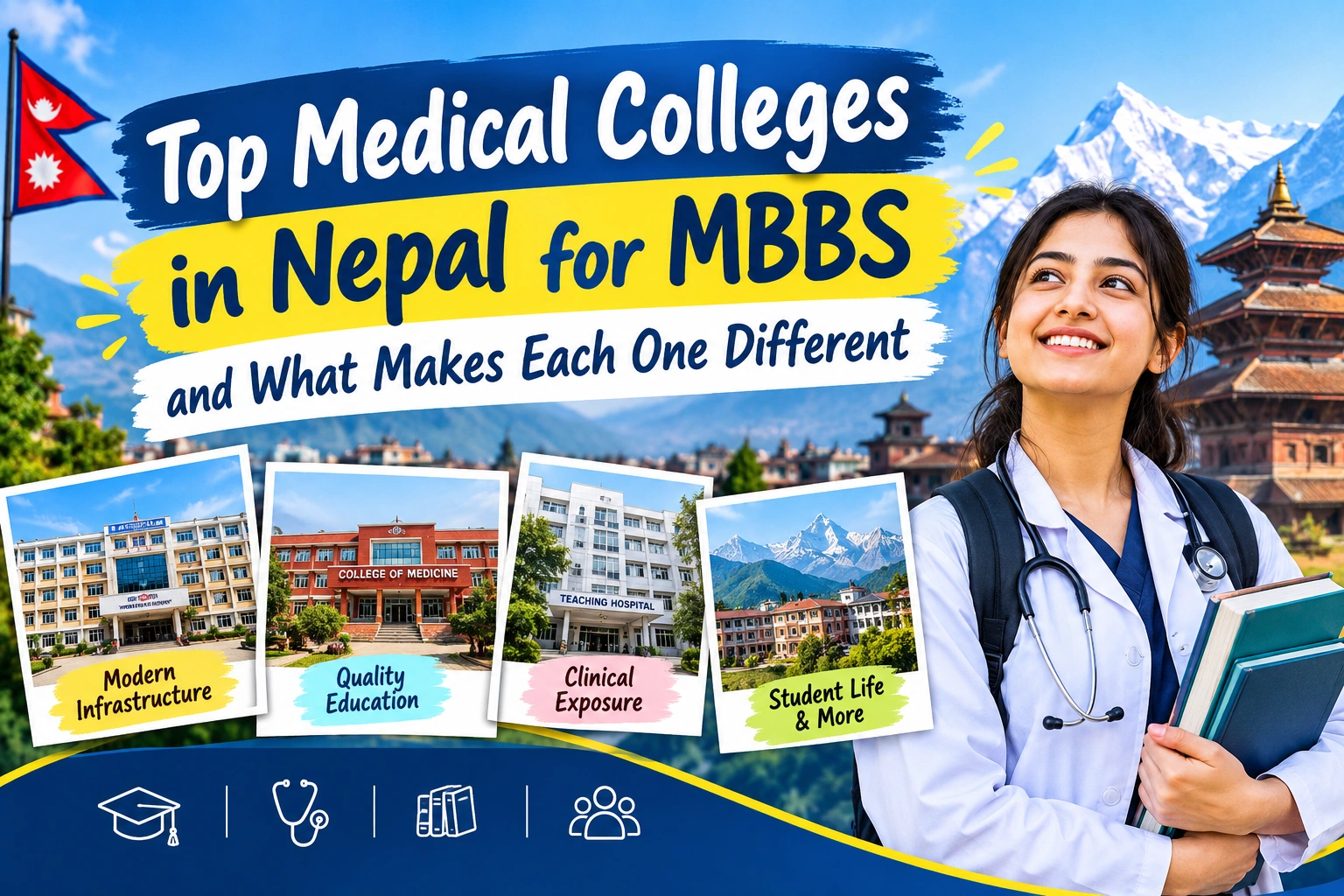
For many Indian students, choosing a medical college abroad isn't really about finding the cheapest seat. It’s about finding a college where the fees make sense, the hospital is good, the course follows the right rules, and the degree won’t create problems later. That’s where MBBS in Nepal gets interesting. Nepal is close to India, English is widely used in medical education, and several established colleges have long experience teaching Indian and international students. But there’s a catch. Not every college offers the same kind of experience. One may have a stronger teaching hospital, another may be better placed in Kathmandu, while a third can be more attractive because of its location and overall student environment. So, instead of simply making a “top 10” list, let’s look at what actually makes some of the better-known medical colleges different.
Why Indian Students Consider MBBS in Nepal
Geography is one obvious reason. You’re not travelling halfway across the world to visit home during a break. For students from North India especially, Nepal can feel relatively accessible by road or air. The other factor is the medical education setup. Nepal has medical schools affiliated with universities such as Kathmandu University and Tribhuvan University, along with public health-science institutions. The World Directory of Medical Schools lists several Nepalese schools offering MBBS qualifications, including Kathmandu University School of Medical Sciences, Institute of Medicine and College of Medical Sciences. Still, don't choose a college just because somebody calls it “NMC approved.” Check the current NMC rules and the individual institution's status before paying anything. NMC's current regulations include specific requirements for foreign medical graduates, including course duration, clinical training and internship arrangements.
Kathmandu University School of Medical Sciences
Located in Dhulikhel, KUSMS is one of the names students usually come across while researching MBBS in Nepal. It is a public medical school affiliated with Kathmandu University, and WDOMS, an WHO records its MBBS programme and clinical teaching facilities. What makes KUSMS different is its university-linked academic environment. Dhulikhel also gives students a different setting from central Kathmandu. It's quieter, less hectic and still within reasonable reach of the capital.
For students who care strongly about university reputation and an established academic setup, this can be worth considering. Fees for Nepalese medical programmes vary by category and admission cycle, so don't rely on an old figure copied from a counselling website. Get the current fee sheet before making a decision.
Institute of Medicine, Tribhuvan University
The Institute of Medicine, particularly Maharajgunj Medical Campus in Kathmandu, has a much longer academic history. WDOMS records instruction beginning in 1978 and identifies Tribhuvan University as its current academic affiliation. This is the kind of college students should investigate if they want a more established public-sector medical education environment. Its location in Kathmandu is another practical advantage. There’s also a difference in the feel of the institution. A large, established medical campus in a major city can offer exposure to a broad patient population and a busy clinical environment. For some students, that's a bigger advantage than having a modern-looking campus.
Manipal College of Medical Sciences, Pokhara
Pokhara is a big part of the attraction here. Beautiful surroundings aside, students often look at Manipal because of its established medical education setup and teaching hospital. The MBBS programme is generally described as 4.5 years of academic study followed by a one-year internship, making the usual duration around 5.5 years. Recent 2026 fee information available online varies significantly depending on the student category and fee source, so students should confirm the official amount directly with the college before making any payment. The biggest difference? Location and the overall student experience. Pokhara isn't Kathmandu. Some students prefer that. Others want the larger-city environment. Honestly, visit the campus if you can. Photos don't tell you much about everyday student life.
Kathmandu Medical College
Kathmandu Medical College is another major option for Indian students looking at MBBS in Nepal. WDOMS lists it as an operational medical school in Kathmandu with Kathmandu University as its current academic affiliation and an MBBS programme. Its location is a practical advantage. Kathmandu gives students access to a major urban healthcare environment, while the college's teaching hospital setup provides the clinical side of medical education.
Fees can be substantial for international students. A published KMC fee document has listed different payment components for Indian/international students, including admission and other institutional charges, while current figures can change with the admission cycle. So don't compare colleges using tuition alone. Add hostel, food, university charges, registration, travel and other expenses.
College of Medical Sciences, Bharatpur
CMS Bharatpur is another established option and is affiliated with Kathmandu University. WDOMS records the institution as operational, with MBBS as one of its current programmes. Bharatpur is interesting because it gives students access to a sizable healthcare environment without putting them right in the middle of Kathmandu's traffic and city rush.
The teaching hospital is a major point to investigate here. Clinical exposure matters a lot in medicine. A college can have good classrooms, but eventually you'll spend a huge part of your training dealing with actual patients. Current online fee estimates for CMS vary considerably, with some 2026 sources placing the overall MBBS cost around the ₹55–65 lakh range depending on what is included. Treat these as indicative rather than final figures and ask the college for the current official fee structure.
Nobel Medical College, Biratnagar
Nobel Medical College in Biratnagar is a private medical institution affiliated with Kathmandu University. WDOMS lists it as operational and offering an MBBS programme. Its location in eastern Nepal is one of the obvious differences. Students who want a large private teaching hospital environment outside Kathmandu may find it worth researching. The college has also published fee notices specifically for Indian and other international students, which is useful because foreign-student fees can differ from local categories. Its 2025/26 fee notice is publicly available, while students applying for a newer intake should request the latest version. That's a small thing, but a useful one. Always ask for a written fee structure.
Nepal Medical College, Kathmandu
Nepal Medical College is another Kathmandu-based private institution and is currently affiliated with Kathmandu University according to WDOMS. The school began instruction in 1997 and offers the MBBS qualification. For students comparing private colleges, its Kathmandu location can be a deciding factor. You get access to the capital's broader student and healthcare ecosystem, although living costs may also be higher than in smaller Nepalese cities. This is where your personal preference matters. Some students want a busy city. Others get tired of it very quickly.
What About Fees for MBBS in Nepal?
There isn't one universal fee for every Indian student. Fees can change based on university rules, student category, admission year and the college. As a broad planning figure, Indian students may see total tuition and institutional costs in the ₹50 lakh to ₹75 lakh or more range at several private medical colleges, with hostel, food, travel, insurance and personal expenses coming separately. Some colleges or categories can be lower or higher.
For example, current online estimates for 2026–27 show substantial differences between colleges, while published college documents also show that payment structures can include one-time charges and university-related fees. So, don't ask only, “What is the tuition?” Ask for the complete payable amount.
NEET, Eligibility and Admission
Indian students planning MBBS in Nepal should treat NEET qualification as a basic requirement rather than something they can simply skip. NEET-UG is the common entrance examination used for undergraduate medical education, and NMC's foreign-medical-graduate guidance also requires Indian students to meet the applicable eligibility conditions. Generally, students should have studied Physics, Chemistry and Biology/Biotechnology with English in their qualifying examination and meet the applicable percentage and age requirements. Admission timing depends on the college and Nepal's medical admission process. For a particular year, check the Medical Education Commission and college notices rather than relying on a counsellor's old WhatsApp PDF.
The FMGE/NExT Question Indian Students Shouldn't Ignore
Here's the part many students think about only after admission. If you plan to return to India and practise medicine, foreign medical graduate rules matter. NMC's current framework includes the Foreign Medical Graduate Licentiate Regulations, and its 2026 advisory highlights requirements involving course duration, medium of instruction, curriculum, clinical training and internship.
The NMC's April 2026 advisory specifically says Indian students should verify requirements such as at least 54 months of education in a single foreign institution, a 12-month internship at the same foreign university, English as the medium of instruction and appropriate clinical training. That's serious. Before selecting any Nepalese college, check its current compliance rather than assuming that every listed medical school automatically meets every Indian registration requirement. Also check the school's listing in WDOMS. But remember, WDOMS itself says that being listed doesn't automatically mean recognition, accreditation or endorsement.
Hidden Costs Students Often Forget
The tuition figure isn't your complete budget.
Keep money aside for:
- Hostel and mess charges
- University and registration fees
- Books and medical equipment
- Travel between India and Nepal
- Visa or documentation-related costs, where applicable
- Insurance
- Personal expenses
- Examination and supplementary examination fees
- Local transportation
A few thousand here and there doesn't sound like much. Over five or six years, it adds up.
How to Choose the Right College
Don't rank colleges only by fees. I'd personally check these points in this order:
- Current NMC compliance for Indian graduates.
- University affiliation and current programme status.
- Teaching hospital and clinical exposure.
- Course duration and internship structure.
- Total fee, not just tuition.
- Hostel and living arrangements.
- Location and travel convenience.
- Current admission rules for Indian students.
- WDOMS listing and other relevant institutional records.
- Written fee and admission documents before payment.
You can also explore college information and related guidance on MBBS in Nepal before shortlisting institutions.
FAQs
Is MBBS in Nepal good for Indian students?
It can be a practical option for students who meet the eligibility requirements and select a college that satisfies the applicable Indian and Nepalese regulations. The college, curriculum, clinical training and internship structure need to be checked individually.
Is NEET compulsory for MBBS in Nepal?
Indian students seeking to study medicine abroad generally need to qualify NEET to meet the applicable Indian eligibility requirements. Always check the current NMC and NEET rules for your admission year.
How long is MBBS in Nepal?
Many Nepalese MBBS programmes are structured around 4.5 years of academic education plus a one-year internship, or approximately 5.5 years overall. The exact structure should be confirmed with the specific college.
Which is better, Kathmandu or Pokhara for MBBS?
Neither is automatically better. Kathmandu offers a major-city environment and access to large healthcare institutions, while Pokhara offers a different pace and setting. Your preference, clinical exposure and college-specific facilities matter more than the city name.
How much does MBBS in Nepal cost for Indian students?
A sensible planning range for several private colleges is around ₹50–75 lakh or more for major academic and institutional costs, but the actual amount varies significantly by college and intake. Get the latest official fee sheet before paying.
Can Indian students practise in India after MBBS in Nepal?
They must satisfy the applicable NMC requirements for foreign medical graduates and complete the required licensing/registration pathway. The rules have changed over time, so students should verify the current requirements before admission rather than assuming the process will be the same as for earlier batches.
Conclusion
The best college for MBBS in Nepal isn't necessarily the one with the lowest fee or the most impressive advertisement. It's the one that fits your budget, gives you meaningful clinical exposure and meets the requirements you'll need after graduation.
KUSMS and IOM stand out for their established academic backgrounds. Manipal attracts students who like the Pokhara setting and established teaching environment. Kathmandu Medical College and Nepal Medical College offer the advantages of studying in the capital, while CMS Bharatpur and Nobel Medical College provide other established options outside Kathmandu. Take your time. Compare the current documents. Speak directly with the college. And before you transfer a large amount of money, verify everything twice. In medical education, that's not overthinking. It's simply being careful.