 Call Us:
  B3/51 Vibhuti Khand, Gomti Nagar, Lucknow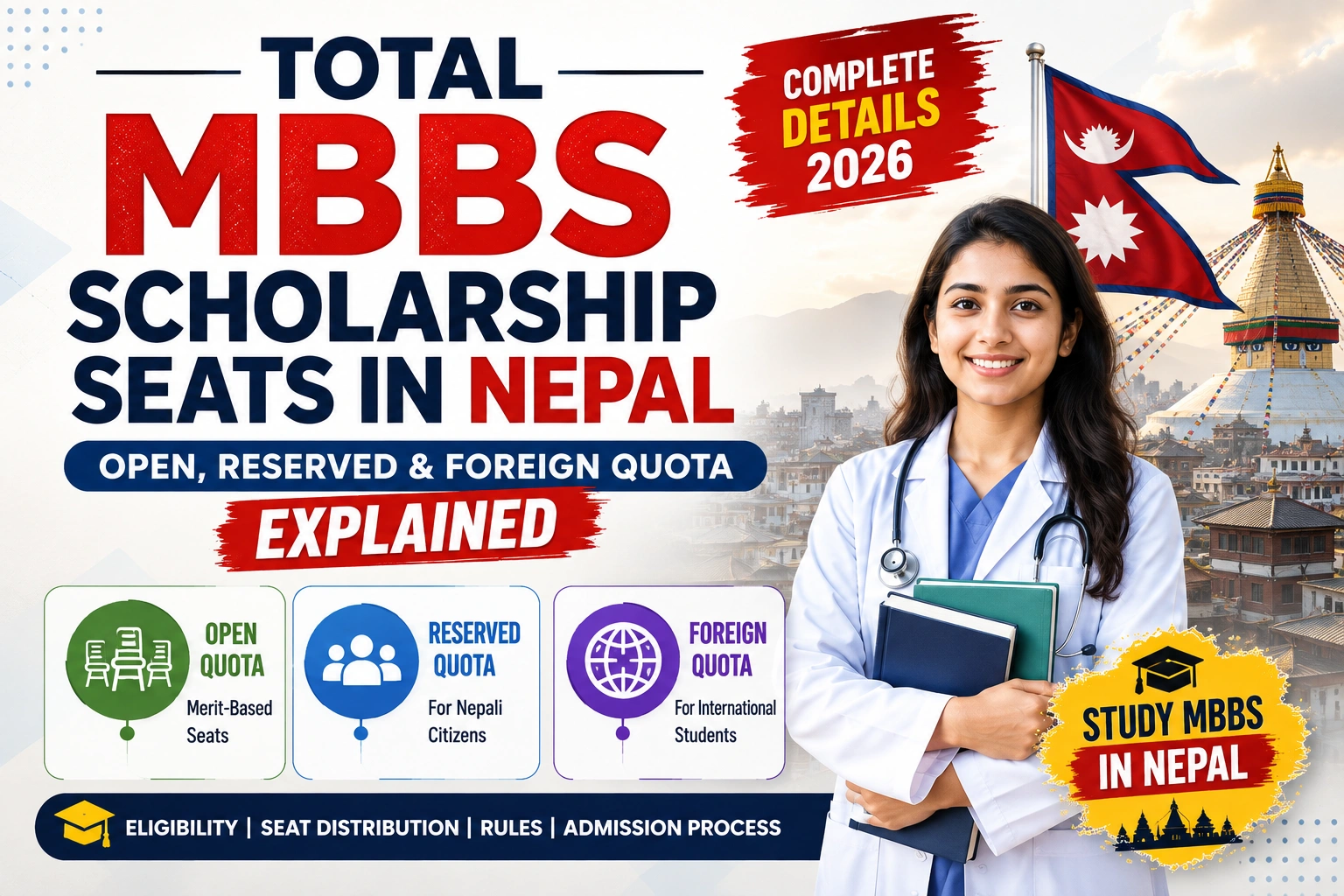
Nepal attracts thousands of Indian students interested in studying medicine abroad for many reasons. Nepal is conveniently located in India, and almost has the same cultural beliefs. Education is cheap and reputable medical schools are available, which help prospective medical students make their decision. Many factors influence such a big decision and Indian students who wish to study MBBS in Nepal are interested in learning about scholarship opportunities, gaps, eligibility, and the application process.
There are open scholarship seats, reserved category seats and foreign quota seats in the scholarship system for MBBS in Nepal. Knowing the different options of the scholarship system in Nepal helps students plan the most effective way to pursue a medical degree in Nepal.
Students can get useful information about MBBS in Nepal by meticulously going through the website. They can also learn about various medical universities in Nepal, the admission procedure in each university, the fees, eligibility, etc.
Nepal’s medical colleges adopt the policies of the regulatory bodies of NMC and other state medical councils in India and expect students to fulfill criteria established by the NEET for studying MBBS beyond India. Most of the medical colleges in Nepal are featured in the World Directory of Medical Schools (WDOMS) and WHO to assure recognition in international schools.
Schemes Available for MBBS in Nepal
The Government of Nepal and the academic institutions of Nepal provide support to deserving students through scholarship programs based on merit, reservation policies, and performance in the qualifying examinations. These scholarships help students from financially weaker sections study medicine without a burden of high tuition fees.
Scholarships in Nepal are divided into three main groups:
- Open scholarships
- Reserved scholarships
- Foreign quotas
Each group has its own criteria for eligibility, how candidates are selected, and how applicants are admitted.
For Indian students, it is important to distinguish between government scholarship seats and foreign quotas because the majority of international students apply in the foreign category.
Open scholarships in Nepal
Open scholarships are awarded on merit basis. A limited number of open scholarships attract many preferred applicants from different regions and varied backgrounds.
Admission into an open scholarship requires candidates to pass the medical entrance examination conducted by the concerned authorities in Nepal. Selection into scholarships is completed based on exam performance, academic records, and other stipulated requirements.
The key features of open scholarships are:
- Selection is strictly based on merit, and competition is higher than reserved categories.
- Scholarships cover a substantial part of the cost of medical education.
- These biowegoässtigta scholarship seats are intended for Nepali students. Foreign nationals including Indian students have restricted access to these government bi packet funded scholarships unless specific agreements or university policies make it possible.
Reserved scholarships in Nepal
Reserved scholarships provide a means of achieving educational equity for target populations as specified in the educational policies of Nepal.
Such scholarships are awarded to students from communities or groups that require special representation in education.
Categories for reserved scholarships can include:
- Communities of Indigenous People
- Dalit Communities
- Disadvantaged Communities
- Candidates who are Women
- Students who reside in Rural Areas
- Other officially recognized communities
Reserved scholarships aim to increase the number of medical students from various social groups and populations across different regions.
Like open scholarships, reserved scholarships are also offered only through competitive examinations and official admissions.
Foreign Quota MBBS Seats in Nepal
Foreign quotas are the main avenues for admission of international students to study MBBS in Nepal. Indian students apply in this category.
Medical colleges in Nepal designate a certain number of seats for foreign students depending on the university rules and the government norms.
Foreign quota applicants need to fulfill the following:
- Study and clear the NEET examination as per the Indian laws.
- Fulfill the university’s academic criteria.
- Provide the required documents.
- Complete the University admission process.
- Fulfill the visa and immigration requirements.
Foreign quota seats are full fee paying seats.
Compared to many other private medical Colleges in India, studying MBBS in Nepal is financially beneficial to many students.
Total MBBS Scholarship Seats in Nepal
The number of MBBS scholarship seats in Nepal changes every year due to the number of medical colleges approved, government directives, and university seat distribution.
Generally, medical schools in Nepal use a fixed percentage allocation system to distribute seats in the following categories:
- Government Scholarship
- Open merit
- Reserved
- Foreign
- Paid
The number of government scholarship seats is influenced by the following factors:
- Number of approved medical colleges
- Available MBBS seats
- Government policies
- University regulations
Applicants should check the latest seat matrix before applying since the allocation of scholarship seats is subject to change every year.
Eligibility Criteria for MBBS Scholarship Seats in Nepal
All applicants for scholarship seats must meet some requirements. These vary for different institutions but are likely to include the following:
Minimum qualification
Requires completion of 10+2 education in science stream
Minimum required marks in science subjects to fulfill the admission requirements
Admission test
Admission to scholarship seats is based on ranking in the medical admission test.
NEET Requirement for Indian Students
Indian students wishing to study MBBS in Nepal must clear NEET, which is a requirement of the Indian Government.
NEET qualification is mandatory for Indian students seeking to join a medical college out of India, including Nepal.
Difference Between Scholarship Seats and Foreign Quota Seats
There is a lot of confusion among students between scholarship seats and foreign quota seats. Both these categories have been created for separate purposes.
Scholarships
- Most of these scholarships are part of the government’s merit system.
- They are aimed at international students.
- They are highly competitive.
- The seats are usually reserved for eligible foreign applicants.
- They are usually fully or partially funded by the government.
- Recruitment is based on the ranking of the applicants at admission.
- Selection can also be based on the ranking of the applicants after the university’s admission processes are completed.
Do note, most admissions in Nepal for Indian students happen under the foreign quota rather than the scholarship quota.
Advantages of Studying MBBS in Nepal for Indian Students
Studying MBBS in Nepal has a lot of advantages for Indian students.
For starters, Indian students have no problem adjusting to the education system in Nepal.
The education system in Nepal is similar to India’s.
The study of medicine in Nepal is also much less expensive compared to many private medical colleges in India.
Indian students face minimal culture shock in Nepal due to the cultural and geographic proximity between the two countries.
Medical Universities in Nepal are recognized throughout the world.
Students should make sure to choose a medical University in Nepal that is recognized by the international Standard laid down by different medical directories and that meets the requirements of the Indian medical education system.
Documents Required for Studying Medicine in Nepal
The main documents needed for studying medicine in Nepal for Indian students are:
- Mark sheets of class 10 and 12.
- NEET score card.
- Passport.
- Birth certificate.
- Photographs.
- Certificates.
- Migration certificate.
- Medical fitness certificate.
- Other documents depending on the University.
Application Process for MBBS in Nepal as an Indian Student
The processes for applying for MBBS in Nepal as an Indian student are:
- Checking on the eligibility criteria.
- Passing NEET.
- Choosing a medical University that is approved for foreign students.
- Applying under the foreign student category.
- Providing all the necessary documents.
- Satisfying the requirements for admission.
- Applying for a student visa (if applicable).
Students must finalize their decisions after they double check the university recognition.
Conclusion
Being informed on MBBS scholarship seats in Nepal, namely open, reserved, and foreign quotas, enables students to have informed decisions when navigating opportunities for medical education within and beyond the country. Scholarship seats predominantly target Nepalese students through merit or reservation systems. Indian students usually apply under foreign quota.
Affordable medical education, along with cultural proximity, makes MBBS degree in Nepal attractive to Indian students seeking medical education. Students should research the requirements thoroughly as they pertain to university recognition, regulations on NEET, and the application process.
Knowing the right college and understanding systems of seat distribution can help students begin their medical education in Nepal.