 Call Us:
  B3/51 Vibhuti Khand, Gomti Nagar, Lucknow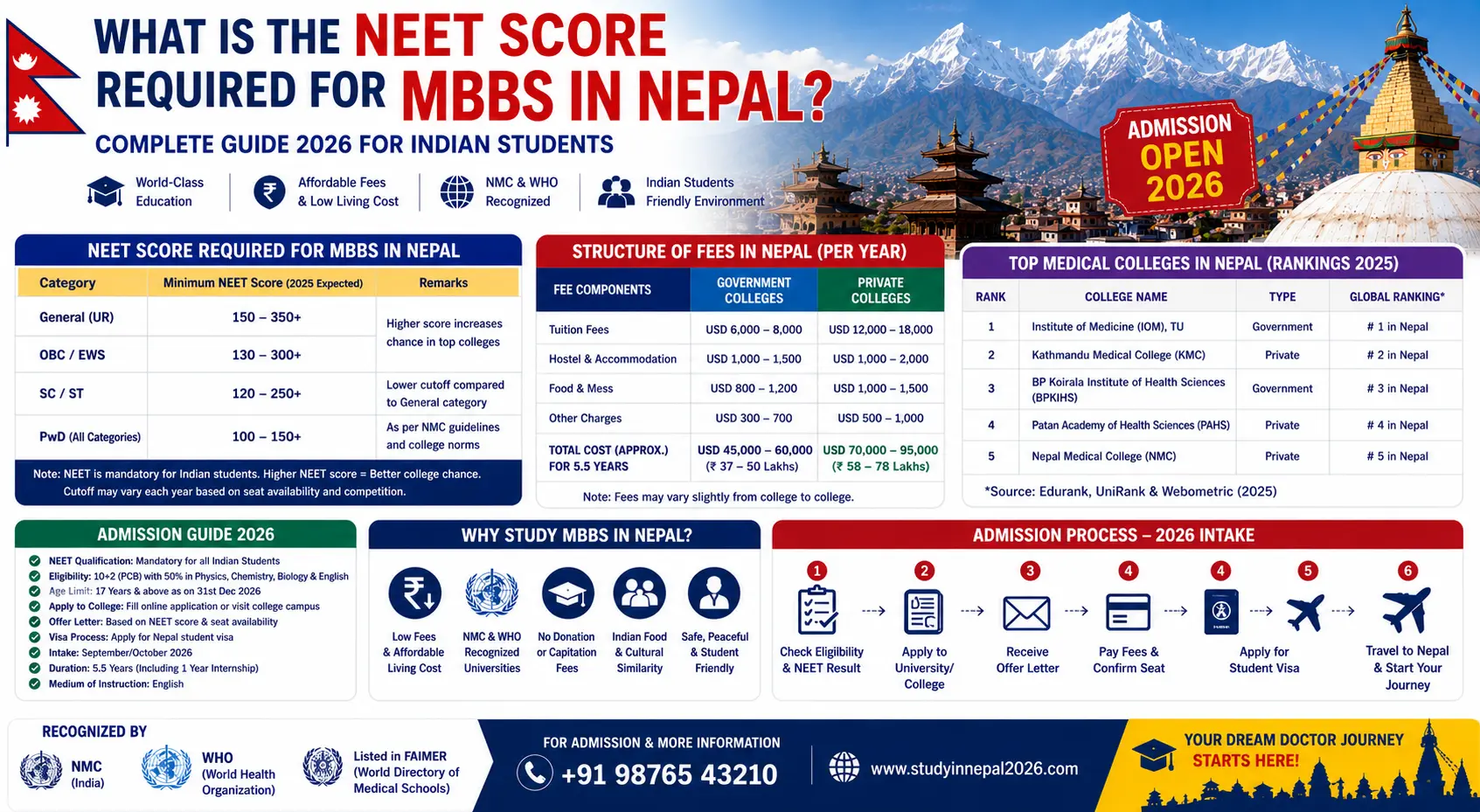
Many Indian students planning to pursue a medical degree overseas first raise this core question: What NEET score is actually required to study MBBS in Nepal?
In fact, Nepal has long been one of the most popular overseas study destinations for Indian students seeking to study medicine, and below we will break down and explain all application-related requirements that most students care about one by one.
✅ Is NEET Mandatory for MBBS in Nepal?
First, it must be clarified that a NEET score is a mandatory requirement for applying to MBBS programs in Nepal.
Per the official regulations of India’s National Medical Commission (NMC), even if a student who fails the NEET exam receives an admission offer from a Nepalese medical school, they cannot take India’s FMGE or NEXT national medical licensing exams after returning to India.
Students can log on to NMC’s official website to check the latest official guidelines for the full set of relevant requirements.
📊 NEET Score Requirements for MBBS Colleges in Nepal
Next are the specific NEET score requirements for different institutions:
- Admission scores for public medical schools in Nepal generally fall in the range of 450 to over 600
- Admission scores for private medical schools range from 250 to over 400
The basic NEET eligibility threshold must meet the cutoff standards released by India’s National Testing Agency (NTA).
Students with high scores can compete for spots at top public medical schools in Nepal, and students with mid-range scores can also receive guidance from the dedicated application platform for MBBS in Nepal, to connect with compliant, accredited private institutions.
⚠️ Important Clarification About NEET Cutoff
A common misconception among many students must be clarified here:
NEET’s basic eligibility cutoff score is completely separate from the actual admission scores set by individual schools.
Meeting only the eligibility threshold in no way guarantees an admission offer, as competition for application spots at Nepalese medical schools is extremely fierce every year.
🌟 Advantages of Studying MBBS in Nepal
In addition, studying medicine in Nepal has 7 core advantages, the most notable of which is that most local medical schools have received World Health Organization (WHO) recognition and are listed in the World Directory of Medical Schools (WDOMS).
Their relevant qualifications can also be verified in the corresponding official databases.
📚 MBBS Eligibility Criteria for Indian Students
In subsequent content, we will elaborate on all the eligibility requirements for Indian students applying to MBBS programs in Nepal.
Indian students planning to apply for the undergraduate Bachelor of Medicine and Bachelor of Surgery (MBBS) program in Nepal may structure their complete application plan around the following core information:
General Eligibility Requirements
- General-category applicants must earn a minimum total score of 50% in their Physics, Chemistry, and Biology (PCB) subjects
- Reserved-category applicants face a minimum score requirement of 40%
- All applicants must pass the NEET exam
- The minimum age to apply is 17 years old
Some institutions may independently administer their own entrance exams or run dedicated counseling processes.
🏥 Top Medical Colleges in Nepal
There are four top medical schools in Nepal:
- Kathmandu University
- Tribhuvan University
- B.P. Koirala Institute of Health Sciences
- Manipal College of Medical Sciences
The full-program tuition fees for these schools range from 4.5 million to 7 million Indian rupees, which is more affordable and transparent than the fees charged by private medical schools within India.
🌍 Global Recognition & Career Opportunities
Degrees from accredited Nepalese medical schools are globally recognized.
After graduation, graduates can:
- Take India’s FMGE/NEXT exam
- Apply for overseas master’s programs
- Sit for international medical licensing exams such as the USMLE and PLAB
- Work at medical institutions across the world
When selecting a school, applicants must prioritize institutions recognized by India’s National Medical Commission (NMC) and listed in the World Directory of Medical Schools.
🚩 Common Mistakes Students Must Avoid
During the application process, applicants must avoid five common pitfalls:
- Choosing an unaccredited institution
- Disregarding NMC-related rules
- Failing to verify a school’s qualifications in advance
- Not using official, formal counseling channels
- Selecting a school solely based on low tuition
Applicants with a NEET score ranging from 250 to 300 are eligible to apply to private medical schools, and higher scores increase the probability of gaining admission to top-tier institutions.
🎯 Final Conclusion
With its advantages of affordable costs, high-quality education, and globally recognized degrees, Nepal is an excellent choice for Indian students seeking to pursue an undergraduate medical degree overseas.
Before applying, applicants must conduct comprehensive research on target schools, eligibility rules, and application processes; those needing support may visit the MBBS in Nepal platform to access full-process application guidance.