 Call Us:
 B3/51 Vibhuti Khand, Gomti Nagar, Lucknow
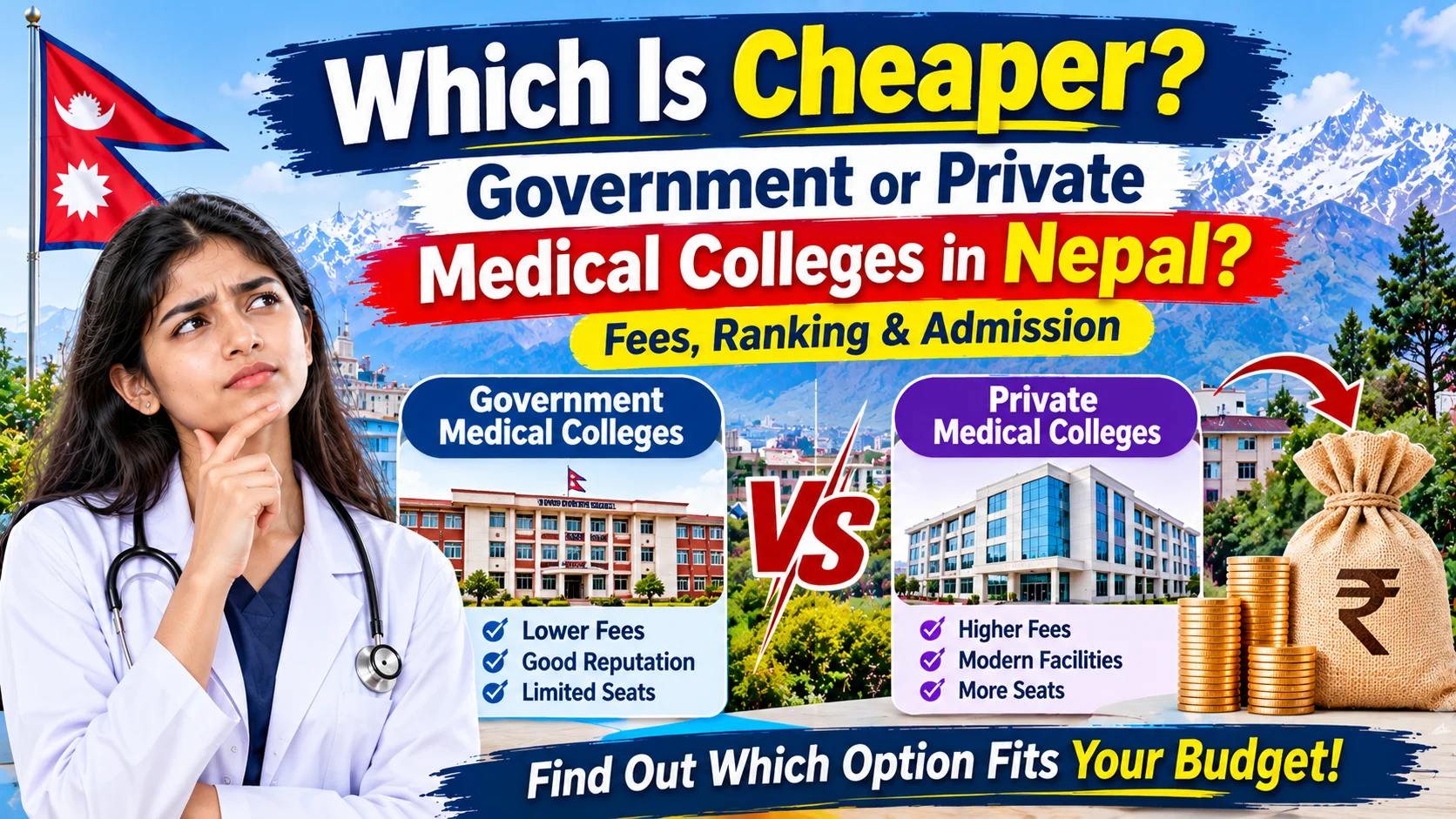
Nepal is often the first country Indian students look to when considering medical studies abroad. Multiple reasons can be attributed to this. Nepal is relatively closer to India, the academic environment is more or less the same as in India, and students don’t have to deal with a language barrier as they may face in other countries. But, when it comes to choosing a college, a question is always there: Are MBBS fees less in government medical colleges in Nepal or students should look into private medical colleges? The answer isn’t as straight forward as most admission websites portray it to be. Generally, government medical colleges are known to provide affordable medical education. However, the fees paid by Indian students is decided by many factors like the college, the admission category, the fee structure, and other expenditures. There are private colleges in Nepal that may cost less than government colleges. On the contrary, there are good private colleges in Nepal that may be expensive. Therefore, students looking to study MBBS in Nepal should look beyond government and private medical colleges. The most crucial aspect is to get an idea about how fees are structured, what tuition fees cover, and how much it will cost to complete medical education.
Quick Comparison of Government and Private Medical Colleges in Nepal
|
Ownership |
Government Medical Colleges |
Private Medical Colleges |
|
Government-operated institutions |
Privately operated institutions |
|
|
Tuition fees |
Affordable (under applicable admission categories) |
Varies (college and foreign student fee structure) |
|
Indian Student Admission |
Depends on availability of foreign seats and admission rules |
Depends on foreign seats and admission rules |
|
Competition |
Generally high |
Varies |
|
Clinical exposure |
Depends on hospital, patient load and medical departments |
Same |
|
Hostel Expenses |
Separate (in most cases) |
Separate (in most cases) |
|
Scholarships |
Available (in certain categories) |
May be available (in certain categories) |
|
Total Expenses |
Depends (tuition, accommodation and other expenses) |
Depends (tuition, accommodation and other expenses) |
One thing students should understand: The Medical Education Commission of Nepal (MEC) governs medical education and determines tuition fees structures. Information published by the MEC states, tuition fee structures can differ between institutes within and outside the Kathmandu Valley and that there may be additional expenses (accommodation and food) which may be charged separately. Hence, Private medical colleges can't be definitely said to be more expensive than Government medical colleges.
MBBS in Government Medical Colleges in Nepal
Government medical colleges, being relatively less expensive, form the first choice of students looking for medical education. These institutions generally provide a well-structured medical school with teaching hospitals and the required experience to teach medical students. The fee applicable to Nepalese medical students will not apply to Indians. Foreign students can be admitted to a particular category, and their fee can be different from the fee charged to domestic students.
Medical Institutions of Nepal:
- B.P. Koirala Institute of Health Sciences (BPKIHS), Dharan: Is one of the oldest health sciences institutes, with a teaching hospital.
- Institute of Medicine (IOM), Tribhuvan University, Kathmandu: Is a reputed medical school.
- Patan Academy of Health Sciences (PAHS), Lalitpur: Is a newly established health sciences school with a community-based medical education approach.
There may be a limitation in the number of seats, admission categories, and the fees charged for a particular session. A domestic scholarship of a college should never be considered as the fee automatically applicable to Indians.
Why are Government College Fees Lower?
There are several reasons why some admission categories in government colleges may appear to be lower than in some private colleges. First, government colleges may receive some form of public subsidy, and second, their expenditure may be more aligned to their financial outlay. However, the competition for foreign student seats at government medical colleges is very high. Before deciding on a particular college, you should check if that college offers an admission seat in your budget category.
MBBS fees at Private Medical Colleges in Nepal
Many other private medical colleges exist outside India. Several private universities and institutions in Nepal offer MBBS programs. These colleges may possess adequate and modern academic infrastructures, laboratories, hostels, and teaching hospitals. The clinical exposures and facilities provided by the colleges may vary from one college to another.
Popular Private Medical Colleges in Nepal
Here are some private medical colleges in Nepal that students should take into consideration. Although the prices may vary depending on the category of students, students should look for complete fee breakups and clinical training at these colleges.
Government vs Private MBBS fees in Nepal: What is the real difference?
Many people believe that all private medical colleges charge more than all government medical colleges in Nepal. This is not always true. Indian students aren't always disadvantaged by this. The Medical Education Commission of Nepal sets various tuition fees and Authorized institutions publish their fees structure as per admission. Foreign students may pay different fees from the domestic students. The location and the academic session of the institution may also matter. An example of the 2025 batch MBBS fees structure of Kathmandu University shows total tuition for foreign students is USD 75,000. Kathmandu University MBBS Information Thus, it is important for students to ask about foreign student fees, if they wish to compare tuition fees with domestic student fees. Total payable tuition fee of the entire program, admission and registration fees, hostel and mess fees, compulsory insurance and other fees, examination fees, payment deadlines, refund policies if admission is cancelled, and installment policy should be considered while making a decision. It is necessary to look beyond the tuition fee published in advertisements and consider the total payable amount. If the main goal is to spend less, then students should consider admission in a government medical college. If, however, students wish to consider admission in medical colleges as per their financial capacity, then they should also look into private medical colleges.
It makes more sense to consider admission in government medical colleges if a student:
- Qualifies for admission in a category for which a confirm fee structure is issued and the fees is within family budget
- Finds the facilities in the college to be acceptable
Limited seats and competitive selection should be considered before making MBBS in Nepal.
When a private medical college may be worth considering
Choosing a private college may be an option for a student who is unable to secure an appropriate government seat and finds a private college with reasonable and transparent fees, good hospital exposure and an appropriate payment plan. The decision should not be based on the institution's guarantee of admission or automatic recognition. The student is advised to carry out an independent verification.
NEET Qualification for Indian Students
Indian students must qualify NEET to be eligible to pursue MBBS in Nepal, and if they wish to practice medicine in India later on. For admission in the said year, students should be aware of the latest information related to NEET and ensure to fulfill the requirements.
Academic Eligibility
Students are required to have passed class 12 with physics, chemistry and biology/ biotech and fulfill the required minimum marks and age. The exact eligibility criteria should be verified against the latest admission notification of the concerned university/college.
Admission and Entrance Examinations
Nepal's medical education admission is systemized through the Medical Education Commission. Foreign applicants should adhere to the admission process and requirements related to their category. Medical Education Commission of Nepal provides information relating to entrance examinations, medical colleges of Nepal and admission updates. It also provides information related to fee structures.
NMC, WDOMS and WHO: What Should Students Verify?
Indian students planning to study medicine in Nepal should verify the legal status of medical colleges and the provisions applicable to their future medical practice in India. The principal Indian regulatory authority is the National Medical Commission (NMC). Students must go through the applicable provisions of Foreign Medical Graduate Licentiate Regulations and other provisions. The World Directory of Medical Schools (WDOMS) provides information about medical schools. However, the directory does not mean the school is entitled to practice medicine in India. Likewise, the World Health Organization (WHO) is an international health organization. Careful analysis is required to verify whether a particular college is “WHO approved.” Students should look into the actual regulatory requirements, and not rely on promotional statements.
How to Choose the Right Medical College in Nepal
Students should shortlist at least four medical colleges and should look beyond the fees while making the final decision. The cheapest college is not always the best and the most expensive college is not always the strongest. Students should see the teaching hospital, check clinical departments, availability of faculty and other facilities, and hostel conditions. Students should ask for the academic calendar and examination arrangement. Other important considerations should include the availability of a complete fee schedule and the payment terms. Although it has a number of components, MBBS in Nepal should assist students who wish to receive additional information on admissions, details on colleges, and fee-related matters. Nepal is close geographically and culturally, and has opportunities for medical education. However, your final choice depends on the college, fees, and the academic level. You need to check whether you are eligible to practice in India.
Conclusion
The lowest fee categories in some government medical colleges in Nepal may seem attractive to some Indian students, but you should not generalize and assume that government means cheaper in the case of Nepal's medical colleges, too. Having said that, some private medical colleges of Nepal can also be good options, if they offer facilities comparable to the student's requirements, and have good clinical training. In most of the cases, medical colleges of Nepal charge foreign students (specially Indians), higher fees than that of local students. Thus, in the case of medical education in Nepal, the choice should be made based on affordability, eligibility and the academic level of the colleges.