 Call Us:
  B3/51 Vibhuti Khand, Gomti Nagar, Lucknow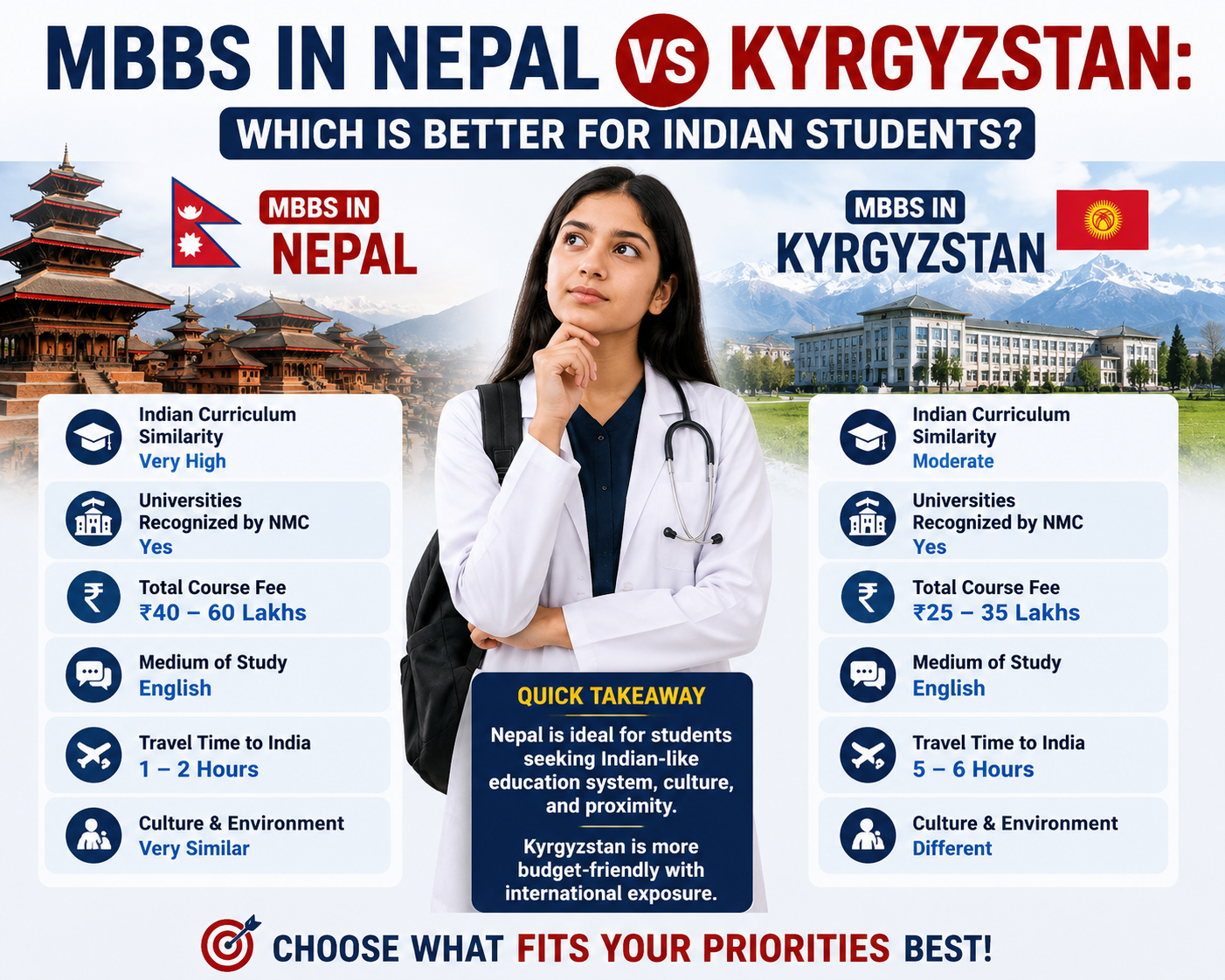
Choosing the country to pursue a medical degree is one of the most important decisions for an aspiring doctor. Every year thousands of Indian students qualify for NEET, but the limited number of government medical seats creates huge competition making it difficult for many students to gain admission. Hence, these students seek opportunities for medical education abroad that is quality driven and cost effective.
MBBS in Nepal and Kyrgyzstan remain among the most sought after destinations for Indian students.
Indian students aspiring to become medical practitioners can benefit from both countries' affordable tuition fees and internationally recognized medical degrees.
While both countries have medical programs that are similar in scope and offerings, the decision making among Indian students seeking medical education abroad needs to involve several elements such as quality of education, clinical exposure, recognition of medical practice, the cultural proximity to India, and future opportunities.
This article seeks to present the most critical parameters in assessing MBBS programs in Nepal and Kyrgyzstan for Indian students.
Reasons Indian Students Look Beyond Indian Medical Schools to Pursue MBBS
There are far too many students seeking admission to Indian medical schools than available seats. This results in students with commendable NEET scores being unable to pursue medical education.
Studying abroad allows students to:
- Continue medical education without losing a year.
- Gain international exposure.
- Access affordable medical programs.
- Earn globally recognized degrees.
- Pursue careers in multiple countries.
Among the significant number of affordable and accessible international destinations for pursuing MBBS, Nepal and Kyrgyzstan dominate.
Overview of MBBS in Nepal
Nepal is one of the favorite destinations for the Indian medical students.
There are multiple medical colleges in Nepal, which are acknowledged to be international colleges, and are listed in the World Directory of Medical Schools (WDOMS). Many of them are in compliance with the National Medical Commission (NMC) guidance.
Some of the highlights for MBBS in Nepal are:
- Curriculum similar to India
- Taught in English
- Good clinical exposure
- Culturally familiar
- Geographically close
- NEET eligibility
Considering all the above benefits, it is the best option for students when compared to studying medicine in India.
Overview of MBBS in Kyrgyzstan
Kyrgyzstan has been another preferred destination for Indian students because of the cost advantage.
There are many medical universities in Kyrgyzstan which have an English-MBBS and which attract a lot of international students.
Some of the advantages are:
- Low tuition fees
- Low cost of living
- Many international students
- Universities are recognized, with some in WDOMS
- Less complicated admission process
Although Kyrgyzstan continues to be an attractive destination, students should keep in mind the overall education system when making their final decision.
Curriculum Comparison
MBBS in Nepal
An important advantage of MBBS in Nepal is that its curriculum is similar to that of Indian medical colleges.
Here, the medical subjects are taught as follows:
- Anatomy
- Physiology
- Biochemistry
- Pathology
- Pharmacology
- Community Medicine
- Clinical Subjects
This helps Indian students in getting mentally prepared for licensing exams.
In fact for many, studying in Nepal is more or less equal to studying in India.
MBBS in Kyrgyzstan
In Kyrgyzstan, Medical universities have their own educational framework and still keep international standards.
While the curriculum may cover the main topics of medicine, there may be differences in teaching and assessment compared to India.
For some students, further bridging programs may be needed to satisfy the Indian medical licensing standards.
Winner: Nepal
For students preferring an education system close to India, MBBS in Nepal is likely to be the easiest option.
Recognition and Accreditation
Recognition is one of the most critical factors in the selection of a medical college abroad.
Nepal
Many Nepalese medical colleges are:
- WDOMS listed
- Recognition of appropriate national authorities
- NMC compliant
- International medical councils
It is very important that the prospective students check the recognition of the medical college before getting admitted.
Kyrgyzstan
A number of Kyrgyz medical colleges are WDOMS listed and recognized worldwide.
Recognition can differ from college to college, and is therefore very important in the selection of the college.
Winner: Tie
Both countries have recognized universities, but students must verify accreditation.
Clinical Exposure
MBBS in Nepal
Clinical training is considered one of the strongest points of MBBS in Nepal.
The teaching hospitals associated with medical colleges have a large patient turnover.
Therefore, students gain clinical exposure to:
- A wide range of medical problems
- A broad spectrum of community and surgical interventions
- Emergency medicine
Early interaction with patients aids in the development of confidence and clinical skills.
MBBS in Kyrgyzstan
Clinical exposure is available, but patient turnover can vary from college to college.
Some students may have relatively less direct patient contact compared to their peers in Nepal.
Once again, the university plays an important role in the determination of the quality of clinical training.
Winner: Nepal
Nepal provides better clinical exposure, resulting in better education due to better patient inflow and hospital partnerships.
Language and Communication
Nepal
Hindi and English are well received in a vast number of regions.
Indian students have little to no communication issues during day-to-day activities as well as during clinical rounds.
This ultimately results in better education and communication with patients.
Kyrgyzstan
Russian and Kyrgyz are the spoken languages.
Although the medium of instruction is English, students may still have to learn the local languages for effective communication during clinical training.
Winner: Nepal
Language familiarity benefits Indian students.
Cultural Similarity
Nepal
Indian students feel that Nepal has a familiar culture.
Students see:
- Similar food
- Shared holidays and festivals
- Social customs
- Comfortable living space
The complete transition from India to Nepal is usually smooth.
Kyrgyzstan
A completely different cultural environment exists in Kyrgyzstan.
International exposure may be beneficial, but many students may require additional time to adjust.
Winner: Nepal
Kyrgyzstan is a completely different culture, but students prefer Nepal for minimal cultural moving.
Travel Convenience
Nepal
One of the notable advantages of MBBS Nepal is proximity to India.
Travel is:
- Faster
- More convenient
- More economically friendly
Students can visit family during holidays.
Kyrgyzstan
International flights involve not only more travel time, but also a higher cost of transportation.
Travel during emergencies can also be more difficult.
Winner: Nepal
Nepal is more convenient due to its proximity.
Cost Comparison
MBBS in Nepal
Tuition fees in Nepal are most of the time affordable.
Costs may still be more than some universities in Kyrgyzstan, students still get:
- Better curriculum alignment
- Better clinical exposure
- Familiar environment
MBBS in Kyrgyzstan
Kyrgyzstan has become popular due to having lower tuition and living expenses.
This may seem appealing to students who want to save money.
Cost alone should never drive your decision.
Winner: Kyrgyzstan
Kyrgyzstan typically has cheaper overall education costs.
Safety and Student Comfort
Nepal
Nepal is seen as a safe country for Indian students.
The abundance of Indian students helps provide a comfortable education.
Kyrgyzstan
Most students educate themselves safely, though adjusting to a new language and culture can add other challenges.
Winner: Nepal
Nepal is a more comfortable option for Indian families.
NEET Eligibility
Generally both Nepal and Kyrgyzstan require Indian students to have qualified NEET to gain admission and for future eligibility under new NMC regulations.
It is advisable that students check the latest requirements of the medical colleges prior to applying.
In all scenarios, NEET needs to be qualified for Indian students intending to return to India post medical graduation.
Academic Environment
Nepal
Some of the medical colleges in Nepal focus on:
- Practical aspects
- Patient-focused training
- Teaching from the hospitals
- Development of clinical skills
Indian students face less of a challenge adapting academically.
Kyrgyzstan
Medical colleges in Kyrgyzstan provide structured medical education, but teaching may differ.
Students need to make an extra effort due to this gap.
Winner: Nepal
The educational environment is typically more aligned to Indian students.
Career Opportunities After Graduation
Medical graduates from India are able to undertake:
- Medical registration
- Post graduation
- Clinical practice
- Research
- Medical administration
in both of the mentioned countries.
The most important thing is to select a school that is in WDOMS, has recognition, and follows the NMC regulations.
Common Misunderstanding
Myth 1: Cheaper Schools are Better Schools
Some schools have more affordable tuition, but it is also important to look at their quality of education and the training they provide.
Myth 2: Medical Schools are the Same
Schools have different levels of infrastructure, different faculties, and access to different hospitals.
Myth 3: Schools Become Known
Not all schools will meet the future licensure requirements.
This requires an employability check.
Who Should Enroll for MBBS in Nepal?
MBBS in Nepal is a good option for students who:
- Have the preference for a more Indian-like syllabus.
- Have the preference for more clinical exposure.
- Have the preference for cultural closeness.
- Have the preference for easier adjustment.
- Have the preference for shorter distance to travel.
- Have the preference for practicing in India.
Who Should Enroll for MBBS in Kyrgyzstan?
Kyrgyzstan is a good option for students who:
- Have a constrained budget.
- Want to travel and study.
- Are willing to adapt to a new culture.
- Are okay with the language barrier for the duration of clinical training.
Summary
Kyrgyzstan and Nepal both have good opportunities for Indian students going abroad to study MBBS. What is important is for the student to choose what they value more.
Kyrgyzstan may be a good option for students who are more price focused, while students who prefer cultural closeness, greater clinical exposure, and a more Indian-like syllabus with stronger communication may choose MBBS in Nepal.
There are a lot of MBBS opportunities for Indians in Nepal. The combination of NEET eligibility, NMC recognition, WDOMS recognition, hospital exposure, and a familiar setting is the strongest reason to study there for Indians.
Conclusion
Combing through tuition fees is not enough to make the right choice for medical school. Future doctors ought to identify the school’s value for money through the curriculum, the school’s sponsorship, and the quality of the doctors to be when they finish school, among other things.
For a lot of Indian students, MBBS in Nepal represents the best opportunity of getting quality education while at the same time providing other tangible benefits, like being in a system that is less different from the Indian system of education, the exposure to working in a hospital that is more, the school being listed in the WDOMShttps://wdoms.org, as well as the school being NMC compliant and accepting only NEET qualified students.
Students are supposed to make some research on the colleges when they are thinking of choosing one and check whether or not the school is recognized while aligning their choice with schools that will boost their success in their future goal of being a doctor.