 Call Us:
  B3/51 Vibhuti Khand, Gomti Nagar, Lucknow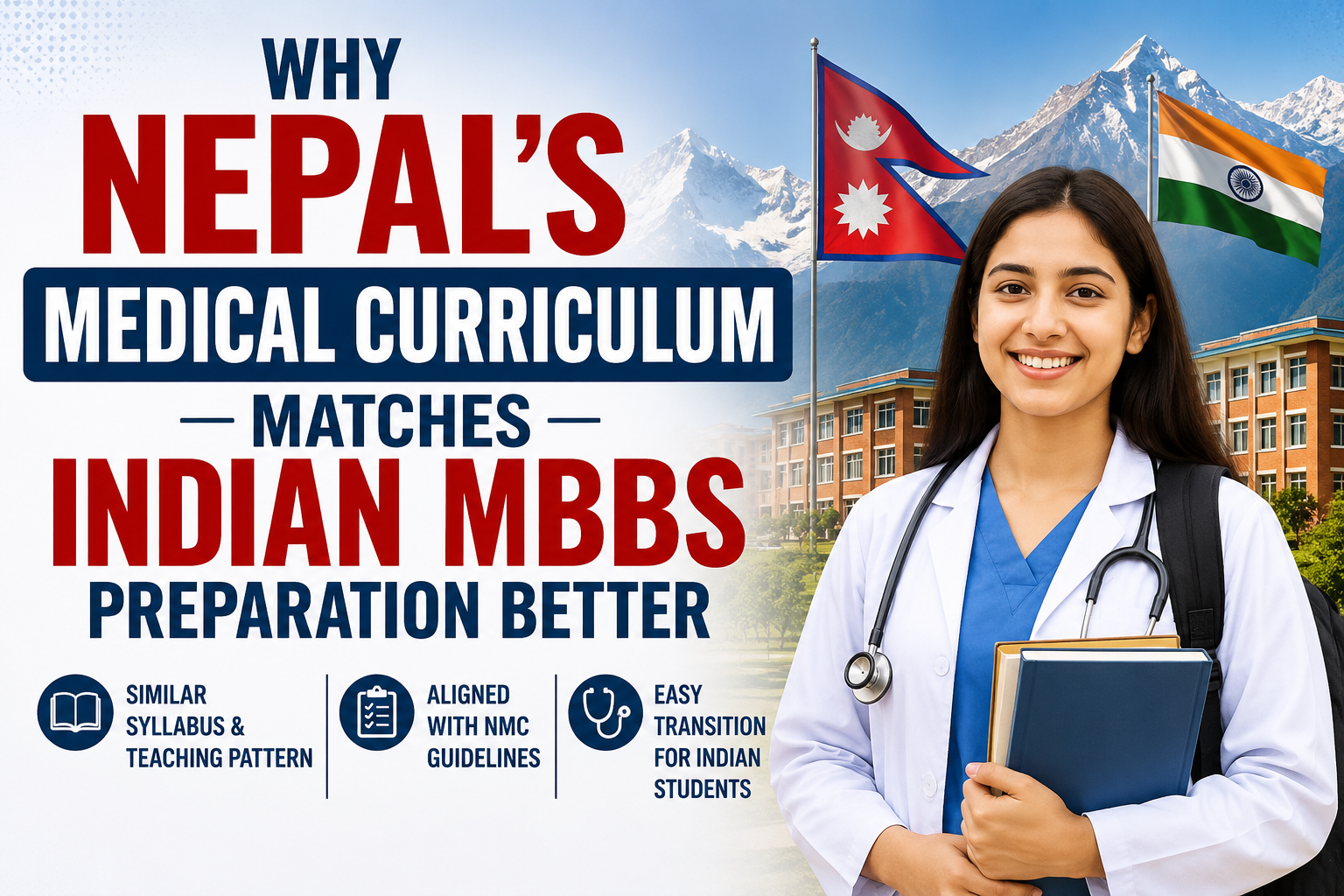
Introduction
Choosing the right country for medical education is an important decision that affects the academic and professional future for Indian students aspiring to become doctors. Many countries provide affordable options for medical programs; however, the alignment of the country’s medical education with Indian medical education is often overlooked.
The similarity of Nepal’s medical education to Indian medical education is one of the main reasons that Indian students are increasingly choosing to pursue an MBBS there. In addition to Nepal’s provision of quality medical education, its medical education system has a structure that is almost identical to the MBBS education in India.
Candidates that qualify the NEET entrance examination and wish to pursue medical education overseas find that Nepal is the most convenient and placid option. Many of the Nepalese medical institutes integrate a system of medical education that corresponds with the standards of medical training in India.
This article aims to provide an understanding as to why Nepal’s medical education system is designed for Indian medical graduates, and most importantly why this offers the Indian students great opportunities for their medical educational ventures.
The Unprecedented Popularity of MBBS in Nepal
The increasing craze for MBBS in Nepal among Indian students is the result of several factors. Some of these factors are:
- A medical curriculum comparable to India
- Recognizing the medical programs by international organizations
- A medical program that is offered in a familiar educational setting
- Intensive clinical training
- High quality education in English
- Nepal’s proximity to India
- NMC guideline friendly
Among these several advantages, Nepal’s medical curriculum is one of the strongest reasons why Indian students select Nepal over other foreign study destinations.
Understanding Indian MBBS
Before comparing with Nepal's curriculum, let us look at the Indian medical education structure.
The Indian MBBS program is divided into three major parts.
Pre-Clinical Subjects
Students study:
- Anatomy
- Physiology
- Biochemistry
These subjects help to build the basic medical science and help the students understand the human body.
Para-Clinical Subjects
The next phase consists of:
- Pathology
- Pharmacology
- Microbiology
- Forensic Medicine
- Community Medicine
These subjects help the students to link the basic medical sciences to the clinical sciences.
Clinical Subjects
This final phase consists of:
- General Medicine
- General Surgery
- Pediatrics
- Obstetrics and Gynecology
- Orthopedics
- Psychiatry
- Dermatology
- ENT
- Ophthalmology
Students are trained and taught alongside hospital rotations and internships.
This educational structure is designed to offer knowledge and skills.
How Nepal’s Medical Curriculum is Related to India
Similar Subject Structure
The MBBS program in Nepal has the advantage of having a structure for subjects that is nearly the same.
Included subjects are:
- Anatomy
- Physiology
- Biochemistry
- Pathology
- Pharmacology
- Microbiology
- Community Medicine
- Surgery
- Medicine
- Pediatrics
- Obstetrics and Gynecology
Indian students adapt to the academic system of the respective medical colleges in Nepal with ease.
Comparable Duration
Most medical colleges in Nepal have a duration comparable to medical colleges in India.
Unlike some other countries, Nepalese students complete:
- Theoretical learning
- Clinical training
- Clinical rotations
- Internship
Clinical training is an essential part of the system.
Clinical Focus
Nepal, similar to India, has a patient-centered clinical education focus.
Students have the opportunity to spend time in clinical settings engaging with patients and faculty staff.
Construction of Medical Programs in Relation to NMC Standards
In order to practice medicine in India, Indian students need to be aware of the NMC regulations.
The structure of several Nepalese medical colleges accommodates the alignment of standards.
Benefits of this Alignment Include:
- Consistent Academic Structures
- Appropriate Clinical Experiences
- Equivalent Examination Systems
- Comprehension of Indian Healthcare
The student is responsible for confirming that the institution of interest is compliant with the NMC requirements.
Recognition through WDOMS
Recognition is a major consideration in selecting a foreign medical college.
Several well-established Nepalese medical colleges are WDOMS listed.
WDOMS listing ensures a degree of recognition outside of Nepal resulting in other opportunities.
Students need to check the WDOMS listing before confirming their admission.
Why Do We Need Similar Curriculums
Facilitates Academic Transition
Considering the level of complexity of the medical curriculum, students studying in a foreign country with a radically different medical system, have to adapt to a different system on a different level.
This is not the case for Indian students in Nepal.
They have:
- Consistent Teaching Styles
- Identical Medical Terminology
- Coherent Examination Structures
- More Focused Learning of Subjects
Allowing students the ability to concentrate on their studies.
Facilitates Understanding
Since many concepts are taught in a manner similar to Indian institutions, students find it easier to relate classroom work with their future profession.
Improves Retention
Students studying in countries with significantly different curricula may find a learning gap when preparing for licensing exams.
One way to address these issues is to ensure Indian and Nepalese medical education systems remain closely aligned.
Need for English-Medium Education
The other reason for MBBS in Nepal matching Indian prep is English, the primary language of instruction.
Students participate in:
- Lectures
- Practical classes
- Lab sessions
- Clinical work
All in English.
All the language-based academic obstacles are cleared, and students can fully concentrate on their medical education.
In addition, several medical school textbooks are the same or highly cited in Indian medical schools.
Possession of Solid Clinical Skills
Patient Variety
Many Nepalese medical schools cater to large populations that contain significant diversity in terms of healthcare needs.
Students encounter a myriad of healthcare issues, such as:
- Communicable diseases
- Long-term illnesses
- Surgical issues
- Pediatrics
- Maternal issues
This type of investment enhances students' clinical skills.
Exact Learning
Clinical training is a major strength of the MBBS program in Nepal.
Students learn how to do:
- Clinical history
- Physical exams
- Lab diagnostics
- Doctor-patient relationships
- Clinical choices
The development of these clinical skills is very important for their future as a doctor.
Opening Up to a New World
Many schools encourage students to visit a hospital early in their training so they can start to see what a healthcare system is like.
Common Healthcare Challenges
India and Nepal have quite a few common challenges with their public health and healthcare system.
Students training in Nepal often see medical issues such as:
- Tropical diseases
- Community health issues
- Mother and child health issues
- Preventative healthcare and health education
Due to this, graduates feel confident to practice in India.
Similar Testing Formats
How students are assessed in Nepalese medical schools is very similar to how students are assessed in Indian medical schools.
Students undergo:
- Written examinations
- Practical examinations
- Viva Voce assessments
- Clinical evaluations
The above evaluation instruments help build confidence and prepare students for their professional assessments.
Preparation for Future Licensing Examinations
Students completing their MBBS in Nepal value the relevance of the courses in relation to their future medical licensing pathways.
Some Advantages Are:
- Familiarity with the subjects
- Similarities in the medical concepts
- Organization of the clinical training
- Adequately progressive academics
Because of the Indian medical education system's influence, students are able to use the time to review prior knowledge instead of learning a new system.
Faculty and Teaching Methodology
The medical schools in Nepal tend to recruit highly qualified faculty that focuses on:
- Learning through concepts
- Clinical logic
- Practical training
- Teaching through communication
This is the style of teaching that is utilized in several Indian medical schools.
The focus of teaching on clinical aspects and academic concepts is beneficial to the students.
Student Comfort and Confidence
A familiar curriculum greatly improves student comfort, and confidence.
Indian students indicate that they:
- Adjust to the academic system faster
- Participate in classes and impart knowledge
- Gain better knowledge of clinical practice and theory
- Gain better clinical practice and theory
Thorough knowledge of the educational system yields better academic output.
Common Misconceptions
Myth 1: Foreign Curriculum is Better
If a foreign curriculum varies greatly from students' future professional requirements, it isn't better.
A curriculum that more closely aligns with a student's future profession is preferred to studying abroad.
Myth 2: All Medical Curriculum are Alike
There is a great deal of variability in the medical education of different countries.
There can be great differences in the structure of a curriculum, exposure to patients, and teaching methodologies.
Myth 3: If They are Alike, Their Standards are Low
The Nepal and India curricula are similar, but that does not mean the standards are low.
Instead, it exhibits educational integration and professional advantage.
More Benefits of MBBS in Nepal
Nepal also provides benefits beyond the alignment of curriculum, including:
- Geographic and cultural proximity
- Low cost of living
- Pleasant environment
- Strong community of Indian students
- Easy travel
These factors create an even better educational experience.
Why Do Parents in India Choose Nepal?
Most parents look for:
- Quality of education
- Safety of the students
- Job opportunities
- Communication
Nepal is able to meet many of these needs due to its comforting environment and educational integration.
It is also reassuring to parents that students will be learning in a system that closely resembles India.
What Will Happen After Students Graduate?
Students that graduate from accredited medical schools in Nepal can be:
- Medical practitioners
- Post graduates
- Researchers
- Public health professionals
- Take other international pathways in medicine
Students should also check if the medical school is in WDOMS and meets the NMC requirements.
Final Thoughts
One of the main advantages of MBBS in Nepal is that Indian medical education and medical education in Nepal is closely related. The structure of the curriculum, the progression of subjects, the teaching styles, the methods of assessment, and the clinical exposure that students undergo are identical to that of India.
For Indian students who have qualified for the NEET, the benefits are huge. This exactness of the two systems even helps students prepare for the future in India with the help of the NMC regulations.
When you also consider WDOMS, great training provided by the hospitals, education in English, and being in a country which shares its culture with India, makes Nepal one of the best options for Indian students wanting to study medicine.
MBBS in Nepal is one of the best options for students that want to study medicine and have an international experience.